<!DOCTYPE html>
    <html lang="vi" xmlns="http://www.w3.org/1999/xhtml" prefix="og: http://ogp.me/ns#">
    <head>
<title>Báo cáo mới về OER của AAC&amp;U</title>
<meta name="description" content="Báo cáo mới về OER của AAC&amp;U - Savefile - Blogs - https&#x3A;&#x002F;&#x002F;letrungnghia.mangvn.org&#x002F;savefile&#x002F;Education&#x002F;bao-cao-moi-ve-oer-cua-aac-u-8020.html">
<meta name="author" content="Blog FOSS by Lê Trung Nghĩa">
<meta name="copyright" content="Blog FOSS by Lê Trung Nghĩa [webmaster@vinades.vn]">
<meta name="generator" content="NukeViet v4.6">
<meta http-equiv="Content-Type" content="text/html; charset=utf-8">
<meta property="og:title" content="Báo cáo mới về OER của AAC&amp;U">
<meta property="og:type" content="website">
<meta property="og:description" content="Savefile - Blogs - https&#x3A;&#x002F;&#x002F;letrungnghia.mangvn.org&#x002F;savefile&#x002F;Education&#x002F;bao-cao-moi-ve-oer-cua-aac-u-8020.html">
<meta property="og:site_name" content="Blog FOSS by Lê Trung Nghĩa">
<meta property="og:url" content="https://letrungnghia.mangvn.org/savefile/Education/bao-cao-moi-ve-oer-cua-aac-u-8020.html">
<link rel="shortcut icon" href="https://letrungnghia.mangvn.org/favicon.ico">
<link rel="canonical" href="https://letrungnghia.mangvn.org/savefile/Education/bao-cao-moi-ve-oer-cua-aac-u-8020.html">
<link rel="alternate" href="https://letrungnghia.mangvn.org/rss/" title="Blogs" type="application/rss+xml">
<link rel="alternate" href="https://letrungnghia.mangvn.org/rss/Government/" title="Blogs - Government" type="application/rss+xml">
<link rel="alternate" href="https://letrungnghia.mangvn.org/rss/Policy/" title="Blogs - Policy" type="application/rss+xml">
<link rel="alternate" href="https://letrungnghia.mangvn.org/rss/Philosophy/" title="Blogs - Philosophy" type="application/rss+xml">
<link rel="alternate" href="https://letrungnghia.mangvn.org/rss/Security/" title="Blogs - Security" type="application/rss+xml">
<link rel="alternate" href="https://letrungnghia.mangvn.org/rss/Legal/" title="Blogs - Legal" type="application/rss+xml">
<link rel="alternate" href="https://letrungnghia.mangvn.org/rss/Education/" title="Blogs - Education" type="application/rss+xml">
<link rel="alternate" href="https://letrungnghia.mangvn.org/rss/Business/" title="Blogs - Business" type="application/rss+xml">
<link rel="alternate" href="https://letrungnghia.mangvn.org/rss/Community/" title="Blogs - Community" type="application/rss+xml">
<link rel="alternate" href="https://letrungnghia.mangvn.org/rss/Interoperability/" title="Blogs - Interoperability" type="application/rss+xml">
<link rel="alternate" href="https://letrungnghia.mangvn.org/rss/Standards/" title="Blogs - Standards" type="application/rss+xml">
<link rel="alternate" href="https://letrungnghia.mangvn.org/rss/Author/" title="Blogs - Author" type="application/rss+xml">
<link rel="alternate" href="https://letrungnghia.mangvn.org/rss/Opinions/" title="Blogs - Opinions" type="application/rss+xml">
<link rel="alternate" href="https://letrungnghia.mangvn.org/rss/CC/" title="Blogs - CC" type="application/rss+xml">
<link rel="alternate" href="https://letrungnghia.mangvn.org/rss/Cloud/" title="Blogs - Cloud" type="application/rss+xml">
<link rel="alternate" href="https://letrungnghia.mangvn.org/rss/Hardware/" title="Blogs - Hardware" type="application/rss+xml">
<link rel="alternate" href="https://letrungnghia.mangvn.org/rss/Software/" title="Blogs - Software" type="application/rss+xml">
<link rel="alternate" href="https://letrungnghia.mangvn.org/rss/Statistics/" title="Blogs - Statistics" type="application/rss+xml">
<link rel="alternate" href="https://letrungnghia.mangvn.org/rss/Trends/" title="Blogs - Trends" type="application/rss+xml">
<link rel="alternate" href="https://letrungnghia.mangvn.org/rss/China/" title="Blogs - China" type="application/rss+xml">
<link rel="alternate" href="https://letrungnghia.mangvn.org/rss/OSs/" title="Blogs - OSs" type="application/rss+xml">
<link rel="alternate" href="https://letrungnghia.mangvn.org/rss/Blogs/" title="Blogs - Blogs" type="application/rss+xml">
<link rel="alternate" href="https://letrungnghia.mangvn.org/rss/Outsourcing/" title="Blogs - Outsourcing" type="application/rss+xml">
<link rel="alternate" href="https://letrungnghia.mangvn.org/rss/elearning/" title="Blogs - Elearning" type="application/rss+xml">
<link rel="preload" as="style" href="https://letrungnghia.mangvn.org/assets/css/font-awesome.min.css" type="text/css">
<link rel="preload" as="style" href="https://letrungnghia.mangvn.org/themes/default/css/bootstrap.non-responsive.css" type="text/css">
<link rel="preload" as="style" href="https://letrungnghia.mangvn.org/themes/default/css/style.css" type="text/css">
<link rel="preload" as="style" href="https://letrungnghia.mangvn.org/themes/default/css/style.non-responsive.css" type="text/css">
<link rel="preload" as="style" href="https://letrungnghia.mangvn.org/themes/default/css/news.css" type="text/css">
<link rel="preload" as="style" href="https://letrungnghia.mangvn.org/themes/default/css/custom.css" type="text/css">
<link rel="preload" as="style" href="https://letrungnghia.mangvn.org/assets/css/default.vi.1106.css" type="text/css">
<link rel="preload" as="script" href="https://letrungnghia.mangvn.org/assets/js/jquery/jquery.min.js" type="text/javascript">
<link rel="preload" as="script" href="https://letrungnghia.mangvn.org/assets/js/language/vi.js" type="text/javascript">
<link rel="preload" as="script" href="https://letrungnghia.mangvn.org/assets/js/DOMPurify/purify3.js" type="text/javascript">
<link rel="preload" as="script" href="https://letrungnghia.mangvn.org/assets/js/global.js" type="text/javascript">
<link rel="preload" as="script" href="https://letrungnghia.mangvn.org/assets/js/site.js" type="text/javascript">
<link rel="preload" as="script" href="https://letrungnghia.mangvn.org/themes/default/js/news.js" type="text/javascript">
<link rel="preload" as="script" href="https://letrungnghia.mangvn.org/themes/default/js/main.js" type="text/javascript">
<link rel="preload" as="script" href="https://letrungnghia.mangvn.org/themes/default/js/custom.js" type="text/javascript">
<link rel="preload" as="script" href="https://letrungnghia.mangvn.org/themes/default/js/bootstrap.min.js" type="text/javascript">
<link rel="stylesheet" href="https://letrungnghia.mangvn.org/assets/css/font-awesome.min.css">
<link rel="stylesheet" href="https://letrungnghia.mangvn.org/themes/default/css/bootstrap.non-responsive.css">
<link rel="stylesheet" href="https://letrungnghia.mangvn.org/themes/default/css/style.css">
<link rel="stylesheet" href="https://letrungnghia.mangvn.org/themes/default/css/style.non-responsive.css">
<link rel="StyleSheet" href="https://letrungnghia.mangvn.org/themes/default/css/news.css">
<link rel="stylesheet" href="https://letrungnghia.mangvn.org/themes/default/css/custom.css">
<link rel="stylesheet" href="https://letrungnghia.mangvn.org/assets/css/default.vi.1106.css">
<style type="text/css">
	body{background: #fff;}
</style>
<script>(function(i,s,o,g,r,a,m){i['GoogleAnalyticsObject']=r;i[r]=i[r]||function(){
(i[r].q=i[r].q||[]).push(arguments)},i[r].l=1*new Date();a=s.createElement(o),
m=s.getElementsByTagName(o)[0];a.async=1;a.src=g;m.parentNode.insertBefore(a,m)
})(window,document,'script','https://www.google-analytics.com/analytics.js','ga');
ga('create', 'UA-70254229-3', '');
ga('send', 'pageview');
</script>
</head>
    <body>
<div id="print">
	<div id="hd_print">
		<h2 class="pull-left">Blog FOSS by Lê Trung Nghĩa</h2>
		<p class="pull-right"><a title="Blog FOSS by Lê Trung Nghĩa" href="https://letrungnghia.mangvn.org/">https://letrungnghia.mangvn.org</a></p>
	</div>
	<div class="clear"></div>
	<hr />
	<div id="content">
		<h1>Báo cáo mới về OER của AAC&amp;U</h1>
		<ul class="list-inline">
			<li>Thứ sáu - 18/09/2026 06:11</li>
			<li class="hidden-print txtrequired"><em class="fa fa-print">&nbsp;</em><a title="In ra" href="javascript:;" onclick="window.print()">In ra</a></li>
			<li class="hidden-print txtrequired"><em class="fa fa-power-off">&nbsp;</em><a title="Đóng cửa sổ này" href="javascript:;" onclick="window.close()">Đóng cửa sổ này</a></li>
		</ul>
		<div class="clear"></div>
		<div id="hometext">
		</div>
				<div class="imghome">
			<img alt="Báo cáo mới về OER của AAC&amp;U" src="https://letrungnghia.mangvn.org/uploads/letrungnghia/news/2026/aacu-new-report.png" width="460" class="img-thumbnail" />
		</div>
		<div class="clear"></div>
		<div id="bodytext" class="clearfix">
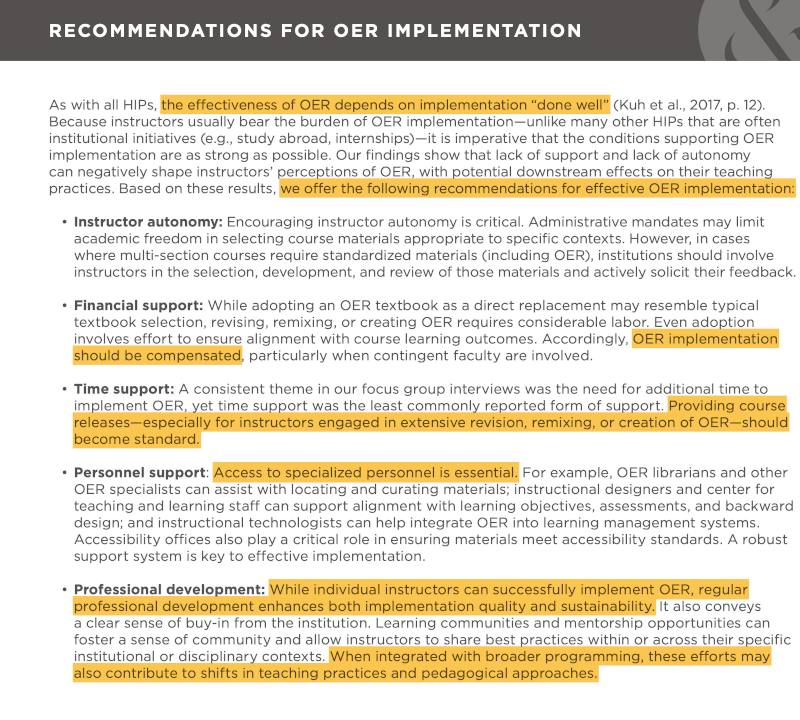
			<p style="text-align:justify;"><span style="background-color:#ffff00;"><span style=""><strong>AAC&amp;U&#039;s New Report on OER</strong></span></span></p><p style="text-align:justify;">June 22, 2026&nbsp;·&nbsp;David Wiley</p><p style="text-align:justify;">Theo: <a target="_blank" rel="noopener noreferrer" href="https://opencontent.org/blog/aacus-new-report-on-oer/">https://opencontent.org/blog/aacus-new-report-on-oer/</a></p><p style="text-align:justify;">Bài được đưa lên Internet ngày: 22/06/2026</p><p style="text-align:justify;">Tôi là người ủng hộ mạnh mẽ Tài nguyên Giáo dục Mở - OER (Open Educational Resources). Thực tế, tôi <i>chính là người tiên phong</i> ủng hộ OER – từ năm 1998, khi tôi tạo ra giấy phép mở đầu tiên cho các tài liệu giáo dục và bắt đầu vận động mọi người cấp phép mở cho chúng. Việc tạo lập và chia sẻ OER là đòn bẩy mạnh mẽ để gia tăng cơ hội giáo dục. (Hiện nay, AI tạo sinh là một phương thức thậm chí còn mạnh mẽ <i>hơn</i> để đạt được mục tiêu này, nhưng đó là chủ đề cho một bài viết khác.)</p><p style="text-align:justify;">Vì là người ủng hộ OER, tôi cảm thấy nản lòng trước những tuyên bố thiếu cơ sở mà mọi người thường đưa ra về OER, đặc biệt là khẳng định rằng &quot;việc áp dụng OER giúp cải thiện kết quả học tập của sinh viên!&quot; Điều đó hoàn toàn không đúng. <span style="color:#c9211e;"><i>Việc áp dụng OER KHÔNG đảm bảo mang lại kết quả học tập tốt hơn cho sinh viên</i>.</span> Có những nghiên cứu cho thấy việc áp dụng OER gắn liền với kết quả tốt hơn, có nghiên cứu cho thấy không có sự thay đổi nào, và cũng có nghiên cứu cho thấy việc áp dụng OER thực tế lại gắn liền với sự sụt giảm trong kết quả học tập của sinh viên. Sự khác biệt trong kết quả các nghiên cứu này một phần bắt nguồn từ các vấn đề trong cách thiết kế nghiên cứu.</p><p style="text-align:justify;">Ba năm trước, tôi đã viết một <a target="_blank" rel="noopener noreferrer" href="https://opencontent.org/blog/pervasive-threats-to-validity-in-the-oer-adoption-research-or-three-questions-to-ask-when-you-read-oer-adoption-research/">tài liệu hướng dẫn cơ bản về cách đọc và đánh giá các nghiên cứu về OER</a> (<a target="_blank" rel="noopener noreferrer" href="https://giaoducmo.avnuc.vn/index.php/giao-duc/nhung-moi-de-doa-pho-bien-doi-voi-tinh-hop-le-trong-cac-nghien-cuu-ve-viec-ap-dung-oer-hoac-ba-cau-hoi-can-dat-ra-khi-doc-cac-nghien-cuu-ve-viec-ap-dung-oer-1810.html">bản dịch sang tiếng Việt</a>). <span style="color:#c9211e;">Tài liệu này khuyến khích độc giả đặt ra ba câu hỏi khi đọc các nghiên cứu về OER:</span></p><ul><li class="ck-list-marker-color" style="--ck-content-list-marker-color:#c9211e;" data-list-item-id="ee1ba5ced309daac55da9300170b7f7f8"><p style="text-align:justify;"><span style="color:#c9211e;">Nghiên cứu có kiểm soát các yếu tố khác biệt về giảng viên hay không?&nbsp;</span></p></li><li class="ck-list-marker-color" style="--ck-content-list-marker-color:#c9211e;" data-list-item-id="e95a940c1327d8b2dce99797aa6aecb8f"><p style="text-align:justify;"><span style="color:#c9211e;">Nghiên cứu có kiểm soát các yếu tố khác biệt về sự hỗ trợ dành cho giảng viên hay không?&nbsp;</span></p></li><li class="ck-list-marker-color" style="--ck-content-list-marker-color:#c9211e;" data-list-item-id="e53f911791a9367165ce9885e7fb6741b"><p style="text-align:justify;"><span style="color:#c9211e;">Nghiên cứu có kiểm soát các yếu tố khác biệt về thiết kế sư phạm của tài liệu học tập hay không?</span></p></li></ul><p style="text-align:justify;">Khi một nghiên cứu được cho là về OER không giải đáp được các câu hỏi này, thì thực chất nó không trả lời được câu hỏi về hiệu quả của OER. Thay vào đó:</p><p style="margin-left:1.25cm;text-align:justify;">Khi một nghiên cứu không kiểm soát được sự khác biệt về giảng viên, thì điều mà nghiên cứu đó thực sự đo lường là: &quot;Kết quả học tập khác nhau như thế nào giữa sinh viên học với những giảng viên chọn áp dụng các đổi mới như OER và sinh viên học với những giảng viên chọn không áp dụng chúng?&quot;</p><p style="margin-left:1.25cm;text-align:justify;">Khi một nghiên cứu không kiểm soát được sự khác biệt về sự hỗ trợ dành cho giảng viên, thì điều mà nghiên cứu đó thực sự đo lường là: &quot;Sinh viên của những giảng viên được hỗ trợ tốt đạt kết quả ra sao so với sinh viên của những giảng viên không nhận được sự hỗ trợ tương đương?&quot;</p><p style="margin-left:1.25cm;text-align:justify;">Khi một nghiên cứu không kiểm soát được sự khác biệt về thiết kế sư phạm giữa OER và tài liệu có bản quyền truyền thống - TCM (Traditionally Copyrighted Materials), thì thực chất nghiên cứu đó đang đặt câu hỏi: &quot;Sinh viên được giảng dạy theo phương pháp sư phạm X đạt kết quả ra sao so với sinh viên được giảng dạy theo phương pháp sư phạm Y?&quot;</p><p style="text-align:justify;"><strong>Một báo cáo mới từ AAC&amp;U</strong></p><p style="text-align:justify;">Hôm qua, tôi rất hào hứng khi thấy Hiệp hội các Trường Cao đẳng và Đại học Hoa Kỳ (AAC&amp;U) công bố một báo cáo nghiên cứu mới có tựa đề “<a target="_blank" rel="noopener noreferrer" href="https://www.aacu.org/research/open-education-resources-a-new-high-impact-practice">Tài nguyên Giáo dục Mở: Một Thực tiễn Mới có Tác động Cao” (Open Educational Resources: A New High-Impact Practice</a>). Đây là một báo cáo nghiên cứu quy mô lớn; tác giả chính của báo cáo, Eddie Watson, là một học giả xuất sắc (tôi tin rằng các tác giả khác cũng vậy, dù Eddie là người duy nhất tôi quen biết).&nbsp;</p><p style="text-align:justify;">Ngay từ đầu, tiêu đề báo cáo đã khiến tôi hơi băn khoăn, bởi AAC&amp;U định nghĩa &quot;các thực tiễn có tác động cao&quot; là những phương pháp &quot;đã được khẳng định rõ ràng trong các tài liệu nghiên cứu là đòn bẩy mạnh mẽ cho sự thành công của sinh viên trong giáo dục đại học&quot;. Tuy nhiên, báo cáo thực sự chứa đựng nhiều khía cạnh tinh tế và chi tiết đáng giá mà tôi rất trân trọng.&nbsp;</p><p style="text-align:justify;">Tôi không rõ liệu các tác giả có đọc tài liệu giới thiệu cơ bản (primer) của tôi hay không, nhưng họ đã đề cập cụ thể đến cả ba vấn đề chính được nêu trong tài liệu đó (điều mà các nghiên cứu trước đây về OER hiếm khi – hoặc chưa từng – thực hiện):</p><ol><li data-list-item-id="edacb8da284d9154efd5125dde195e200"><p style="text-align:justify;">Các tác giả kiểm soát sự khác biệt giữa các giảng viên bằng cách so sánh kết quả học tập của sinh viên <i>trước</i> khi giảng viên áp dụng OER với kết quả của chính những sinh viên đó <i>sau</i> khi giảng viên áp dụng OER. Đây thực sự là một điểm tuyệt vời và tôi rất phấn khích khi thấy điều này.</p></li><li data-list-item-id="e55538fad2070afa2932ec2813c199485"><p style="text-align:justify;">Các tác giả đi sâu tìm hiểu các hình thức hỗ trợ mà giảng viên nhận được, bao gồm hỗ trợ tài chính, giảm tải giờ dạy (release time), hỗ trợ từ các chuyên gia như thủ thư và chuyên gia thiết kế giảng dạy, cũng như các hoạt động phát triển chuyên môn.</p></li><li data-list-item-id="eb72650520063a5f8d1a887058b00e1d1"><p style="text-align:justify;">Các tác giả cũng nắm bắt những khác biệt ở mức độ tổng quát trong thiết kế giảng dạy dựa trên khái niệm của Hofer về mức độ triển khai OER &quot;cao&quot; và &quot;thấp&quot; – trong nghiên cứu này, khái niệm đó được cụ thể hóa thành việc giảng viên sử dụng nguyên trạng sách giáo khoa OER (mức thấp) hay chỉnh sửa, phối hợp lại (remix) hoặc tự tạo mới tài liệu OER (mức cao).&nbsp;</p></li></ol><p style="text-align:justify;">Mặc dù các tác giả đã thu thập thông tin về sự hỗ trợ dành cho giảng viên và thiết kế giảng dạy, tôi phải thừa nhận mình hơi thất vọng khi họ không sử dụng yếu tố hỗ trợ giảng viên làm biến đồng biến (covariate) trong bất kỳ phân tích nào về kết quả học tập của sinh viên, và chỉ sử dụng mức độ triển khai cao/thấp làm biến đồng biến trong duy nhất một phân tích – đó là mô hình về tỷ lệ bỏ học (withdrawal-rate model). Các phân tích về điểm số và thời gian hoàn thành khóa học chỉ sử dụng các biến dự báo là: có/không sử dụng OER, loại hình cơ sở đào tạo và mức độ phức tạp của người học như các chỉ số dự báo. Điều này khiến chúng ta không thể có được đánh giá định lượng rõ ràng về mức độ đóng góp của sự khác biệt trong hỗ trợ giảng viên hoặc thiết kế giảng dạy đối với sự cải thiện kết quả học tập của sinh viên, so với sự khác biệt về tài liệu giảng dạy (OER hay TCM).</p><p style="text-align:justify;">Tuy nhiên, như sẽ thấy ở phần dưới, các tác giả thực sự công nhận vai trò then chốt của sự hỗ trợ từ giảng viên và phương pháp sư phạm đối với thành công của sinh viên! Đây là một điểm tích cực của báo cáo, đồng thời là một khía cạnh hiếm thấy trong các tài liệu nghiên cứu về hiệu quả của OER.</p><p style="text-align:justify;"><strong>Hoan hô sự tinh tế trong cách nhìn nhận vấn đề!</strong></p><p style="text-align:justify;">Báo cáo này chứa đựng những điểm tinh tế rất đáng chú ý, đòi hỏi chúng ta phải quan sát kỹ lưỡng để không bỏ sót chúng!</p><p style="text-align:justify;">Báo cáo chủ yếu sử dụng thuật ngữ &quot;triển khai OER&quot; thay vì &quot;áp dụng OER&quot;. Đây là một sự phân biệt cực kỳ quan trọng mà độc giả rất dễ bỏ qua.</p><p style="text-align:justify;">Ở trang áp chót, báo cáo tóm tắt các kết quả nghiên cứu bằng cách giải thích rằng OER chỉ thực sự là một giải pháp mang lại tác động lớn khi quá trình triển khai được thực hiện &quot;một cách hiệu quả&quot;.</p><figure class="image"><img style="aspect-ratio:800/720;" src="https://letrungnghia.mangvn.org/uploads/letrungnghia/news/2026/aacu-new-report.png" width="800" height="720" /></figure><p style="text-align:justify;"><span style="color:#c9211e;">Nói cách khác, bạn không thể chỉ trao đổi Tài liệu có bản quyền truyền thống (TCM) lấy Tài nguyên giáo dục mở (OER) và mong đợi thấy những thay đổi có ý nghĩa trong kết quả</span>. Việc áp dụng OER chỉ là một phần của sự can thiệp rộng hơn cần bao gồm cả sự hỗ trợ của người hướng dẫn và những thay đổi trong phương pháp sư phạm nếu bạn muốn cải thiện thành công của sinh viên một cách đáng tin cậy.</p><p style="text-align:justify;">(Nếu bạn muốn nói về các tác động của việc chỉ áp dụng OER mà không có các thành phần khác của triển khai có tác động cao, thì sự thật là việc áp dụng OER sẽ tiết kiệm tiền cho sinh viên của bạn và mang lại cho họ những kết quả gần như giống nhau. Và nhận được cùng kết quả với ít tiền hơn là một thỏa thuận tuyệt vời! Nhưng nếu bạn đang tìm kiếm thứ gì đó &#039;được thiết lập tốt trong tài liệu nghiên cứu như một đòn bẩy mạnh mẽ cho sự thành công của sinh viên trong giáo dục đại học&#039;, bạn cần triển khai toàn bộ, &quot;hoàn thành tốt&quot;.)</p><p style="text-align:justify;">Chỗ duy nhất mà báo cáo chú ý đến sắc thái dường như bị mất đi là ở phần mô tả tác động của OER đối với các điểm số cuối cùng. Báo cáo nêu rằng các điểm A đã tăng lên trong <i>mọi</i> bối cảnh - gần 5 điểm phần trăm tổng thể - và sau đó các thuộc tính thay đổi thành OER. Nhưng việc phân tích điểm số không bao gồm tác động của sự hỗ trợ từ giảng viên hoặc mức độ triển khai. Do đó, sự tăng điểm A đó không thể được quy một cách tự tin cho OER - sự thay đổi về điểm số có thể là do OER, hoặc nó có thể là do sự hỗ trợ mà các giảng viên đã nhận được, hoặc nó có thể là do những thay đổi mà các giảng viên đã thực hiện đối với phương pháp sư phạm của họ, hoặc sự kết hợp nào đó của cả ba. Báo cáo có thể tự tin nói rằng điểm số đã tăng lên, nhưng không thể nói một cách tự tin <i>tại sao</i> chúng lại đã cải thiện. Mâu thuẫn gai góc này cũng chính là điều mà các tác giả đã thừa nhận trong tác phẩm trước đây của họ (Colvard và cộng sự, 2018), và tôi cũng đã thừa nhận trong một số tác phẩm trước đây của mình.</p><p style="text-align:justify;"><strong>Suy nghĩ cuối cùng</strong></p><p style="text-align:justify;">Đây là một báo cáo xuất sắc sẽ đóng góp lớn cho tài liệu nghiên cứu OER. <span style="color:#c9211e;">Tôi chỉ hy vọng rằng những người ủng hộ chia sẻ những gì nó thực sự nói: rằng nếu bạn muốn vượt ra ngoài việc tiết kiệm tiền và thực sự cải thiện sự thành công của sinh viên, bạn phải triển khai OER một cách hiệu quả - nghĩa là bạn áp dụng OER <i>và</i> được hỗ trợ tốt về kinh phí, thời gian, khả năng tiếp cận các chuyên gia và phát triển chuyên môn (PD), <i>và</i> sự hỗ trợ đó dẫn bạn áp dụng các thực hành giảng dạy hiệu quả hơn</span>. <i>Đó</i> là khi sự thành công của học sinh được cải thiện một cách có ý nghĩa.</p><p style="text-align:justify;"><span style="color:#c9211e;">Đừng vung vẩy báo cáo này và nói &quot;Thấy chưa?!? Việc áp dụng OER cải thiện các kết quả!&quot; Hãy nói, “Khi được kết hợp với những hỗ trợ có ý nghĩa của giảng viên và những thay đổi trong thiết kế giảng dạy, việc áp dụng OER góp phần cải thiện kết quả!</span>”</p><p style="text-align:justify;"><span style="background-color:#ffff00;"><span style="">I’m a huge proponent of OER. In fact, I’m the </span><i><span style="">original</span></i><span style=""> OER advocate - since 1998, when I created the first open license for educational materials and began working to persuade people to openly license them. Creating and sharing OER is a powerful lever for increasing educational opportunity. (Generative AI is now an even </span><i><span style="">more</span></i><span style=""> powerful way of accomplishing this goal, but that’s a subject for another post.)</span></span></p><p style="text-align:justify;"><span style="background-color:#ffff00;"><span style="">Because I’m an OER advocate, I’m frustrated by the unfounded claims I hear people make about OER, especially the claim that ‘adopting OER improves student outcomes!’ That’s simply not true. </span><i><span style="">Adopting OER does NOT reliably improve student success.</span></i><span style=""> In some studies adopting OER is associated with better outcomes, in some studies there’s no change at all, and it some studies adopting OER is actually associated with decreases in student success. This variability in study results is partly due to problems with the ways studies are designed.</span></span></p><p style="text-align:justify;"><span style="background-color:#ffff00;"><span style="">Three years ago I wrote a </span></span><a target="_blank" rel="noopener noreferrer" href="https://opencontent.org/blog/pervasive-threats-to-validity-in-the-oer-adoption-research-or-three-questions-to-ask-when-you-read-oer-adoption-research/"><span style="background-color:#ffff00;"><span style="">primer for critically reading OER research</span></span></a><span style="background-color:#ffff00;"><span style="">. The primer encourages readers to ask three questions as they read OER research:</span></span></p><ul><li data-list-item-id="e2bd4baa05da4701d75b6b4fc78927179"><p style="text-align:justify;"><span style="background-color:#ffff00;"><span style="">Did the study control for differences in instructors?</span></span></p></li><li data-list-item-id="eaab44febe97a8eb83286ac9abd24a62b"><p style="text-align:justify;"><span style="background-color:#ffff00;"><span style="">Did the study control for differences in instructor support?</span></span></p></li><li data-list-item-id="e6b961ec5d95f65d09acf8427b33dab64"><p style="text-align:justify;"><span style="background-color:#ffff00;"><span style="">Did the study control for differences in the instructional design of the learning materials?</span></span></p></li></ul><p style="text-align:justify;"><span style="background-color:#ffff00;"><span style="">When research that purports to be about OER doesn’t answer these questions, it doesn’t actually answer questions about the effectiveness of OER. Instead:</span></span></p><p style="margin-left:1.25cm;text-align:justify;"><span style="background-color:#ffff00;"><span style="">When a study fails to control for differences in instructors, what that study is really measuring is, “How do outcomes differ when students take courses from the kind of instructors who choose to adopt innovations like OER compared to the students who take classes from the kind of instructors who choose not to?”</span></span></p><p style="margin-left:1.25cm;text-align:justify;"><span style="background-color:#ffff00;"><span style="">When a study fails to control for differences in instructor support, what that study is really measuring is, “How do the students of well-supported instructors perform compared to the students of instructors who are not as well supported?”</span></span></p><p style="text-align:justify;"><span style="background-color:#ffff00;"><span style="">When a study fails to control for differences in instructional design between the OER and the TCM, the study is really asking, “How do students taught using pedagogical approach X perform compared to students taught using pedagogical approach Y?”</span></span></p><p style="text-align:justify;"><a id="a-new-report-from-aacu"></a><span style="background-color:#ffff00;"><span style=""><strong>A New Report from AAC&amp;U</strong></span></span></p><p style="text-align:justify;"><span style="background-color:#ffff00;"><span style="">I was excited yesterday to see that the American Association of Colleges and Universities (AAC&amp;U) had released a new research report titled “</span></span><a target="_blank" rel="noopener noreferrer" href="https://www.aacu.org/research/open-education-resources-a-new-high-impact-practice"><span style="background-color:#ffff00;"><span style="">Open Educational Resources: A New High-Impact Practice</span></span></a><span style="background-color:#ffff00;"><span style="">.” This is a very large-scale research report whose lead author, Eddie Watson, is a terrific scholar (I’m sure the other authors are as well; Eddie is the only one I know).</span></span></p><p style="text-align:justify;"><span style="background-color:#ffff00;"><span style="">The title caused me some concern right off the bat, as AAC&amp;U defines high impact practices as “well established in the research literature as powerful levers for student success in higher education.” But there’s actually plenty of nuance in the report, which I really appreciated.</span></span></p><p style="text-align:justify;"><span style="background-color:#ffff00;"><span style="">I don’t know if the authors of the report had read my primer, but they did specifically call out each of the primer’s three issues (which previous OER research rarely - if ever - did):</span></span></p><ol><li data-list-item-id="e9e6bc24aa753d3b55aa52ff3ddab285b"><p style="text-align:justify;"><span style="background-color:#ffff00;"><span style="">The authors control for instructor differences by comparing the success of instructors’ students before they adopted OER with the success of those same instructors’ students after they adopted OER. This is genuinely awesome and I was excited to see this.</span></span></p></li><li data-list-item-id="e8593555b6b1321e38f6c3961a196217d"><p style="text-align:justify;"><span style="background-color:#ffff00;"><span style="">The authors dig into the kinds of supports instructors receive, including financial support, release time support, support from specialized personnel like librarians and instructional designers, and professional development.</span></span></p></li><li data-list-item-id="e0eb79e36728c9d6a751a17b02256816c"><p style="text-align:justify;"><span style="background-color:#ffff00;"><span style="">The authors also capture coarse-grained differences in instructional design using Hofer’s notion of “high” and “low” OER implemention - operationalized in this study as whether the instructor adopted an OER textbook as-is (low) or revised, remixed, or created OER materials (high).</span></span></p></li></ol><p style="text-align:justify;"><span style="background-color:#ffff00;"><span style="">While the authors did collect information about instructor support and instructional design, I will admit to being a little disappointed that they never used instructor support as a covariate in any of the student-outcome analyses, and used high/low implementation as a covariate in only a single analysis - the withdrawal-rate model. The grade and time-to-completion analyses use only OER yes/no, institution type, and learner complexity as predictors. That prevents us from getting a clean quantitative read on the degree to which improvements in student success are due to differences in instructor support or instructional design, as opposed to differences in instructional materials (OER or TCM).</span></span></p><p style="text-align:justify;"><span style="background-color:#ffff00;"><span style="">But, as we’ll see below, the authors do explicitly recognize the critical role instructor support and pedagogy play in student success! This is a positive for the report, and another rarity in the OER efficacy literature.</span></span></p><p style="text-align:justify;"><a id="hooray-for-nuance"></a><span style="background-color:#ffff00;"><span style=""><strong>Hooray for Nuance!</strong></span></span></p><p style="text-align:justify;"><span style="background-color:#ffff00;"><span style="">There is some great nuance in this paper, which means we have to pay close attention so we don’t miss it!</span></span></p><p style="text-align:justify;"><span style="background-color:#ffff00;"><span style="">The report predominantly uses the language of “OER implementation” as opposed to “OER adoption.” This is a critically important distinction that will be easy for readers to miss.</span></span></p><p style="text-align:justify;"><span style="background-color:#ffff00;"><span style="">On the second-to-last page, the report summarizes its findings by explaining that OER is only a high-impact practice when its implementation is “done well.”</span></span></p><p style="text-align:justify;"><span style="background-color:#ffff00;"><span style="">In other words, you can’t just swap Traditionally Copyrighted Materials (TCM) for Open Educational Resources (OER) and expect to see meaningful changes in outcomes. OER adoption is only one part of a broader intervention that needs to include both instructor support and changes in pedagogy if you want to reliably improve student success.</span></span></p><p style="text-align:justify;"><span style="background-color:#ffff00;"><span style="">(If you want to talk about the impacts of just adopting OER without the other components of a high impact implementation, the truth is that adopting OER will save your students money and get them roughly the same outcomes. And getting the same outcomes for less money is a great deal! But if you’re looking for something ‘well established in the research literature as a powerful lever for student success in higher education,’ you need the entire, “well done” implementation.)</span></span></p><p style="text-align:justify;"><span style="background-color:#ffff00;"><span style="">The one place the report’s attention to nuance seems to lapse is in the description of OER’s impact on final grades. The report states that A grades rose in </span><i><span style="">every</span></i><span style=""> context - nearly five percentage points overall - and then attributes that change to OER. But the grade analysis does not include the effects of instructor support or implementation level. Consequently, that bump in A grades can’t be attributed confidently to OER - the change in grades could have been due to OER, or it could have been due to the support instructors received, or it could have been due to changes instructors made to their pedagogy, or some combination of the three. The report can say with confidence that grades rose, but it can’t confidently say </span><i><span style="">why</span></i><span style=""> they improved. This thorny tangle of effects is the same confound the authors acknowledge in their earlier work (Colvard et al., 2018), and which I have acknowledged in some of my earlier work as well.</span></span></p><p style="text-align:justify;"><a id="final-thoughts"></a><span style="background-color:#ffff00;"><span style=""><strong>Final Thoughts</strong></span></span></p><p style="text-align:justify;"><span style="background-color:#ffff00;"><span style="">This is an excellent report that will make a great contribution to the OER research literature. I just hope that advocates share what it actually says: that if you want to go beyond saving money and actually improve student success, you have to implement OER effectively - meaning you adopt OER, </span><i><span style="">and</span></i><span style=""> are well supported with funding, time, access to specialists, and PD, </span><i><span style="">and</span></i><span style=""> that the support leads you to adopt more effective teaching practices. </span><i><span style="">That’s</span></i><span style=""> when student success improves meaningfully.</span></span></p><p style="text-align:justify;"><span style="background-color:#ffff00;"><span style="">Let’s not wave this report around and say “See?!? Adopting OER improves outcomes!” Let’s say, “When combined with meaningful instructor supports and changes in instructional design, OER adoption contributes to improved outcomes!”</span></span></p><p style="text-align:justify;">Dịch: Lê Trung Nghĩa</p><p style="text-align:justify;">letrungnghia.foss@gmail.com</p>
		</div>
				<div id="author">
						<p>
				<strong>Tác giả:</strong>
				<a href="https://letrungnghia.mangvn.org/author/Nghia-Le-Trung/">Nghĩa Lê Trung</a>
			</p>
		</div>
	</div>
	<div id="footer" class="clearfix">
		<div id="url">
			<strong>URL của bản tin này: </strong><a href="https://letrungnghia.mangvn.org/savefile/Education/bao-cao-moi-ve-oer-cua-aac-u-8020.html" title="Báo cáo mới về OER của AAC&amp;U">https://letrungnghia.mangvn.org/savefile/Education/bao-cao-moi-ve-oer-cua-aac-u-8020.html</a>

		</div>
		<div class="clear"></div>
		<div class="copyright">
			&copy; Blog FOSS by Lê Trung Nghĩa
		</div>
		<div id="contact">
			<a href="mailto:webmaster@vinades.vn">webmaster@vinades.vn</a>
		</div>
	</div>
</div>
        <div id="timeoutsess" class="chromeframe">
            Bạn đã không sử dụng Site, <a onclick="timeoutsesscancel();" href="https://letrungnghia.mangvn.org/#">Bấm vào đây để duy trì trạng thái đăng nhập</a>. Thời gian chờ: <span id="secField"> 60 </span> giây
        </div>
        <div id="openidResult" class="nv-alert" style="display:none"></div>
        <div id="openidBt" data-result="" data-redirect=""></div>
<div id="run_cronjobs" style="visibility:hidden;display:none;"><img alt="cron" src="/index.php?second=cronjobs&amp;p=p5MJ9xz7" width="1" height="1" /></div>
<script src="https://letrungnghia.mangvn.org/assets/js/jquery/jquery.min.js"></script>
<script>var nv_base_siteurl="/",nv_lang_data="vi",nv_lang_interface="vi",nv_name_variable="nv",nv_fc_variable="op",nv_lang_variable="language",nv_module_name="news",nv_func_name="savefile",nv_is_user=0, nv_my_ofs=7,nv_my_abbr="+07",nv_cookie_prefix="nv4c_Cgoz2",nv_check_pass_mstime=1738000,nv_area_admin=0,nv_safemode=0,theme_responsive=0,nv_recaptcha_ver=2,nv_recaptcha_sitekey="6LcNwC8UAAAAAMm8ZTYNygweLUQtOU0IapbDRk69",nv_recaptcha_type="image",XSSsanitize=1;</script>
<script src="https://letrungnghia.mangvn.org/assets/js/language/vi.js"></script>
<script src="https://letrungnghia.mangvn.org/assets/js/DOMPurify/purify3.js"></script>
<script src="https://letrungnghia.mangvn.org/assets/js/global.js"></script>
<script src="https://letrungnghia.mangvn.org/assets/js/site.js"></script>
<script src="https://letrungnghia.mangvn.org/themes/default/js/news.js"></script>
<script src="https://letrungnghia.mangvn.org/themes/default/js/main.js"></script>
<script src="https://letrungnghia.mangvn.org/themes/default/js/custom.js"></script>
<script type="application/ld+json">
        {
            "@context": "https://schema.org",
            "@type": "Organization",
            "url": "https://letrungnghia.mangvn.org",
            "logo": "https://letrungnghia.mangvn.org/uploads/letrungnghia/le-trung-nghia.png"
        }
        </script>
<script src="https://letrungnghia.mangvn.org/themes/default/js/bootstrap.min.js"></script>
</body>
</html>