<!DOCTYPE html>
    <html lang="vi" xmlns="http://www.w3.org/1999/xhtml" prefix="og: http://ogp.me/ns#">
    <head>
<title>Công nghệ nguồn mở trong kỷ nguyên AI</title>
<meta name="description" content="Công nghệ nguồn mở trong kỷ nguyên AI - Savefile - Blogs - https&#x3A;&#x002F;&#x002F;letrungnghia.mangvn.org&#x002F;savefile&#x002F;Education&#x002F;cong-nghe-nguon-mo-trong-ky-nguyen-ai-7718.html">
<meta name="author" content="Blog FOSS by Lê Trung Nghĩa">
<meta name="copyright" content="Blog FOSS by Lê Trung Nghĩa [webmaster@vinades.vn]">
<meta name="generator" content="NukeViet v4.5">
<meta http-equiv="Content-Type" content="text/html; charset=utf-8">
<meta property="og:title" content="Công nghệ nguồn mở trong kỷ nguyên AI">
<meta property="og:type" content="website">
<meta property="og:description" content="Savefile - Blogs - https&#x3A;&#x002F;&#x002F;letrungnghia.mangvn.org&#x002F;savefile&#x002F;Education&#x002F;cong-nghe-nguon-mo-trong-ky-nguyen-ai-7718.html">
<meta property="og:site_name" content="Blog FOSS by Lê Trung Nghĩa">
<meta property="og:url" content="https://letrungnghia.mangvn.org/savefile/Education/cong-nghe-nguon-mo-trong-ky-nguyen-ai-7718.html">
<link rel="shortcut icon" href="https://letrungnghia.mangvn.org/favicon.ico">
<link rel="canonical" href="https://letrungnghia.mangvn.org/savefile/Education/cong-nghe-nguon-mo-trong-ky-nguyen-ai-7718.html">
<link rel="alternate" href="https://letrungnghia.mangvn.org/rss/" title="Blogs" type="application/rss+xml">
<link rel="alternate" href="https://letrungnghia.mangvn.org/rss/Government/" title="Blogs - Government" type="application/rss+xml">
<link rel="alternate" href="https://letrungnghia.mangvn.org/rss/Policy/" title="Blogs - Policy" type="application/rss+xml">
<link rel="alternate" href="https://letrungnghia.mangvn.org/rss/Philosophy/" title="Blogs - Philosophy" type="application/rss+xml">
<link rel="alternate" href="https://letrungnghia.mangvn.org/rss/Security/" title="Blogs - Security" type="application/rss+xml">
<link rel="alternate" href="https://letrungnghia.mangvn.org/rss/Legal/" title="Blogs - Legal" type="application/rss+xml">
<link rel="alternate" href="https://letrungnghia.mangvn.org/rss/Education/" title="Blogs - Education" type="application/rss+xml">
<link rel="alternate" href="https://letrungnghia.mangvn.org/rss/Business/" title="Blogs - Business" type="application/rss+xml">
<link rel="alternate" href="https://letrungnghia.mangvn.org/rss/Community/" title="Blogs - Community" type="application/rss+xml">
<link rel="alternate" href="https://letrungnghia.mangvn.org/rss/Interoperability/" title="Blogs - Interoperability" type="application/rss+xml">
<link rel="alternate" href="https://letrungnghia.mangvn.org/rss/Standards/" title="Blogs - Standards" type="application/rss+xml">
<link rel="alternate" href="https://letrungnghia.mangvn.org/rss/Author/" title="Blogs - Author" type="application/rss+xml">
<link rel="alternate" href="https://letrungnghia.mangvn.org/rss/Opinions/" title="Blogs - Opinions" type="application/rss+xml">
<link rel="alternate" href="https://letrungnghia.mangvn.org/rss/CC/" title="Blogs - CC" type="application/rss+xml">
<link rel="alternate" href="https://letrungnghia.mangvn.org/rss/Cloud/" title="Blogs - Cloud" type="application/rss+xml">
<link rel="alternate" href="https://letrungnghia.mangvn.org/rss/Hardware/" title="Blogs - Hardware" type="application/rss+xml">
<link rel="alternate" href="https://letrungnghia.mangvn.org/rss/Software/" title="Blogs - Software" type="application/rss+xml">
<link rel="alternate" href="https://letrungnghia.mangvn.org/rss/Statistics/" title="Blogs - Statistics" type="application/rss+xml">
<link rel="alternate" href="https://letrungnghia.mangvn.org/rss/Trends/" title="Blogs - Trends" type="application/rss+xml">
<link rel="alternate" href="https://letrungnghia.mangvn.org/rss/China/" title="Blogs - China" type="application/rss+xml">
<link rel="alternate" href="https://letrungnghia.mangvn.org/rss/OSs/" title="Blogs - OSs" type="application/rss+xml">
<link rel="alternate" href="https://letrungnghia.mangvn.org/rss/Blogs/" title="Blogs - Blogs" type="application/rss+xml">
<link rel="alternate" href="https://letrungnghia.mangvn.org/rss/Outsourcing/" title="Blogs - Outsourcing" type="application/rss+xml">
<link rel="alternate" href="https://letrungnghia.mangvn.org/rss/elearning/" title="Blogs - Elearning" type="application/rss+xml">
<link rel="preload" as="style" href="https://letrungnghia.mangvn.org/assets/css/font-awesome.min.css" type="text/css">
<link rel="preload" as="style" href="https://letrungnghia.mangvn.org/themes/default/css/bootstrap.non-responsive.css" type="text/css">
<link rel="preload" as="style" href="https://letrungnghia.mangvn.org/themes/default/css/style.css" type="text/css">
<link rel="preload" as="style" href="https://letrungnghia.mangvn.org/themes/default/css/style.non-responsive.css" type="text/css">
<link rel="preload" as="style" href="https://letrungnghia.mangvn.org/themes/default/css/news.css" type="text/css">
<link rel="preload" as="style" href="https://letrungnghia.mangvn.org/themes/default/css/custom.css" type="text/css">
<link rel="preload" as="style" href="https://letrungnghia.mangvn.org/assets/css/default.vi.1106.css" type="text/css">
<link rel="preload" as="script" href="https://letrungnghia.mangvn.org/assets/js/jquery/jquery.min.js" type="text/javascript">
<link rel="preload" as="script" href="https://letrungnghia.mangvn.org/assets/js/language/vi.js" type="text/javascript">
<link rel="preload" as="script" href="https://letrungnghia.mangvn.org/assets/js/DOMPurify/purify3.js" type="text/javascript">
<link rel="preload" as="script" href="https://letrungnghia.mangvn.org/assets/js/global.js" type="text/javascript">
<link rel="preload" as="script" href="https://letrungnghia.mangvn.org/assets/js/site.js" type="text/javascript">
<link rel="preload" as="script" href="https://letrungnghia.mangvn.org/themes/default/js/news.js" type="text/javascript">
<link rel="preload" as="script" href="https://letrungnghia.mangvn.org/themes/default/js/main.js" type="text/javascript">
<link rel="preload" as="script" href="https://letrungnghia.mangvn.org/themes/default/js/custom.js" type="text/javascript">
<link rel="preload" as="script" href="https://letrungnghia.mangvn.org/themes/default/js/bootstrap.min.js" type="text/javascript">
<link rel="stylesheet" href="https://letrungnghia.mangvn.org/assets/css/font-awesome.min.css">
<link rel="stylesheet" href="https://letrungnghia.mangvn.org/themes/default/css/bootstrap.non-responsive.css">
<link rel="stylesheet" href="https://letrungnghia.mangvn.org/themes/default/css/style.css">
<link rel="stylesheet" href="https://letrungnghia.mangvn.org/themes/default/css/style.non-responsive.css">
<link rel="StyleSheet" href="https://letrungnghia.mangvn.org/themes/default/css/news.css">
<link rel="stylesheet" href="https://letrungnghia.mangvn.org/themes/default/css/custom.css">
<link rel="stylesheet" href="https://letrungnghia.mangvn.org/assets/css/default.vi.1106.css">
<style type="text/css">
	body{background: #fff;}
</style>
<script>(function(i,s,o,g,r,a,m){i['GoogleAnalyticsObject']=r;i[r]=i[r]||function(){
(i[r].q=i[r].q||[]).push(arguments)},i[r].l=1*new Date();a=s.createElement(o),
m=s.getElementsByTagName(o)[0];a.async=1;a.src=g;m.parentNode.insertBefore(a,m)
})(window,document,'script','https://www.google-analytics.com/analytics.js','ga');
ga('create', 'UA-70254229-3', '');
ga('send', 'pageview');
</script>
</head>
    <body>
<div id="print">
	<div id="hd_print">
		<h2 class="pull-left">Blog FOSS by Lê Trung Nghĩa</h2>
		<p class="pull-right"><a title="Blog FOSS by Lê Trung Nghĩa" href="https://letrungnghia.mangvn.org/">https://letrungnghia.mangvn.org</a></p>
	</div>
	<div class="clear"></div>
	<hr />
	<div id="content">
		<h1>Công nghệ nguồn mở trong kỷ nguyên AI</h1>
		<ul class="list-inline">
			<li>Thứ sáu - 01/08/2025 06:26</li>
			<li class="hidden-print txtrequired"><em class="fa fa-print">&nbsp;</em><a title="In ra" href="javascript:;" onclick="window.print()">In ra</a></li>
			<li class="hidden-print txtrequired"><em class="fa fa-power-off">&nbsp;</em><a title="Đóng cửa sổ này" href="javascript:;" onclick="window.close()">Đóng cửa sổ này</a></li>
		</ul>
		<div class="clear"></div>
		<div id="hometext">
		</div>
				<div class="imghome">
			<img alt="Công nghệ nguồn mở trong kỷ nguyên AI" src="https://letrungnghia.mangvn.org/uploads/letrungnghia/news/2025/open-source-technology-in-the-age-of-ai.png" width="460" class="img-thumbnail" />
		</div>
		<div class="clear"></div>
		<div id="bodytext" class="clearfix">
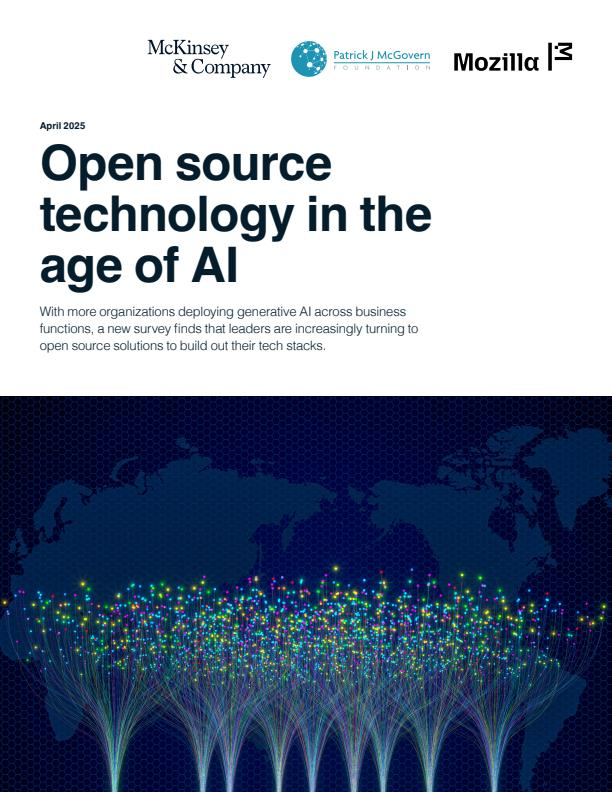
			<p align="justify"><b><span style="background: rgb(255, 255, 0);">Open source technology in the age of AI</span></b></p>

<p align="justify">April 22, 2025 | Report</p>

<p align="justify">Theo: <a href="https://www.mckinsey.com/capabilities/quantumblack/our-insights/open-source-technology-in-the-age-of-ai#/">https://www.mckinsey.com/capabilities/quantumblack/our-insights/open-source-technology-in-the-age-of-ai#/</a></p>

<p align="justify">Bài được đưa lên Internet ngày: 22/04/2025</p>

<p align="justify">Với việc ngày càng nhiều tổ chức triển khai AI thế hệ mới trên khắp các chức năng kinh doanh, một khảo sát mới cho thấy các nhà lãnh đạo đang ngày càng chuyển sang các giải pháp AI nguồn mở để xây dựng các ngăn xếp công nghệ của họ.</p>

<p align="justify">Báo cáo này là một phần của sự hợp tác nghiên cứu giữa McKinsey, Quỹ Mozilla và Quỹ Patrick J. McGovern.</p>

<p align="justify">Phần mềm nguồn mở từ lâu đã là một phần quan trọng của hệ sinh thái công nghệ. Phần mềm thương mại thường yêu cầu giấy phép thương mại hoặc đăng ký và hạn chế quyền truy cập vào công nghệ cốt lõi của nó. Tuy nhiên, các công cụ nguồn mở được phát triển thông qua hợp tác và được cung cấp cho công chúng để sử dụng, sửa đổi và phân phối với ít hạn chế hơn nhiều. Mô hình nguồn mở mang đến cho các nhà phát triển khả năng điều chỉnh và định hình các giải pháp phù hợp với nhu cầu cụ thể của tổ chức họ.</p>

<p align="justify">Thời đại AI hiện nay cũng không ngoại lệ. Khi ngày càng nhiều doanh nghiệp xây dựng và triển khai các giải pháp dựa trên AI trên toàn bộ hoạt động kinh doanh của mình, họ đang chuyển sang một loạt các công nghệ nguồn mở ngày càng tăng. Các sản phẩm như vậy bao gồm dòng Llama của Meta, dòng Gemma của Google, dòng OLMo của Viện Trí tuệ Nhân tạo Allen, dòng NeMo của Nvidia, DeepSeek-R1 và Qwen 2.5-Max của Alibaba Cloud—nhiều sản phẩm trong số đó đang nhanh chóng thu hẹp khoảng cách hiệu suất so với các mô hình AI độc quyền.</p>

<p align="justify">Một cuộc khảo sát mới, lần đầu tiên được thực hiện với hơn 700 nhà lãnh đạo công nghệ và nhà phát triển cấp cao tại 41 quốc gia, do McKinsey, Quỹ Mozilla và Quỹ Patrick J. McGovern thực hiện, cung cấp phân tích chi tiết và quy mô lớn nhất về cách các doanh nghiệp đang suy nghĩ và triển khai AI nguồn mở trong tổ chức của họ. Kết quả cho thấy các nhà lãnh đạo đang áp dụng các công cụ nguồn mở như những thành phần thiết yếu trong bộ công nghệ của họ, với những lợi thế như hiệu suất cao, dễ sử dụng và chi phí triển khai và bảo trì thấp hơn so với các công cụ độc quyền. Trong khi đó, các nhà phát triển ngày càng coi trải nghiệm với AI nguồn mở là một phần quan trọng trong sự hài lòng chung về công việc của họ. Trong khi các giải pháp nguồn mở đi kèm với những lo ngại về bảo mật và thời gian đánh giá, hơn ba phần tư số người trả lời khảo sát mong đợi sẽ tăng cường sử dụng AI nguồn mở trong những năm tới.</p>

<p align="justify">Nghiên cứu của chúng tôi cho thấy các doanh nghiệp đang sử dụng các mô hình nguồn mở nhiều hơn mong đợi. Trên nhiều lĩnh vực của công nghệ AI, hơn 50% số người được hỏi báo cáo rằng tổ chức của họ đang sử dụng các công nghệ AI nguồn mở (thường kết hợp với các công cụ độc quyền từ các công ty như Anthropic, OpenAI và Google). Các tổ chức đặt ưu tiên cao cho AI là những tổ chức có nhiều khả năng sử dụng công nghệ nguồn mở nhất: Những người được hỏi từ các tổ chức coi AI là quan trọng đối với lợi thế cạnh tranh của họ có khả năng báo cáo sử dụng các mô hình và công cụ AI nguồn mở cao hơn 40% so với những người được hỏi từ các tổ chức khác. Ngành công nghệ đang dẫn đầu, với 72% tổ chức của những người được hỏi sử dụng mô hình AI nguồn mở, so với 63% số người được hỏi từ tất cả các tổ chức. Kết quả khảo sát cung cấp một số phát hiện chính:</p>

<ul>
	<li>
	<p align="justify">Xu hướng và việc sử dụng AI nguồn mở:</p>

	<ul>
		<li>
		<p align="justify"><i>Việc sử dụng các công nghệ AI nguồn mở rất phổ biến.</i> Hơn 50% số người được hỏi cho biết họ đang tận dụng giải pháp nguồn mở trong từng lĩnh vực dữ liệu, mô hình và công cụ của bộ công nghệ.</p>
		</li>
		<li>
		<p align="justify"><i>Trình độ kỹ thuật và kinh nghiệm của nhà phát triển ảnh hưởng đến việc sử dụng AI nguồn mở.</i> Tỷ lệ sử dụng này cao nhất trong lĩnh vực công nghệ, truyền thông và viễn thông (70%), và các nhà phát triển AI giàu kinh nghiệm có khả năng sử dụng các giải pháp AI nguồn mở cao hơn 40% so với các đồng nghiệp.</p>
		</li>
		<li>
		<p align="justify"><i>Các tổ chức đang sử dụng các công cụ AI nguồn mở từ những đối tác quen thuộc.</i> Tính đến tháng 1 năm 2025, các công cụ AI nguồn mở được sử dụng phổ biến nhất trong các doanh nghiệp là các công cụ do các công ty công nghệ lớn phát triển, chẳng hạn như Meta với dòng sản phẩm Llama và Google với dòng sản phẩm Gemma.</p>
		</li>
	</ul>
	</li>
	<li>
	<p align="justify">Giá trị đối với các tổ chức và nhà phát triển:</p>

	<ul>
		<li>
		<p align="justify"><i>Hầu hết người được hỏi đều hài lòng với các mô hình AI nguồn mở của họ.</i> Lý do hàng đầu cho sự hài lòng được báo cáo là hiệu suất và tính dễ sử dụng.</p>
		</li>
		<li>
		<p align="justify"><i>Các công cụ AI nguồn mở dẫn đầu về lợi ích về chi phí, trong khi các công cụ AI độc quyền có thời gian thu hồi vốn nhanh hơn</i><i>.</i> Những người được hỏi cho biết AI nguồn mở có chi phí triển khai thấp hơn (60%) và chi phí bảo trì thấp hơn (46%). Tuy nhiên, những người được hỏi cho rằng thời gian thu hồi vốn nhanh hơn từ các công cụ AI độc quyền (48%).</p>
		</li>
		<li>
		<p align="justify"><i>Các nhà phát triển đánh giá cao các công cụ AI nguồn mở</i><i>.</i> Hầu hết các nhà phát triển (81%) cho biết kinh nghiệm sử dụng các công cụ AI nguồn mở được đánh giá cao trong lĩnh vực của họ và việc làm việc với các công cụ này rất quan trọng đối với sự hài lòng trong công việc của họ (66%).</p>
		</li>
	</ul>
	</li>
</ul>

<ul>
	<li>
	<p align="justify">Triển vọng tương lai của AI nguồn mở: Các tổ chức sẵn sàng áp dụng kết hợp các giải pháp AI mở và độc quyền. Gần ba phần tư số người được hỏi (hơn 70%) cho biết họ sẵn sàng áp dụng công nghệ AI nguồn mở hoặc độc quyền trên nhiều lĩnh vực công nghệ.</p>
	</li>
	<li>
	<p align="justify">Rủi ro và chiến lược giảm thiểu:</p>

	<ul>
		<li>
		<p align="justify"><i>Các công cụ AI nguồn mở tiềm ẩn những thách thức.</i> Người được hỏi nêu ra những lo ngại về an ninh mạng (62%), tuân thủ quy định (54%) và vi phạm sở hữu trí tuệ (50%) khi sử dụng các công cụ AI.</p>
		</li>
		<li>
		<p align="justify"><i>Các tổ chức đang triển khai các biện pháp bảo vệ để quản lý rủi ro liên quan đến các công cụ AI nguồn mở.</i> Các chiến lược bao gồm tăng cường khung bảo mật thông tin và kiểm soát chuỗi cung ứng phần mềm, sử dụng đánh giá của bên thứ ba về các mô hình và triển khai các biện pháp bảo vệ để hạn chế hành vi của mô hình.</p>
		</li>
	</ul>
	</li>
</ul>

<p align="justify">Nhìn chung, hơn ba phần tư số người được hỏi—76%—kỳ vọng tổ chức của họ sẽ tăng cường sử dụng các công nghệ AI nguồn mở trong vài năm tới. Điều này có thể một phần là do các công cụ nguồn mở đã đóng vai trò là một phần của hệ sinh thái phần mềm năng động trong nhiều danh mục phần mềm doanh nghiệp, cũng như là một nguồn tài nguyên nền tảng cho cộng đồng nhà phát triển trong nhiều thập kỷ. Khi AI tiếp tục được cải thiện, các nhà lãnh đạo doanh nghiệp và công nghệ nên chú ý đến tất cả các cơ hội và đổi mới đang nổi lên. Giống như trong ngành công nghiệp đám mây và phần mềm, phương pháp tiếp cận đa mô hình có thể sẽ phổ biến đối với nhiều công ty, với các công nghệ nguồn mở và độc quyền cùng tồn tại trong nhiều lĩnh vực của bộ công nghệ AI.</p>

<p align="justify">Để xem toàn bộ dữ liệu và thông tin chi tiết, vui lòng tải xuống báo cáo <a href="https://www.mckinsey.com/~/media/mckinsey/business%20functions/quantumblack/our%20insights/open%20source%20technology%20in%20the%20age%20of%20ai/open-source-technology-in-the-age-of-ai_final.pdf">tại đây</a>.</p>

<p align="center"><b>VỀ (CÁC) TÁC GIẢ</b></p>

<p align="justify"><strong><a href="https://www.mckinsey.com/our-people/ankit-bisht">Ankit Bisht</a></strong> là đối tác tại văn phòng McKinsey ở Dubai, và <strong><a href="https://www.mckinsey.com/our-people/lareina-yee">Lareina Yee</a></strong> là đối tác cấp cao tại văn phòng Vùng Vịnh, nơi <strong><a href="https://www.mckinsey.com/our-people/roger-roberts">Roger Roberts</a></strong> là đối tác, <b>Brittany Presten</b> là đối tác liên kết, và <b>Katherine Ottenbreit</b> là cố vấn.</p>

<p align="justify">Các tác giả xin cảm ơn các đối tác nghiên cứu của họ tại Quỹ Mozilla và Quỹ Patrick J. McGovern; các đồng nghiệp tại QuantumBlack Labs, bộ phận phát triển phần mềm và nghiên cứu và phát triển của QuantumBlack, AI by McKinsey, đơn vị mang đến những đổi mới về AI cho khách hàng và đã có nhiều đóng góp cho hệ sinh thái phần mềm nguồn mở trong lĩnh vực AI và học máy; Cayla Volandes tại văn phòng McKinsey ở New York; Natasha Maniar tại văn phòng McKinsey ở Vùng Vịnh; và các cộng tác viên học thuật bên ngoài đã chia sẻ những hiểu biết sâu sắc và quan điểm của họ về bản thảo và phân tích khảo sát, bao gồm Knut Blind tại Fraunhofer ISI, Luca Vendraminelli tại Đại học Stanford, Sayash Kapoor tại Đại học Princeton, và Genevieve Smith tại Đại học California, Berkeley.</p>

<p align="justify"><span style="background: rgb(255, 255, 0);">With more organizations deploying gen AI across business functions, a new survey finds that leaders are increasingly turning to open source AI solutions to build out their tech stacks.</span></p>

<p align="justify"><em><span style="background: rgb(255, 255, 0);">This report is part of a research collaboration among McKinsey, the Mozilla Foundation, and the Patrick J. McGovern Foundation.</span></em></p>

<p align="justify"><strong><span style="background: rgb(255, 255, 0);">Open source software</span></strong><span style="background: rgb(255, 255, 0);"> has long been a critical part of the technology ecosystem. Commercial software typically requires a commercial license or subscription and restricts access to its core technology. However, open source tools are developed collaboratively and made available to the public to use, modify, and distribute with far fewer restrictions. The open source model gives developers the ability to adapt and shape well-tailored solutions to the particular needs of their organizations. </span></p>

<p align="justify"><span style="background: rgb(255, 255, 0);">The current age of AI is no different. As more enterprises build and deploy AI-driven solutions across their businesses, they are turning to a growing array of open source technologies. Such offerings include Meta’s Llama family, Google’s Gemma family, the Allen Institute for Artificial Intelligence’s OLMo family, Nvidia’s NeMo family, DeepSeek-R1, and Alibaba Cloud’s Qwen 2.5-Max—many of which are fast closing the performance gap relative to proprietary AI models.</span></p>

<p align="justify"><span style="background: rgb(255, 255, 0);">A new, first-of-its-kind survey of more than 700 technology leaders and senior developers across 41 countries, conducted by McKinsey, the Mozilla Foundation, and the Patrick J. McGovern Foundation, provides the largest and most detailed analysis of how enterprises are thinking about and deploying open source AI in their organizations. The results suggest that leaders are embracing open source tools as essential components of their technology stacks, citing advantages such as high performance, ease of use, and lower implementation and maintenance costs relative to proprietary tools. Developers, meanwhile, increasingly view experience with open source AI as an important part of their overall job satisfaction. While open source solutions come with concerns about security and time to value, more than three-quarters of survey respondents expect to increase their use of open source AI in the years ahead. </span></p>

<p align="justify"><span style="background: rgb(255, 255, 0);">Our research shows that enterprises are using open source models more than one might expect. Across several areas of the AI technology stack, over 50 percent of respondents report that their organizations are using open source AI technologies (often alongside proprietary tools from players such as Anthropic, OpenAI, and Google). Organizations that place a high priority on AI are the ones most likely to use open source technologies: Respondents from organizations that view AI as important to their competitive advantage are more than 40 percent more likely to report using open source AI models and tools than respondents from other organizations. The technology industry is leading the way, with 72 percent of respondents’ organizations using an open source AI model, compared with 63 percent of respondents from all organizations.</span></p>

<p align="justify"><span style="background: rgb(255, 255, 0);">The survey results provide several key findings: </span></p>

<ul>
	<li>
	<p align="justify"><span style="background: rgb(255, 255, 0);">Open source AI usage and trends: </span></p>

	<ul>
		<li>
		<p align="justify"><em><span style="background: rgb(255, 255, 0);">Use of open source AI technologies is widespread.</span></em><span style="background: rgb(255, 255, 0);"> More than 50 percent of respondents report leveraging an open source solution in each of the data, models, and tools areas of the technology stack. </span></p>
		</li>
		<li>
		<p align="justify"><em><span style="background: rgb(255, 255, 0);">Technical maturity and developer experience influence open source AI use. </span></em><span style="background: rgb(255, 255, 0);">Such use is highest in technology, media, and telecommunications (70 percent), and experienced AI developers are 40 percent more likely than peers to use open source AI solutions. </span></p>
		</li>
		<li>
		<p align="justify"><em><span style="background: rgb(255, 255, 0);">Organizations are using open source AI tools from familiar players.</span></em><span style="background: rgb(255, 255, 0);"> The most commonly used open source AI tools among enterprises, as of January 2025, are those developed by large technology players, such as Meta with its Llama family and Google with its Gemma family. </span></p>
		</li>
	</ul>
	</li>
	<li>
	<p align="justify"><span style="background: rgb(255, 255, 0);">Value to organizations and developers: </span></p>

	<ul>
		<li>
		<p align="justify"><em><span style="background: rgb(255, 255, 0);">Most respondents are satisfied with their open source AI models.</span></em><span style="background: rgb(255, 255, 0);"> The top reasons for satisfaction reported are performance and ease of use. </span></p>
		</li>
		<li>
		<p align="justify"><em><span style="background: rgb(255, 255, 0);">Open source AI tools lead on cost benefits, while proprietary AI tools have faster time to value. </span></em><span style="background: rgb(255, 255, 0);">Respondents say that open source AI has lower implementation costs (60 percent) and lower maintenance costs (46 percent). But respondents see faster time to value from proprietary AI tools (48 percent). </span></p>
		</li>
		<li>
		<p align="justify"><em><span style="background: rgb(255, 255, 0);">Developers value open source AI tools. </span></em><span style="background: rgb(255, 255, 0);">Most developers (81 percent) report that experience with open source AI tools is highly valued in their field and that working with such tools is important to their job satisfaction (66 percent). </span></p>
		</li>
	</ul>
	</li>
	<li>
	<p align="justify"><span style="background: rgb(255, 255, 0);">Future outlook on open source AI: Organizations are open to a mixture of open and proprietary AI solutions. Nearly three-quarters of respondents (over 70 percent) say that they are open to either open source or proprietary AI technologies across areas of the technology stack. </span></p>
	</li>
	<li>
	<p align="justify"><span style="background: rgb(255, 255, 0);">Risks and mitigation strategies: </span></p>

	<ul>
		<li>
		<p align="justify"><em><span style="background: rgb(255, 255, 0);">Open source AI tools involve potential challenges.</span></em><span style="background: rgb(255, 255, 0);"> Respondents cite concerns about cybersecurity (62 percent), regulatory compliance (54 percent), and intellectual property infringement (50 percent) when engaging with AI tools. </span></p>
		</li>
		<li>
		<p align="justify"><em><span style="background: rgb(255, 255, 0);">Organizations are implementing safeguards to manage risks associated with open source AI tools.</span></em><span style="background: rgb(255, 255, 0);"> Strategies include strengthening information security frameworks and software supply chain controls, using third-party evaluation of models, and implementing guardrails to limit model behavior. </span></p>
		</li>
	</ul>
	</li>
</ul>

<p align="justify"><span style="background: rgb(255, 255, 0);">Overall, more than three-quarters of respondents—76 percent—expect their organizations to increase use of open source AI technologies over the next several years. This may be in part because open source tools have served as a part of a vibrant software ecosystem in many categories of enterprise software, as well as a foundational resource for developer communities, for decades. As AI continues to improve, business and technology leaders should pay close attention to all the opportunities and innovations that emerge. Much like in the cloud and software industries, a multimodel approach will likely be prevalent for many companies, with open source and proprietary technologies coexisting in multiple areas of the AI technology stack.</span></p>

<p align="justify"><span style="background: rgb(255, 255, 0);">For the full set of data and insights, download the report <a href="https://www.mckinsey.com/~/media/mckinsey/business%20functions/quantumblack/our%20insights/open%20source%20technology%20in%20the%20age%20of%20ai/open-source-technology-in-the-age-of-ai_final.pdf">here</a>.</span></p>

<p align="center"><b><span style="background: rgb(255, 255, 0);">ABOUT THE AUTHOR(S)</span></b></p>

<p align="justify"><strong><a href="https://www.mckinsey.com/our-people/ankit-bisht"><span style="background: rgb(255, 255, 0);">Ankit Bisht</span></a></strong><span style="background: rgb(255, 255, 0);"> is a partner in McKinsey’s Dubai office, and </span><strong><a href="https://www.mckinsey.com/our-people/lareina-yee"><span style="background: rgb(255, 255, 0);">Lareina Yee</span></a></strong><span style="background: rgb(255, 255, 0);"> is a senior partner in the Bay Area office, where </span><strong><a href="https://www.mckinsey.com/our-people/roger-roberts"><span style="background: rgb(255, 255, 0);">Roger Roberts</span></a></strong><span style="background: rgb(255, 255, 0);"> is a partner, </span><strong><span style="background: rgb(255, 255, 0);">Brittany Presten</span></strong><span style="background: rgb(255, 255, 0);"> is an associate partner, and </span><strong><span style="background: rgb(255, 255, 0);">Katherine Ottenbreit</span></strong><span style="background: rgb(255, 255, 0);"> is a consultant.</span></p>

<p align="justify"><span style="background: rgb(255, 255, 0);">The authors wish to thank their research partners at the Mozilla Foundation and the Patrick J. McGovern Foundation; their colleagues in QuantumBlack Labs, the software development and R&amp;D arm of QuantumBlack, AI by McKinsey, which brings AI innovations to clients and has made many contributions to the open source software ecosystem in AI and machine learning; Cayla Volandes in McKinsey’s New York office; Natasha Maniar in McKinsey’s Bay Area office; and their external academic collaborators for their insights and perspectives on the survey draft and analysis, including Knut Blind at Fraunhofer ISI, Luca Vendraminelli at Stanford University, Sayash Kapoor at Princeton University, and Genevieve Smith at University of California, Berkeley. </span></p>

<p align="justify">Dịch: Lê Trung Nghĩa</p>

<p align="justify">letrungnghia.foss@gmail.com</p>
		</div>
				<div id="author">
						<p>
				<strong>Tác giả:</strong>
				<a href="https://letrungnghia.mangvn.org/author/Nghia-Le-Trung/">Nghĩa Lê Trung</a>
			</p>
		</div>
	</div>
	<div id="footer" class="clearfix">
		<div id="url">
			<strong>URL của bản tin này: </strong><a href="https://letrungnghia.mangvn.org/savefile/Education/cong-nghe-nguon-mo-trong-ky-nguyen-ai-7718.html" title="Công nghệ nguồn mở trong kỷ nguyên AI">https://letrungnghia.mangvn.org/savefile/Education/cong-nghe-nguon-mo-trong-ky-nguyen-ai-7718.html</a>

		</div>
		<div class="clear"></div>
		<div class="copyright">
			&copy; Blog FOSS by Lê Trung Nghĩa
		</div>
		<div id="contact">
			<a href="mailto:webmaster@vinades.vn">webmaster@vinades.vn</a>
		</div>
	</div>
</div>
        <div id="timeoutsess" class="chromeframe">
            Bạn đã không sử dụng Site, <a onclick="timeoutsesscancel();" href="https://letrungnghia.mangvn.org/#">Bấm vào đây để duy trì trạng thái đăng nhập</a>. Thời gian chờ: <span id="secField"> 60 </span> giây
        </div>
        <div id="openidResult" class="nv-alert" style="display:none"></div>
        <div id="openidBt" data-result="" data-redirect=""></div>
<div id="run_cronjobs" style="visibility:hidden;display:none;"><img alt="cron" src="/index.php?second=cronjobs&amp;p=d2FB4dmx" width="1" height="1" /></div>
<script src="https://letrungnghia.mangvn.org/assets/js/jquery/jquery.min.js"></script>
<script>var nv_base_siteurl="/",nv_lang_data="vi",nv_lang_interface="vi",nv_name_variable="nv",nv_fc_variable="op",nv_lang_variable="language",nv_module_name="news",nv_func_name="savefile",nv_is_user=0, nv_my_ofs=7,nv_my_abbr="+07",nv_cookie_prefix="nv4c_Cgoz2",nv_check_pass_mstime=1738000,nv_area_admin=0,nv_safemode=0,theme_responsive=0,nv_recaptcha_ver=2,nv_recaptcha_sitekey="6LcNwC8UAAAAAMm8ZTYNygweLUQtOU0IapbDRk69",nv_recaptcha_type="image",XSSsanitize=1;</script>
<script src="https://letrungnghia.mangvn.org/assets/js/language/vi.js"></script>
<script src="https://letrungnghia.mangvn.org/assets/js/DOMPurify/purify3.js"></script>
<script src="https://letrungnghia.mangvn.org/assets/js/global.js"></script>
<script src="https://letrungnghia.mangvn.org/assets/js/site.js"></script>
<script src="https://letrungnghia.mangvn.org/themes/default/js/news.js"></script>
<script src="https://letrungnghia.mangvn.org/themes/default/js/main.js"></script>
<script src="https://letrungnghia.mangvn.org/themes/default/js/custom.js"></script>
<script type="application/ld+json">
        {
            "@context": "https://schema.org",
            "@type": "Organization",
            "url": "https://letrungnghia.mangvn.org",
            "logo": "https://letrungnghia.mangvn.org/uploads/letrungnghia/le-trung-nghia.png"
        }
        </script>
<script src="https://letrungnghia.mangvn.org/themes/default/js/bootstrap.min.js"></script>
</body>
</html>