<!DOCTYPE html>
    <html lang="vi" xmlns="http://www.w3.org/1999/xhtml" prefix="og: http://ogp.me/ns#">
    <head>
<title>Giảng dạy với Sư phạm Mở</title>
<meta name="description" content="Giảng dạy với Sư phạm Mở - Savefile - Blogs - https&#x3A;&#x002F;&#x002F;letrungnghia.mangvn.org&#x002F;savefile&#x002F;Education&#x002F;giang-day-voi-su-pham-mo-7506.html">
<meta name="author" content="Blog FOSS by Lê Trung Nghĩa">
<meta name="copyright" content="Blog FOSS by Lê Trung Nghĩa [webmaster@vinades.vn]">
<meta name="generator" content="NukeViet v4.5">
<meta http-equiv="Content-Type" content="text/html; charset=utf-8">
<meta property="og:title" content="Giảng dạy với Sư phạm Mở">
<meta property="og:type" content="website">
<meta property="og:description" content="Savefile - Blogs - https&#x3A;&#x002F;&#x002F;letrungnghia.mangvn.org&#x002F;savefile&#x002F;Education&#x002F;giang-day-voi-su-pham-mo-7506.html">
<meta property="og:site_name" content="Blog FOSS by Lê Trung Nghĩa">
<meta property="og:url" content="https://letrungnghia.mangvn.org/savefile/Education/giang-day-voi-su-pham-mo-7506.html">
<link rel="shortcut icon" href="https://letrungnghia.mangvn.org/favicon.ico">
<link rel="canonical" href="https://letrungnghia.mangvn.org/savefile/Education/giang-day-voi-su-pham-mo-7506.html">
<link rel="alternate" href="https://letrungnghia.mangvn.org/rss/" title="Blogs" type="application/rss+xml">
<link rel="alternate" href="https://letrungnghia.mangvn.org/rss/Government/" title="Blogs - Government" type="application/rss+xml">
<link rel="alternate" href="https://letrungnghia.mangvn.org/rss/Policy/" title="Blogs - Policy" type="application/rss+xml">
<link rel="alternate" href="https://letrungnghia.mangvn.org/rss/Philosophy/" title="Blogs - Philosophy" type="application/rss+xml">
<link rel="alternate" href="https://letrungnghia.mangvn.org/rss/Security/" title="Blogs - Security" type="application/rss+xml">
<link rel="alternate" href="https://letrungnghia.mangvn.org/rss/Legal/" title="Blogs - Legal" type="application/rss+xml">
<link rel="alternate" href="https://letrungnghia.mangvn.org/rss/Education/" title="Blogs - Education" type="application/rss+xml">
<link rel="alternate" href="https://letrungnghia.mangvn.org/rss/Business/" title="Blogs - Business" type="application/rss+xml">
<link rel="alternate" href="https://letrungnghia.mangvn.org/rss/Community/" title="Blogs - Community" type="application/rss+xml">
<link rel="alternate" href="https://letrungnghia.mangvn.org/rss/Interoperability/" title="Blogs - Interoperability" type="application/rss+xml">
<link rel="alternate" href="https://letrungnghia.mangvn.org/rss/Standards/" title="Blogs - Standards" type="application/rss+xml">
<link rel="alternate" href="https://letrungnghia.mangvn.org/rss/Author/" title="Blogs - Author" type="application/rss+xml">
<link rel="alternate" href="https://letrungnghia.mangvn.org/rss/Opinions/" title="Blogs - Opinions" type="application/rss+xml">
<link rel="alternate" href="https://letrungnghia.mangvn.org/rss/CC/" title="Blogs - CC" type="application/rss+xml">
<link rel="alternate" href="https://letrungnghia.mangvn.org/rss/Cloud/" title="Blogs - Cloud" type="application/rss+xml">
<link rel="alternate" href="https://letrungnghia.mangvn.org/rss/Hardware/" title="Blogs - Hardware" type="application/rss+xml">
<link rel="alternate" href="https://letrungnghia.mangvn.org/rss/Software/" title="Blogs - Software" type="application/rss+xml">
<link rel="alternate" href="https://letrungnghia.mangvn.org/rss/Statistics/" title="Blogs - Statistics" type="application/rss+xml">
<link rel="alternate" href="https://letrungnghia.mangvn.org/rss/Trends/" title="Blogs - Trends" type="application/rss+xml">
<link rel="alternate" href="https://letrungnghia.mangvn.org/rss/China/" title="Blogs - China" type="application/rss+xml">
<link rel="alternate" href="https://letrungnghia.mangvn.org/rss/OSs/" title="Blogs - OSs" type="application/rss+xml">
<link rel="alternate" href="https://letrungnghia.mangvn.org/rss/Blogs/" title="Blogs - Blogs" type="application/rss+xml">
<link rel="alternate" href="https://letrungnghia.mangvn.org/rss/Outsourcing/" title="Blogs - Outsourcing" type="application/rss+xml">
<link rel="alternate" href="https://letrungnghia.mangvn.org/rss/elearning/" title="Blogs - Elearning" type="application/rss+xml">
<link rel="preload" as="style" href="https://letrungnghia.mangvn.org/assets/css/font-awesome.min.css" type="text/css">
<link rel="preload" as="style" href="https://letrungnghia.mangvn.org/themes/default/css/bootstrap.non-responsive.css" type="text/css">
<link rel="preload" as="style" href="https://letrungnghia.mangvn.org/themes/default/css/style.css" type="text/css">
<link rel="preload" as="style" href="https://letrungnghia.mangvn.org/themes/default/css/style.non-responsive.css" type="text/css">
<link rel="preload" as="style" href="https://letrungnghia.mangvn.org/themes/default/css/news.css" type="text/css">
<link rel="preload" as="style" href="https://letrungnghia.mangvn.org/themes/default/css/custom.css" type="text/css">
<link rel="preload" as="style" href="https://letrungnghia.mangvn.org/assets/css/default.vi.1106.css" type="text/css">
<link rel="preload" as="script" href="https://letrungnghia.mangvn.org/assets/js/jquery/jquery.min.js" type="text/javascript">
<link rel="preload" as="script" href="https://letrungnghia.mangvn.org/assets/js/language/vi.js" type="text/javascript">
<link rel="preload" as="script" href="https://letrungnghia.mangvn.org/assets/js/DOMPurify/purify3.js" type="text/javascript">
<link rel="preload" as="script" href="https://letrungnghia.mangvn.org/assets/js/global.js" type="text/javascript">
<link rel="preload" as="script" href="https://letrungnghia.mangvn.org/assets/js/site.js" type="text/javascript">
<link rel="preload" as="script" href="https://letrungnghia.mangvn.org/themes/default/js/news.js" type="text/javascript">
<link rel="preload" as="script" href="https://letrungnghia.mangvn.org/themes/default/js/main.js" type="text/javascript">
<link rel="preload" as="script" href="https://letrungnghia.mangvn.org/themes/default/js/custom.js" type="text/javascript">
<link rel="preload" as="script" href="https://letrungnghia.mangvn.org/themes/default/js/bootstrap.min.js" type="text/javascript">
<link rel="stylesheet" href="https://letrungnghia.mangvn.org/assets/css/font-awesome.min.css">
<link rel="stylesheet" href="https://letrungnghia.mangvn.org/themes/default/css/bootstrap.non-responsive.css">
<link rel="stylesheet" href="https://letrungnghia.mangvn.org/themes/default/css/style.css">
<link rel="stylesheet" href="https://letrungnghia.mangvn.org/themes/default/css/style.non-responsive.css">
<link rel="StyleSheet" href="https://letrungnghia.mangvn.org/themes/default/css/news.css">
<link rel="stylesheet" href="https://letrungnghia.mangvn.org/themes/default/css/custom.css">
<link rel="stylesheet" href="https://letrungnghia.mangvn.org/assets/css/default.vi.1106.css">
<style type="text/css">
	body{background: #fff;}
</style>
<script>(function(i,s,o,g,r,a,m){i['GoogleAnalyticsObject']=r;i[r]=i[r]||function(){
(i[r].q=i[r].q||[]).push(arguments)},i[r].l=1*new Date();a=s.createElement(o),
m=s.getElementsByTagName(o)[0];a.async=1;a.src=g;m.parentNode.insertBefore(a,m)
})(window,document,'script','https://www.google-analytics.com/analytics.js','ga');
ga('create', 'UA-70254229-3', '');
ga('send', 'pageview');
</script>
</head>
    <body>
<div id="print">
	<div id="hd_print">
		<h2 class="pull-left">Blog FOSS by Lê Trung Nghĩa</h2>
		<p class="pull-right"><a title="Blog FOSS by Lê Trung Nghĩa" href="https://letrungnghia.mangvn.org/">https://letrungnghia.mangvn.org</a></p>
	</div>
	<div class="clear"></div>
	<hr />
	<div id="content">
		<h1>Giảng dạy với Sư phạm Mở</h1>
		<ul class="list-inline">
			<li>Thứ năm - 03/10/2024 05:55</li>
			<li class="hidden-print txtrequired"><em class="fa fa-print">&nbsp;</em><a title="In ra" href="javascript:;" onclick="window.print()">In ra</a></li>
			<li class="hidden-print txtrequired"><em class="fa fa-power-off">&nbsp;</em><a title="Đóng cửa sổ này" href="javascript:;" onclick="window.close()">Đóng cửa sổ này</a></li>
		</ul>
		<div class="clear"></div>
		<div id="hometext">
		</div>
				<div class="imghome">
			<img alt="Giảng dạy với Sư phạm Mở" src="https://letrungnghia.mangvn.org/uploads/letrungnghia/news/2024/framework-op-2.0.jpg" width="460" class="img-thumbnail" />
		</div>
		<div class="clear"></div>
		<div id="bodytext" class="clearfix">
			<p><b><span style="background: rgb(255, 255, 0);">Teaching with Open Pedagogy</span></b></p>

<p><a href="https://www.utrgv.edu/textbook-affordability-project/resources-and-support/teaching-with-open-pedagogy/index.htm">https://www.utrgv.edu/textbook-affordability-project/resources-and-support/teaching-with-open-pedagogy/index.htm</a></p>

<p align="justify">Giáo dục Mở gồm phổ rộng các hoạt động xoay quanh ý tưởng chia sẻ. Sự cộng tác tập thể để tạo lập kiến thức, nghiên cứu, và các tư liệu học tập được chia sẻ tự do không mất tiền, làm lợi cho tất cả chúng ta.</p>

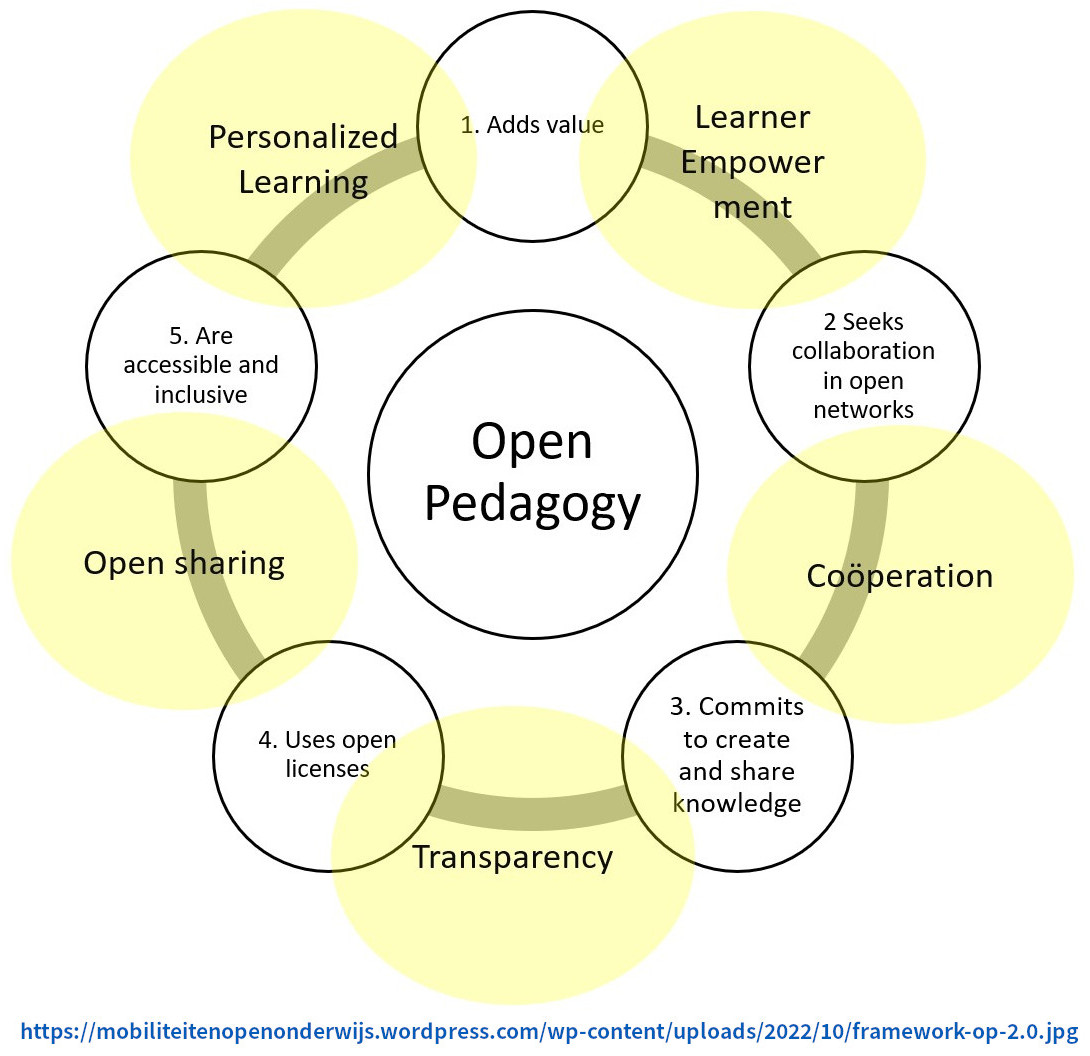
<p align="justify">“<b>Sư phạm Mở (Open Pedagogy)</b> có nhiều định nghĩa. Chúng tôi định nghĩa sư phạm mở như là các dự án hoặc bài tập có các đặc tính: tham gia với <b>người học như những người sáng tạo</b> thông tin thay vì chỉ đơn giản tiêu dùng nó; <b>học tập trải nghiệm</b> ở đó người học thể hiện sự hiểu biết thông qua hành động sáng tạo; mời người học trở thành một phần của quá trình giảng dạy/tham gia trong việc <b>đồng tạo lập kiến thức</b>; rời bỏ khỏi các bài tập sử dụng chỉ một lần để chuyển sang các bài tập <b>có vị trí</b>, <b>có tính cộng tác</b>, và <b>tái tạo lại được</b>; <b>Quyền tự quyết của người học</b> trong việc quyết định có chia sẻ công việc của mình hay không và chia sẻ như thế nào.” (<a href="https://oeproadmap.psu.edu/introduction-and-glossary/">Lộ trình của Dự án Sư phạm Mở</a>)</p>

<p align="justify">Thực hành Giáo dục Mở - OEP (Open Educational Practices), chẳng hạn như sư phạm mở, sử dụng TNGDM để mở rộng quyền tự do hàn lâm của các nhà giáo dục và cho phép họ trở thành các nhà giám tuyển và các nhà thiết kế nội dung khi lên kế hoạch cho chương trình giảng dạy của họ. Một số ví dụ về sư phạm mở là để sinh viên chú thích xã hội các bài báo học học thuật hoặc tạo một ngân hàng câu hỏi cho một sách giáo khoa mở. Khi thực hiện các hoạt động này, chúng ta có thể thu hẹp khoảng cách về khả năng tiếp cận và tạo ra nội dung khóa học công bằng có thể được chia sẻ và triển khai miễn phí trong các lớp học trên toàn thế giới.</p>

<p align="justify">Được liệt kê bên dưới là các tài nguyên và ý tưởng giúp bạn mạng các hoạt động giáo dục mở và sư phạm mở vào trong lớp học của bạn. Nếu bạn có các ý tưởng về một dự án hoặc muốn biết nhiều hơn về thực hành giáo dục mở hoặc sư phạm mở, hay nhấn vào đây để <a href="https://utrgv.libwizard.com/f/tapinfo">yêu cầu sự tư vấn</a>.</p>

<p align="justify"><b>Nguồn cảm hứng</b></p>

<ul>
	<li>
	<p align="justify"><a href="https://digscholarship.unco.edu/oer_resources/1/">Các công cụ để thúc đẩy Sư phạm Mở trong lớp học</a></p>

	<ul>
		<li>
		<p align="justify">Bộ công cụ giải thích nhiều phương pháp giảng dạy độc đáo thúc đẩy sư phạm mở. Bộ công cụ giải thích sư phạm mở và mối quan hệ của nó với TNGDM và có các tài nguyên bố sung và các bước tiếp sau nếu giảng viên muốn triển khai một số phương pháp đó.</p>
		</li>
	</ul>
	</li>
	<li>
	<p align="justify"><a href="http://openpedagogy.org/examples/">Ghi chép về Sư phạm Mở</a></p>

	<ul>
		<li>
		<p align="justify">Bộ sưu tập các dự án sư phạm mở các giảng viên đã tạo ra và đã triển khai trong các khóa học của họ.</p>
		</li>
	</ul>
	</li>
	<li>
	<p align="justify"><a href="https://milnepublishing.geneseo.edu/openpedagogyapproaches/">Các cách tiếp cận Sư phạm Mở: các trường hợp điển hình</a></p>

	<ul>
		<li>
		<p align="justify">Bộ sưu tập các trường hợp ở đó các nhân viên thư viện, giảng viên, và sinh viên đã cộng tác thành công như những đối tác thực sự trong việc giảng dạy trong lớp học bằng việc sử dụng một khung sư phạm mở. Xem bài viết với tiêu đề “<a href="https://milnepublishing.geneseo.edu/openpedagogyapproaches/chapter/whose-history-expanding-place-based-initiatives-through-open-collaboration/">Lịch sử của ai?: Mở rộng các sáng kiến dựa vào địa điểm thông qua cộng tác mở</a>” để xem dự án sư phạm mở do các giảng viên UTRGV dẫn dắt.</p>
		</li>
	</ul>
	</li>
	<li>
	<p align="justify"><a href="https://iastate.pressbooks.pub/oerstarterkit/chapter/considerations-open-pedagogy/">Bộ công cụ Khởi tạo </a><a href="https://iastate.pressbooks.pub/oerstarterkit/chapter/considerations-open-pedagogy/"><u>TNGDM</u></a><a href="https://iastate.pressbooks.pub/oerstarterkit/chapter/considerations-open-pedagogy/">: Cân nhắc sử dụng Sư phạm Mở</a></p>

	<ul>
		<li>
		<p align="justify">Chương sách này cung cấp những điều cân nhắc trước khi triển khai các hoạt động sư phạm mở trong khóa học của bạn.</p>
		</li>
	</ul>
	</li>
	<li>
	<p align="justify"><a href="https://press.rebus.community/makingopentextbookswithstudents/">Hướng dẫn làm sách giáo khoa mở với sinh viên</a></p>

	<ul>
		<li>
		<p align="justify">Sổ tay cho các giảng viên có quan tâm thực hành sư phạm mở bằng việc thu hút sinh viên vào làm sách giáo khoa mở, các tư liệu phụ trợ, hoặc các TNGDM khác.</p>
		</li>
	</ul>
	</li>
	<li>
	<p align="justify"><a href="https://courses.lumenlearning.com/suny-oercommunitycourse-understandingoer/chapter/embracing-open-pedagogy/">Ôm lấy Sư phạm Mở: Lumen Learning</a></p>

	<ul>
		<li>
		<p align="justify">Học phần này cung cấp tổng quan các hoạt động sư phạm mở và các ý tưởng cấy ghép.</p>
		</li>
	</ul>
	</li>
	<li>
	<p align="justify"><a href="https://wikiedu.org/">Wiki Education</a></p>

	<ul>
		<li>
		<p align="justify">Học nhiều hơn về cách để thu hút sinh viên vào việc chia sẻ kiến thức với công chúng nói chung thông qua Wikipedia, Wikidata, và các dự án cộng tác mở khác trên web.</p>
		</li>
	</ul>
	</li>
	<li>
	<p align="justify"><a href="https://outreach.wikimedia.org/wiki/File:Wikipedia_Education_Program_Case_Studies.pdf">Các trường hợp điển hình: Các giáo sư đang giảng dạy với Wikip</a><a href="https://outreach.wikimedia.org/wiki/File:Wikipedia_Education_Program_Case_Studies.pdf">edia như thế nào</a></p>

	<ul>
		<li>
		<p align="justify">Trong sách này, các giáo sư khắp trên thế giới sẽ giải thích các bài tập trên Wikipedia họ đã sử dụng để đáp ứng các mục tiêu học tập cho các khóa học của họ. Họ cũng sẽ giải thích cách họ đã chấm điểm các bài tập đó.</p>
		</li>
	</ul>
	</li>
</ul>

<p align="justify"><b>Các nguồn và ví dụ về Sư phạm Mở</b></p>

<p align="justify"><b>Các bài tập ví dụ </b></p>

<ul>
	<li>
	<p align="justify"><span style="font-weight: normal">Tạo </span><span style="font-weight: normal">video hướng dẫn về một chủ đề hoặc bài tập từ lớp học. </span></p>
	</li>
	<li>
	<p align="justify" style="font-weight: normal">Các ví dụ làm việc cung cấp cho các sinh viên khác các mẫu template từng bước một về cách để giải quyết các vấn đề.</p>
	</li>
	<li>
	<p align="justify"><span style="font-weight: normal">Giáo trình cộng tác hoặc <a href="https://ablconnect.harvard.edu/book/blank-syllabus">Bài tập về Giáo trình Trống</a> </span></p>
	</li>
	<li>
	<p align="justify"><span style="font-weight: normal">Tạo ra các trò chơi để những </span><span style="font-weight: normal">người học các thế hệ sau chơi nhằm giúp họ chuẩn bị, hoặc đào sâu việc học tập của họ về các chủ đề cụ thể. </span></p>
	</li>
	<li>
	<p align="justify" style="font-weight: normal">Tạo ra các hướng dẫn để hướng dẫn các sinh viên khác qua danh sách đọc hoặc các bài giảng.</p>
	</li>
	<li>
	<p align="justify"><span style="font-weight: normal">Các bài trình chiếu dựa vào </span><span style="font-weight: normal">video hoặc được viết ra mà tóm tắt một ý tưởng. </span></p>
	</li>
	<li>
	<p align="justify">Các bài đăng trên blog</p>

	<ul>
		<li>
		<p align="justify"><a href="https://recipes.hypotheses.org/tag/ug-series">Dự án về các bí quyết cho sinh viên đại học</a></p>
		</li>
	</ul>
	</li>
	<li>
	<p align="justify">Chú thích xã hội</p>

	<ul>
		<li>
		<p align="justify"><a href="https://academictech.uchicago.edu/2021/03/03/social-annotation-and-the-pedagogy-of-hypothesis/">Chú thích xã hội và sư phạm của Hypo</a><a href="https://academictech.uchicago.edu/2021/03/03/social-annotation-and-the-pedagogy-of-hypothesis/">thes.is</a></p>
		</li>
		<li>
		<p align="justify"><a href="https://web.hypothes.is/education/examples-of-classroom-use/"><span style="font-weight: normal">Sử dụng Hypo</span></a><span style="font-weight: normal"><a href="https://web.hypothes.is/education/examples-of-classroom-use/">thes.is trong lớp học</a> </span></p>
		</li>
	</ul>
	</li>
</ul>

<p align="justify">“Các ví dụ bài tập”, là một dẫn xuất của “Hiểu biết TNGDM”. <b>Được cung cấp bởi</b>: Các dịch vụ TNGDM của SUNY. <b>Có tại</b>: <a href="https://oer.suny.edu/" target="_blank">https://oer.suny.edu/</a>. Dự án: Khóa học của cộng đồng TNGDM. <b>Giấy phép</b>: <a href="https://creativecommons.org/licenses/by/4.0/" target="_blank">CC BY: </a><a href="https://creativecommons.org/licenses/by/4.0/" target="_blank"><u>Ghi công</u></a>. &quot;<a href="https://www.utrgv.edu/textbook-affordability-project/resources-and-support/teaching-with-open-pedagogy/index.htm" target="_blank"><u>Các ví dụ bài tập</u></a>&quot; được cấp giấy phép <a href="https://creativecommons.org/licenses/by/4.0/" target="_blank">CC BY 4.0</a> của Natalie Young</p>

<p align="justify"><b>Các ví dụ dự án </b></p>

<ul>
	<li>
	<p align="justify">Kho bài kiểm tra: sinh viên tạo lập các câu hỏi cho kho bài kiểm tra</p>
	</li>
	<li>
	<p align="justify">Đa dạng và Toàn diện: thêm các quan điểm đa dạng về TNGDM hiện có.</p>
	</li>
	<li>
	<p align="justify">Tùy chỉnh sách giáo khoa: Biến TNGDM nghiên cứu chung thành văn bản có nội dung cụ thể.</p>
	</li>
	<li>
	<p align="justify">Các thuật ngữ chính: Tạo một bảng thuật ngữ chính cho TNGDM còn chưa có bảng thuật ngữ.</p>
	</li>
	<li>
	<p align="justify">Những người đóng góp cho Wikipedia: Cập nhật hoặc tạo lập thông tin về một chủ đề khóa học.</p>

	<ul>
		<li>
		<p align="justify"><a href="https://commons.wikimedia.org/w/index.php?title=File%3ACase_Studies%2C_How_instructors_are_teaching_with_Wikipedia_(Wiki_Education_Foundation).pdf&amp;page=1">Các giảng viên đang giảng dạy với Wikip</a><a href="https://commons.wikimedia.org/w/index.php?title=File%3ACase_Studies%2C_How_instructors_are_teaching_with_Wikipedia_(Wiki_Education_Foundation).pdf&amp;page=1">edia như thế nào</a></p>
		</li>
	</ul>
	</li>
	<li>
	<p align="justify">Câu chuyện sinh viên: Giám tuyển nội dung xung quanh triển vọng độc đáo của sinh viên khi tiếng nói của họ theo truyền thống không được đại diện đầy đủ.</p>
	</li>
	<li>
	<p align="justify">Quản điểm lịch sử: Để sinh viên thu thập các chế tác lịch sử từ gia đình hoặc thư viện cộng đồng của họ và viết về lịch sử một chế tác. Điều này cũng có thể được sử dụng để làm kế hoạch bài giảng lịch sử TEKS. (Ví dụ: <a href="https://omeka.utrgv.edu/rgvprimarysourceguides" target="_blank">Hướng dẫn nguồn chính của Rio Grande Valley</a>)</p>
	</li>
	<li>
	<p align="justify">Đóng góp cho các dự án hiện có: <a href="https://press.rebus.community/openamlit/front-matter/help-expand-the-anthology/" target="_blank">Tuyển tập mở về văn học Mỹ thời kỳ đầu</a></p>
	</li>
	<li>
	<p align="justify"><span style="font-weight: normal">Sách giáo khoa mở do sinh viên tạo ra: <a href="https://linghispintro.pressbooks.com/" target="_blank">La lingüística hispánica: Una introducció</a>n </span></p>
	</li>
</ul>

<p align="justify"><b>Các câu hỏi thường gặp </b></p>

<p align="justify"><b>Sư phạm mở liên quan đến TNGDM như thế nào?</b></p>

<p align="justify">Thường thì, sư phạm mở bao gồm việc tạo lập, sử dụng, hoặc sửa lại TNGDM. Robin DeRosa và Scott Robison (2017) gợi ý rằng “Khi chúng ta nghĩ về TNGDM chỉ như tài nguyên kỹ thuật số miễn phí, như các sản phẩm, … chúng ta phần lớn bỏ qua cơ hội trao quyền cho người học của chúng ta, để giúp họ thấy nội dung như thứ gì đó họ có thể giám tuyển và sáng tạo, và để giúp họ thấy bản thân như là những thành viên đóng góp cho thị trường công cộng các ý tưởng”.</p>

<p align="justify">DeRosa, R và Robison S. 2017. Từ TNGDM đến Sư phạm Mở: Khai thác sức mạnh của Mở. Trong: Jhangiani, R S và Biswas-Diener, R. (eds.) Mở: Triết lý và Thực hành đang cách mạng hóa giáo dục và <span style="font-weight: normal">khoa học</span>. Các trang 115-124. Luân Đôn: Ubiquity Press. DOI: <a href="https://doi.org/10.5334/bbc.i">https://doi.org/10.5334/bbc.i</a>. Giấy phép: CC-BY 4.0</p>

<p align="justify"><b>Các bài tập sử dụng một lần so với các bài tập tái tạo lại được là gì?</b></p>

<p align="justify"><span style="font-weight: normal">Các bài tập sử dụng một lần là các bài tập mà một sinh viên bỏ ra nhiều giờ tạo lập, một giảng viên chấm điểm cho nó, và sau đó sinh viên này có khả năng xem lại phản hồi và vứt bỏ hoặc xóa bài tập đó. Ngay cả dù chúng là dạng các bài tập và </span><span style="font-weight: normal">đánh giá mà sinh viên quen sử dụng, nếu họ thực sự dừng nghĩ về tất cả công việc họ đặt vào bài tập đó chỉ để vứt bỏ nó, họ có lẽ bắt đầu oán giận hệ thống đó. Mặt khác, các bài tập tái tạo lại được, liên quan đến sự hiểu biết rằng công việc của sinh viên sẽ không bị vứt bỏ khi kết thúc quá trình đó, mà thay vào đó sẽ đóng góp cho kiến thức tập thể theo vài cách thức. </span><span style="font-weight: normal">(<a href="https://via.hypothes.is/https://opencontent.org/blog/archives/4691">Hướng đến các </a></span><a href="https://via.hypothes.is/https://opencontent.org/blog/archives/4691"><span style="font-weight: normal">đánh giá tái tạo lại được</span></a><span style="font-weight: normal">)</span></p>

<p align="justify"><span style="font-weight: normal">Bạn có thể thấy mẫu template bài tập tái tạo lại được đặc thù môn học với phiếu đánh giá <a href="https://openedgroup.org/doer-fellows-renewable-assignments">ở đây</a>.</span></p>

<p align="justify"><b>Bạn có được sự cho phép từ sinh viên để sử dụng tác phẩm của họ trước khi bắt đầu một dự án sư phạm mở?</b></p>

<p align="justify">Bất cứ khi nào bạn muốn sử dụng tác phẩm của sinh viên - dù cho các mục đích nghiên cứu hay sư phạm - bạn phải hỏi sự cho phép của sinh viên. Chúng tôi khuyên bạn nên dành thời gian vào đầu khóa học để thông báo cho sinh viên về cách thức chia sẻ bài tập của họ nếu họ chọn tham gia các dự án sư phạm mở đối mặt với công chúng. Trong thời gian này, bạn có thể phân phối các miễn trừ FERPA, nếu có, và cung cấp các bài tập thay thế hoặc các cách chia sẻ tác phẩm của họ mà không đính kèm thông tin cá nhân của họ vào đó nếu đây là mối lo ngại. Bạn cũng nên xác định rõ ràng trong giáo trình về cách thức và địa điểm chia sẻ nội dung khóa học do sinh viên tạo ra.</p>

<p align="justify">Sinh viên cũng nên nhận được chỉ dẫn về cách để loại bỏ tên của họ khỏi các tài liệu công khai trong tương lai nếu học quyết định họ không còn muốn có liên quan đến tác phẩm đó nữa.</p>

<p align="justify">Để biết thêm thông tin về chủ đề quyền riêng tư của sinh viên và các ví dụ về cách các giảng viên bảo vệ quyền riêng tư của sinh viên trong các dự án sư phạm mở của mình, hãy xem các tài nguyên này.</p>

<ul>
	<li>
	<p align="justify"><a href="https://iastate.pressbooks.pub/oerstarterkit/chapter/considerations-open-pedagogy/">Bộ công cụ khởi tạo TNGDM: Các cân nhắc sử dụng Sư phạm Mở</a></p>
	</li>
	<li>
	<p align="justify"><a href="https://humtech.ucla.edu/news/a-student-collaborators-bill-of-rights/">Tuyên bố về quyền của cộng tác viên sinh viên</a></p>
	</li>
	<li>
	<p align="justify"><a href="https://press.rebus.community/makingopentextbookswithstudents/chapter/privacy-anonymity/">Hướng dẫn tạo lập sách giáo khoa mở với sinh viên: Quyền riêng tư </a><a href="https://press.rebus.community/makingopentextbookswithstudents/chapter/privacy-anonymity/">&amp; ẩn danh</a></p>
	</li>
</ul>

<p align="justify"><b>Tôi phải làm gì nếu sinh viên không muốn tác phẩm của họ sẵn sàng công khai?</b></p>

<p align="justify">Trong khi một số sinh viên sẽ hồ hởi với ý tưởng rằng bài tập về nhà của họ có thể được nhìn thấy, được sử dụng, hoặc thậm chí được cải thiện bởi các sinh viên tương lai trong một lớp học, thì những sinh viên khác có thể cảm thấy không thoải mái với bước này. Việc cho phép sinh viên lựa chọn không tham gia làm cho tư liệu của họ công khai nếu họ không chắc chắn về việc làm như vậy và trao cho họ lựa chọn loại bỏ tên của họ khỏi các tài liệu công khai nếu họ không chắc chắn về điều này vì bất kỳ lý do nào (<a href="https://iastate.pressbooks.pub/oerstarterkit/chapter/considerations-open-pedagogy/">Bộ công cụ Khởi tạo </a><a href="https://iastate.pressbooks.pub/oerstarterkit/chapter/considerations-open-pedagogy/"><u>TNGDM</u></a><a href="https://iastate.pressbooks.pub/oerstarterkit/chapter/considerations-open-pedagogy/">: Cân nhắc sử dụng Sư phạm Mở</a>).</p>

<p align="justify"><b>Làm thế nào tôi có thể chắc chắn sinh viên của mình biết các thực hành trích dẫn và cấp phép đúng cách khi làm việc về tư liệu công khai hoặc được cấp phép mở?</b></p>

<p align="justify"><span style="font-weight: normal">Là quan trọng rằng sinh viên đang sáng tạo các hạng mục có thể được xuất bản và chia sẻ mở có thể hiểu mở có ý nghĩa gì. Nếu bạn không thoải mái thảo luận về bản quyền và trích dẫn với sinh viên của mình, hãy lên lịch <a href="https://utrgv.libwizard.com/f/tapinfo">tham vấn</a> với Thư viện Đại học và một </span><span style="font-weight: normal">thủ thư sẽ hạnh phúc đến thăm lớp học của bạn để làm cho quá trình đó dễ dàng hơn. </span></p>

<p align="justify"><span style="font-weight: normal">Đáng lưu ý rằng sinh viên quen nói về việc “trích dẫn nguồn của họ” khi viết học thuật, mặc dù trong thế giới TNGDM việc trích dẫn các tư liệu được cấp phép mở thường được tham chiếu tới như là sự “ghi công”. Trích dẫn và ghi công hoàn thành cùng một mục tiêu thừa nhận các tác giả cho </span><span style="font-weight: normal">nội dung và ý tưởng của họ, vì thế là quan trọng rằng sinh viên biết chính xác làm thế nào và khi nào trích dẫn các nguồn của họ. Có thể hữu ích trong một dự án sư phạm mở để sinh viên của bạn thực hành cả các dạng trích dẫn (ví dụ, MLA + Ghi công) vì họ có thể hưởng lợi từ thực hành với cả hai. Khi trích dẫn các tư liệu được cấp phép mở, bạn có thể hướng sinh viên đến <a href="http://www.openwa.org/open-attrib-builder/">Trình xây dựng Ghi công Mở</a> hoặc dạy họ phương pháp Tiêu đề, Tác giả, Nguồn, Giấy phép - TASL (Title, Author, Source, License) như được giải thích <a href="https://wiki.creativecommons.org/wiki/best_practices_for_attribution">ở đây</a>. Ngoài ra, Đại học Indiana đã tạo ra <a href="https://plagiarism.iu.edu/">các học phần</a></span><a href="https://plagiarism.iu.edu/"><u><span style="font-weight: normal"> về đạo văn</span></u></a><span style="font-weight: normal"><a href="https://plagiarism.iu.edu/"> hướng đến sinh viên</a> để giúp họ học cách nhận biết đạo văn và tránh nó khi họ viết bài. </span></p>

<p align="justify"><b>Nghiên cứu nào là có sẵn về sư phạm mở?</b></p>

<p align="justify"><a href="https://docs.google.com/document/d/1A0KWQiEAU_UTf4DXWbmMXZvcEDfHjn8n/edit?usp=sharing&amp;ouid=115439513278049636469&amp;rtpof=true&amp;sd=true">Hướng dẫn Giảng viên về Sư phạm Mở</a> trình bày các phương pháp sư phạm mở khác nhau và các nghiên cứu về từng phương pháp này.</p>

<p align="justify"><b>Tôi muốn làm một dự án sư phạm mở trong khóa học của mình nhưng không biết bắt đầu từ đâu </b></p>

<p align="justify" style="font-weight: normal">Việc lên kế hoạch về phạm vi và các chi tiết cho dự án sư phạm mở của bạn là bước quan trọng đầu tiên. Bạn có thể <a href="https://utrgv.libwizard.com/f/tapinfo">yêu cầu sự tham vấn</a> từ một thủ thư có kiến thức về dự án của bạn và nên cân nhắc làm việc qua các học phần <a href="https://oeproadmap.psu.edu/">Lộ trình Dự án Sư phạm Mở</a> trước khi bắt đầu một dự án với sinh viên.</p>

<p align="justify"><span style="background: rgb(255, 255, 0);">Open education consists of a broad spectrum of practices that encompass the idea of sharing. The collaborative creation of knowledge, research, and learning materials, that are freely shared, benefits us all.&nbsp;</span></p>

<p align="justify"><strong><i><span style="background: rgb(255, 255, 0);">&quot;Open</span></i></strong><strong><span style="background: rgb(255, 255, 0);"> </span></strong><strong><i><span style="background: rgb(255, 255, 0);">pedagogy</span></i></strong><strong><span style="background: rgb(255, 255, 0);"> </span></strong><span style="background: rgb(255, 255, 0);">has many definitions. We are defining open pedagogy as projects or assignments which have the characteristics of: engaging with </span><strong><span style="background: rgb(255, 255, 0);">students as creators </span></strong><span style="background: rgb(255, 255, 0);">of information rather than simply consumers of it; </span><strong><span style="background: rgb(255, 255, 0);">experiential learning </span></strong><span style="background: rgb(255, 255, 0);">in which students demonstrate understanding through the act of creation; inviting students to be part of the teaching process/participating in the </span><strong><span style="background: rgb(255, 255, 0);">co-creation of knowledge; </span></strong><span style="background: rgb(255, 255, 0);">moving away from single-use assignments in favor of </span><strong><span style="background: rgb(255, 255, 0);">situated</span></strong><span style="background: rgb(255, 255, 0);"> , </span><strong><span style="background: rgb(255, 255, 0);">collaborative</span></strong><span style="background: rgb(255, 255, 0);"> , and </span><strong><span style="background: rgb(255, 255, 0);">renewable</span></strong><span style="background: rgb(255, 255, 0);"> ones; </span><strong><span style="background: rgb(255, 255, 0);">Student agency </span></strong><span style="background: rgb(255, 255, 0);">in deciding if and how their work is shared .&quot; (<a href="https://oeproadmap.psu.edu/introduction-and-glossary/" target="_blank">The Open Pedagogy Project Roadmap</a>)</span></p>

<p align="justify"><span style="background: rgb(255, 255, 0);">Open Educational Practices (OEP), such as open pedagogy, utilize open educational resources (OER) to expand the academic freedom of educators and allow them to become curators and content designers when planning out their curriculum. Some examples of open pedagogy would be to have students socially annotate scholarly articles or create a test bank of questions for an open textbook. In implementing these practices, we can close accessibility gaps and create equitable course content which can be freely shared and implemented in classrooms around the world.</span></p>

<p align="justify"><span style="background: rgb(255, 255, 0);">Listed below are resources and ideas to help you bring open educational practices and open pedagogy into your classroom. If you have ideas about a project or would like to learn more about open educational practices or open pedagogy click here to <a href="https://utrgv.libwizard.com/f/tapinfo" target="_blank">request a consultation</a>.</span></p>

<p align="justify"><b><span style="background: rgb(255, 255, 0);">Resources for Inspiration </span></b></p>

<ul>
	<li>
	<p align="justify" style="margin-bottom: 0cm"><span style="background: rgb(255, 255, 0);"><a href="https://digscholarship.unco.edu/oer_resources/1/">Tools to Promote Open Pedagogy in the Classroom</a> </span></p>

	<ul>
		<li>
		<p align="justify"><span style="background: rgb(255, 255, 0);">A toolkit explaining multiple distinct teaching methods that promote open pedagogy. The toolkit explains open pedagogy and its relationship to OER and has additional resources and next steps if faculty want to implement some of these methods. </span></p>
		</li>
	</ul>
	</li>
</ul>

<ul>
	<li>
	<p align="justify" style="margin-bottom: 0cm"><span style="background: rgb(255, 255, 0);"><a href="http://openpedagogy.org/examples/" target="_blank">Open Pedagogy Notebook</a> </span></p>

	<ul>
		<li>
		<p align="justify"><span style="background: rgb(255, 255, 0);">A collection of open pedagogy projects that faculty have created and implemented in their courses. </span></p>
		</li>
	</ul>
	</li>
</ul>

<ul>
	<li>
	<p align="justify" style="margin-bottom: 0cm"><span style="background: rgb(255, 255, 0);"><a href="https://milnepublishing.geneseo.edu/openpedagogyapproaches/" target="_blank">Open Pedagogy Approaches: Case Studies</a> </span></p>

	<ul>
		<li>
		<p align="justify"><span style="background: rgb(255, 255, 0);">A collection of cases where library staff, faculty, and students have successfully collaborated as true partners in classroom instruction using an open pedagogy framework. View the article titled &quot;<a href="https://milnepublishing.geneseo.edu/openpedagogyapproaches/chapter/whose-history-expanding-place-based-initiatives-through-open-collaboration/" target="_blank">Whose History?: Expanding Place-Based Initiatives Through Open Collaboration</a>&quot; to see a UTRGV faculty-led open pedagogy project.</span></p>
		</li>
	</ul>
	</li>
	<li>
	<p align="justify" style="margin-bottom: 0cm"><span style="background: rgb(255, 255, 0);"><a href="https://iastate.pressbooks.pub/oerstarterkit/chapter/considerations-open-pedagogy/" target="_blank">OER Starter Kit: Considerations for Using Open Pedagogy</a> </span></p>

	<ul>
		<li>
		<p align="justify"><span style="background: rgb(255, 255, 0);">This book chapter provides things to consider before implementing open pedagogical practices in your course.</span></p>
		</li>
	</ul>
	</li>
	<li>
	<p align="justify" style="margin-bottom: 0cm"><span style="background: rgb(255, 255, 0);"><a href="https://press.rebus.community/makingopentextbookswithstudents/" target="_blank">A Guide to Making Open Textbooks with Students</a> </span></p>

	<ul>
		<li>
		<p align="justify"><span style="background: rgb(255, 255, 0);">A handbook for faculty interested in practicing open pedagogy by involving students in the making of open textbooks, ancillary materials, or other Open Educational Resources.</span></p>
		</li>
	</ul>
	</li>
	<li>
	<p align="justify" style="margin-bottom: 0cm"><span style="background: rgb(255, 255, 0);"><a href="https://courses.lumenlearning.com/suny-oercommunitycourse-understandingoer/chapter/embracing-open-pedagogy/" target="_blank">Embracing Open Pedagogy: Lumen Learning</a> </span></p>

	<ul>
		<li>
		<p align="justify"><span style="background: rgb(255, 255, 0);">This learning module provides an overview of open pedagogical practices and implantation ideas.</span></p>
		</li>
	</ul>
	</li>
	<li>
	<p align="justify" style="margin-bottom: 0cm"><span style="background: rgb(255, 255, 0);"><a href="https://wisc.pb.unizin.org/oersourcebook/" target="_blank">The OER Activity Sourcebook: An Interactive Resource Guide</a> </span></p>

	<ul>
		<li>
		<p align="justify"><span style="background: rgb(255, 255, 0);">This is an evolving resource intended to provide inspiration for instructors who use Open Educational Resources for their teaching. </span></p>
		</li>
	</ul>
	</li>
</ul>

<ul>
	<li>
	<p align="justify" style="margin-bottom: 0cm"><span style="background: rgb(255, 255, 0);"><a href="https://wikiedu.org/" target="_blank">Wiki Education</a> </span></p>

	<ul>
		<li>
		<p align="justify"><span style="background: rgb(255, 255, 0);">Learn more about how to engage students in sharing their knowledge with the general public through Wikipedia, Wikidata, and other open collaboration projects on the web.</span></p>
		</li>
	</ul>
	</li>
	<li>
	<p align="justify" style="margin-bottom: 0cm"><span style="background: rgb(255, 255, 0);"><a href="https://outreach.wikimedia.org/wiki/File:Wikipedia_Education_Program_Case_Studies.pdf" target="_blank">Case Studies: How professors are teaching with Wikipedia</a> </span></p>

	<ul>
		<li>
		<p align="justify"><span style="background: rgb(255, 255, 0);">In this brochure, professors around the world will explain Wikipedia assignments they’ve used to meet learning objectives for their courses. They will also explain how they graded these assignments.&nbsp; </span></p>
		</li>
	</ul>
	</li>
</ul>

<p align="justify"><b><span style="background: rgb(255, 255, 0);">Open Pedagogy Resources and Examples</span></b></p>

<p align="justify"><b><span style="background: rgb(255, 255, 0);">Assignment Examples</span></b></p>

<ul>
	<li>
	<p align="justify"><span style="background: rgb(255, 255, 0);">Make a tutorial video over a topic or assignment from class. </span></p>
	</li>
</ul>

<ul>
	<li>
	<p align="justify"><span style="background: rgb(255, 255, 0);">Worked examples that provide other students with step-by-step templates of how to do problems. </span></p>
	</li>
</ul>

<ul>
	<li>
	<p align="justify"><span style="background: rgb(255, 255, 0);">Collaborative Syllabus or <a href="https://ablconnect.harvard.edu/book/blank-syllabus" target="_blank">Blank Syllabus Assignment</a> </span></p>
	</li>
</ul>

<ul>
	<li>
	<p align="justify"><span style="background: rgb(255, 255, 0);">Create games to be played by future generations of learners to help them prepare for, or deepen their learning on, specific topics. </span></p>
	</li>
</ul>

<ul>
	<li>
	<p align="justify"><span style="background: rgb(255, 255, 0);">Create guides to direct other students through readings or lectures. </span></p>
	</li>
</ul>

<ul>
	<li>
	<p align="justify"><span style="background: rgb(255, 255, 0);">Written or video-based presentations that summarize an idea. </span></p>
	</li>
</ul>

<ul>
	<li>
	<p align="justify"><span style="background: rgb(255, 255, 0);">Blog posts </span></p>

	<ul>
		<li>
		<p align="justify"><span style="background: rgb(255, 255, 0);"><a href="https://recipes.hypotheses.org/tag/ug-series" target="_blank">The Recipes Project Undergraduate Series</a> </span></p>
		</li>
	</ul>
	</li>
</ul>

<ul>
	<li>
	<p align="justify"><span style="background: rgb(255, 255, 0);">Social annotation </span></p>

	<ul>
		<li>
		<p align="justify"><span style="background: rgb(255, 255, 0);"><a href="https://academictech.uchicago.edu/2021/03/03/social-annotation-and-the-pedagogy-of-hypothesis/" target="_blank">Social Annotation and the Pedagogy of Hypothesis.is</a> </span></p>
		</li>
		<li>
		<p align="justify"><span style="background: rgb(255, 255, 0);"><a href="https://web.hypothes.is/education/examples-of-classroom-use/" target="_blank">Using Hypothes.is in the Classroom</a> </span></p>
		</li>
	</ul>
	</li>
</ul>

<p align="justify"><span style="background: rgb(255, 255, 0);">&quot;Assignment Examples&quot;, is a derivative of &quot;Understanding OER&quot;. </span><strong><span style="background: rgb(255, 255, 0);">Provided by</span></strong><span style="background: rgb(255, 255, 0);">: SUNY OER Services. </span><strong><span style="background: rgb(255, 255, 0);">Located at</span></strong><span style="background: rgb(255, 255, 0);">: <a href="https://oer.suny.edu/" target="_blank">https://oer.suny.edu/</a>. Project: OER Community Course. </span><strong><span style="background: rgb(255, 255, 0);">License</span></strong><span style="background: rgb(255, 255, 0);">: <a href="https://creativecommons.org/licenses/by/4.0/" target="_blank">CC BY: Attribution</a>. &quot;<a href="https://www.utrgv.edu/textbook-affordability-project/resources-and-support/teaching-with-open-pedagogy/index.htm" target="_blank">Assignment Examples</a>&quot; is licensed under <a href="https://creativecommons.org/licenses/by/4.0/" target="_blank">CC BY 4.0</a> by Natalie Young </span></p>

<p align="justify"><b><span style="background: rgb(255, 255, 0);">Project Examples</span></b></p>

<ul>
	<li>
	<p align="justify"><span style="background: rgb(255, 255, 0);">Test Banks: students create test bank questions </span></p>
	</li>
	<li>
	<p align="justify"><span style="background: rgb(255, 255, 0);">Diversity and Inclusion: Add diverse points of view to existing OER. </span></p>
	</li>
	<li>
	<p align="justify"><span style="background: rgb(255, 255, 0);">Textbook Adaptation: Turn a general studies OER into a content-specific text. </span></p>
	</li>
	<li>
	<p align="justify"><span style="background: rgb(255, 255, 0);">Key Terms: Create a glossary of key terms for an OER that does not have one. </span></p>
	</li>
	<li>
	<p align="justify"><span style="background: rgb(255, 255, 0);">Wikipedia Contributors: Update or create information on a course topic. </span></p>

	<ul>
		<li>
		<p align="justify"><span style="background: rgb(255, 255, 0);"><a href="https://commons.wikimedia.org/w/index.php?title=File%3ACase_Studies%2C_How_instructors_are_teaching_with_Wikipedia_(Wiki_Education_Foundation).pdf&amp;page=1" target="_blank">How instructors are teaching with Wikipedia</a> </span></p>
		</li>
	</ul>
	</li>
	<li>
	<p align="justify"><span style="background: rgb(255, 255, 0);">Student Stories: Curate content around the unique perspective of students whose voices are traditionally underrepresented. </span></p>
	</li>
	<li>
	<p align="justify"><span style="background: rgb(255, 255, 0);">Historical Perspectives: Have students collect historical artifacts from their family or community library and write about the history of the artifact. This can also be used to make TEKS history lesson plans. (Example: <a href="https://omeka.utrgv.edu/rgvprimarysourceguides" target="_blank">Rio Grande Valley Primary Souce Guides</a>) </span></p>
	</li>
	<li>
	<p align="justify"><span style="background: rgb(255, 255, 0);">Contribute to Existing Projects: <a href="https://press.rebus.community/openamlit/front-matter/help-expand-the-anthology/" target="_blank">Open Anthology of Earlier American Literature</a> </span></p>
	</li>
	<li>
	<p align="justify"><span style="background: rgb(255, 255, 0);">Student-authored Open Textbooks:&nbsp;<a href="https://linghispintro.pressbooks.com/" target="_blank">La lingüística hispánica: Una introducció</a>n </span></p>
	</li>
</ul>

<p align="justify"><b><span style="background: rgb(255, 255, 0);">Frequently Asked Questions</span></b></p>

<p align="justify"><b><span style="background: rgb(255, 255, 0);">How does open pedagogy relate to OER?</span></b></p>

<p align="justify"><span style="background: rgb(255, 255, 0);">Often, open pedagogy includes the creation, use, or revision of Open Educational Resources. Robin DeRosa and Scott Robison (2017) suggest that “when we think of OER as just free digital stuff, as products,... we largely miss out on the opportunity to empower our students, to help them see content as something they can curate and create, and to help them see themselves as contributing members to the public marketplace of ideas.”&nbsp;</span></p>

<p align="justify"><span style="background: rgb(255, 255, 0);">DeRosa, R and Robison S. 2017. From OER to Open Pedagogy: Harnessing the Power of Open. In: Jhangiani, R S and Biswas-Diener, R. (eds.) Open: The Philosophy and Practices that are Revolutionizing Education and Science. Pp. 115–124. London: Ubiquity Press. DOI: https://doi.org/10.5334/bbc.i. License: CC-BY 4.0</span></p>

<p align="justify"><b><span style="background: rgb(255, 255, 0);">What are single-use assignments vs. renewable assignments?</span></b></p>

<p align="justify"><span style="background: rgb(255, 255, 0);">Single-use (or disposable) assignments are assignments that a student spends hours creating, a teacher grades it, and then the student likely reviews feedback and throws the assignment away or deletes it. Even though these are the kinds of assignments and assessments students are used to, if they really stopped to think about all the work they put into the assignment only to discard it, they might begin to resent the system. Renewable assignments, on the other hand, involve an understanding that the student’s work won’t be discarded at the end of the process, but will instead contribute to collective knowledge in some way. (<a href="https://via.hypothes.is/https://opencontent.org/blog/archives/4691" target="_blank">Towards Renewable Assessments</a>)</span></p>

<p align="justify"><span style="background: rgb(255, 255, 0);">You can find disciple-specific renewable assignment templates with rubrics <a href="https://openedgroup.org/doer-fellows-renewable-assignments" target="_blank">here</a>.</span></p>

<p align="justify"><b><span style="background: rgb(255, 255, 0);">Do you have to get permission from students to use their work before starting an open pedagogical project?</span></b></p>

<p align="justify"><span style="background: rgb(255, 255, 0);">Any time you want to use student work-- whether for research or for pedagogical purposes-- you must ask for student permission. We recommend setting aside time at the beginning of your course to inform your students about exactly how their work will be shared if they opt-in to participating in public-facing open pedagogy projects. During this time, you can distribute FERPA waivers, if applicable, and offer alternative assignments or ways to share their work without attaching their personal information to it if this is a concern. It is also good to clearly define on your syllabus how and where student-created course content will be shared.</span></p>

<p align="justify"><span style="background: rgb(255, 255, 0);">Students should also be given instructions about how to remove their names from public documents in the future if they ever decide they no longer want to be associated with the work.</span></p>

<p align="justify"><span style="background: rgb(255, 255, 0);">For more information on the subject of student privacy rights and examples of how instructors have protected student privacy in their open pedagogy projects, check out these resources.</span></p>

<ul>
	<li>
	<p align="justify"><span style="background: rgb(255, 255, 0);"><a href="https://iastate.pressbooks.pub/oerstarterkit/chapter/considerations-open-pedagogy/" target="_blank">The OER Starter Kit: Considerations for Using Open Pedagogy</a> </span></p>
	</li>
	<li>
	<p align="justify"><span style="background: rgb(255, 255, 0);"><a href="https://humtech.ucla.edu/news/a-student-collaborators-bill-of-rights/" target="_blank">A Student Collaborators’ Bill of Rights</a> </span></p>
	</li>
	<li>
	<p align="justify"><span style="background: rgb(255, 255, 0);"><a href="https://press.rebus.community/makingopentextbookswithstudents/chapter/privacy-anonymity/" target="_blank">A Guide to Making Open Textbooks with Students: Privacy &amp; Anonymity</a> </span></p>
	</li>
</ul>

<p align="justify"><b><span style="background: rgb(255, 255, 0);">What do I do if a student does not want their work to be available to the public?</span></b></p>

<p align="justify"><span style="background: rgb(255, 255, 0);">While some students will be energized by the idea that their homework can be seen, used, or even improved upon by future students in the class, others may feel uncomfortable with this step. Allow students to opt out of making their materials public if they are uncertain about doing so and give them the option to remove their name from public documents if they are uncertain about this for any reason (<a href="https://iastate.pressbooks.pub/oerstarterkit/chapter/considerations-open-pedagogy/" target="_blank">The OER Starter Kit: Considerations for Using Open Pedagogy</a>). </span></p>

<p align="justify"><b><span style="background: rgb(255, 255, 0);">How can I be sure my students know proper citation and licensing practices when working on Openly Licensed or public material?</span></b></p>

<p align="justify"><span style="background: rgb(255, 255, 0);">It’s important that students who are creating items that might be published and shared openly can understand what open means. If you are uncomfortable about discussing copyright and citation with your students, schedule a <a href="https://utrgv.libwizard.com/f/tapinfo" target="_blank">consultation</a> with the University Library, and a librarian will happily visit your class to make the process easier.</span></p>

<p align="justify"><span style="background: rgb(255, 255, 0);">It’s also worth mentioning that students are used to talking about “citing their sources” when writing academically, however in the OER world citing openly licensed materials is usually referred to as “attribution.” Citation and attribution accomplish the same goal of crediting authors for their content and ideas, so it’s important that students know exactly how and when to cite their sources. It may be helpful in an open pedagogy project to have your students practice both forms of citation (i.e. MLA + Attribution) because they may benefit from practice with both. When citing openly licensed materials, you can direct students to this <a href="http://www.openwa.org/open-attrib-builder/" target="_blank">Open Attribution Builder</a> or teach them the TASL (Title, Author, Source, License) method which is explained <a href="https://wiki.creativecommons.org/wiki/best_practices_for_attribution" target="_blank">here</a>. Additionally, Indiana University created in-depth <a href="https://plagiarism.iu.edu/">student-oriented plagiarism modules</a> that help students learn how to recognize plagiarism and avoid it in their writing.</span></p>

<p align="justify"><b><span style="background: rgb(255, 255, 0);">What research is available about open pedagogy?</span></b></p>

<p align="justify"><span style="background: rgb(255, 255, 0);">The <a href="https://docs.google.com/document/d/1A0KWQiEAU_UTf4DXWbmMXZvcEDfHjn8n/edit?usp=sharing&amp;ouid=115439513278049636469&amp;rtpof=true&amp;sd=true" target="_blank">Faculty Guide to Open Pedagogy</a> presents different open pedagogical practices and research studies on each of these practices. </span></p>

<p align="justify"><b><span style="background: rgb(255, 255, 0);">I want to do an open pedagogy project in my course but don’t know where to start.</span></b></p>

<p align="justify"><span style="background: rgb(255, 255, 0);">Planning out the scope and details of your open pedagogy project is an important first step. You can <a href="https://utrgv.libwizard.com/f/tapinfo" target="_blank">request a consultation</a> from a knowledgeable librarian about your project and should consider working through the <a href="https://oeproadmap.psu.edu/">Open Pedagogy Project Roadmap</a> modules before beginning a project with students. </span></p>

<p align="justify">Dịch: Lê Trung Nghĩa</p>

<p align="justify">letrungnghia.foss@gmail.com</p>
		</div>
				<div id="author">
						<p>
				<strong>Tác giả:</strong>
				<a href="https://letrungnghia.mangvn.org/author/Nghia-Le-Trung/">Nghĩa Lê Trung</a>
			</p>
		</div>
	</div>
	<div id="footer" class="clearfix">
		<div id="url">
			<strong>URL của bản tin này: </strong><a href="https://letrungnghia.mangvn.org/savefile/Education/giang-day-voi-su-pham-mo-7506.html" title="Giảng dạy với Sư phạm Mở">https://letrungnghia.mangvn.org/savefile/Education/giang-day-voi-su-pham-mo-7506.html</a>

		</div>
		<div class="clear"></div>
		<div class="copyright">
			&copy; Blog FOSS by Lê Trung Nghĩa
		</div>
		<div id="contact">
			<a href="mailto:webmaster@vinades.vn">webmaster@vinades.vn</a>
		</div>
	</div>
</div>
        <div id="timeoutsess" class="chromeframe">
            Bạn đã không sử dụng Site, <a onclick="timeoutsesscancel();" href="https://letrungnghia.mangvn.org/#">Bấm vào đây để duy trì trạng thái đăng nhập</a>. Thời gian chờ: <span id="secField"> 60 </span> giây
        </div>
        <div id="openidResult" class="nv-alert" style="display:none"></div>
        <div id="openidBt" data-result="" data-redirect=""></div>
<div id="run_cronjobs" style="visibility:hidden;display:none;"><img alt="cron" src="/index.php?second=cronjobs&amp;p=q5eEMcdV" width="1" height="1" /></div>
<script src="https://letrungnghia.mangvn.org/assets/js/jquery/jquery.min.js"></script>
<script>var nv_base_siteurl="/",nv_lang_data="vi",nv_lang_interface="vi",nv_name_variable="nv",nv_fc_variable="op",nv_lang_variable="language",nv_module_name="news",nv_func_name="savefile",nv_is_user=0, nv_my_ofs=7,nv_my_abbr="+07",nv_cookie_prefix="nv4c_Cgoz2",nv_check_pass_mstime=1738000,nv_area_admin=0,nv_safemode=0,theme_responsive=0,nv_recaptcha_ver=2,nv_recaptcha_sitekey="6LcNwC8UAAAAAMm8ZTYNygweLUQtOU0IapbDRk69",nv_recaptcha_type="image",XSSsanitize=1;</script>
<script src="https://letrungnghia.mangvn.org/assets/js/language/vi.js"></script>
<script src="https://letrungnghia.mangvn.org/assets/js/DOMPurify/purify3.js"></script>
<script src="https://letrungnghia.mangvn.org/assets/js/global.js"></script>
<script src="https://letrungnghia.mangvn.org/assets/js/site.js"></script>
<script src="https://letrungnghia.mangvn.org/themes/default/js/news.js"></script>
<script src="https://letrungnghia.mangvn.org/themes/default/js/main.js"></script>
<script src="https://letrungnghia.mangvn.org/themes/default/js/custom.js"></script>
<script type="application/ld+json">
        {
            "@context": "https://schema.org",
            "@type": "Organization",
            "url": "https://letrungnghia.mangvn.org",
            "logo": "https://letrungnghia.mangvn.org/uploads/letrungnghia/le-trung-nghia.png"
        }
        </script>
<script src="https://letrungnghia.mangvn.org/themes/default/js/bootstrap.min.js"></script>
</body>
</html>