Tồi tệ nhất của cả 2 thế giới: Truy cập Mở Lai
- Thứ ba - 17/07/2018 07:25
- In ra
- Đóng cửa sổ này
The worst of both worlds: Hybrid Open Access
Lisa Matthias , 2018-06-26
*** Cảm ơn Mikael Laakso về phản hồi tuyệt vời**
*** Thank you to Mikael Laakso for the excellent feedback **
Theo: https://blogs.openaire.eu/?p=3431
Bài được đưa lên Internet ngày: 26/06/2018
Xem thêm: Khoa học Mở - Open Science
Vài tuần trước, Ủy ban châu Âu (EC) đã công bố bắt đầu với chương trình cấp vốn mới, Horizon Europe, họ sẽ không còn hoàn lại tiền các khoản phí xuất bản cho Truy cập Mở lai nữa. Trước đó, EC đã loại bỏ các khoản phí xử lý bài báo - APC (Article Processing Charges) lai (hybrid) khi họ lần đầu giới thiệu các vốn cấp Truy cập Mở trong dự án Thí điểm Truy cập Mở Sau - Trợ cấp của FP7, nhưng sau đó đã trang trải cho Truy cập Mở lai trong chương trình cấp vốn sau đó, Horizon 2020 (2014-2020).
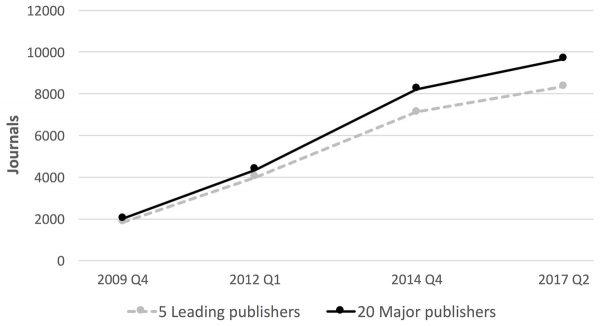
Truy cập Mở lai mô tả mô hình xuất bản nơi mà vài bài báo được làm cho sẵn sàng mở, ngược với thanh toán của APC, trong khi các bài báo khác vẫn là truy cập đóng, và tạp chí như là tổng thể dựa vào thuê bao. Các tạp chí lai đầu tiên được tung ra với Springer Open Choice (Lựa chọn Mở của Springer) và Wiley Online Open (Mở trên Trực tuyến của Wiley) vào năm 2004. Hai năm sau, mô hình xuất bản này đã được kết hợp qua Elsevier Open Access (Truy cập Mở của Elsevier), Sage Choice và Taylor & Francis Open Select, và Nature Publishing Group (NPG) Open đi theo sau vào năm 2007. Kể từ đó, số lượng các tạp chí Truy cập Mở (OA) lai đã tăng vùn vụt và đã vượt quá mốc 10.000, với 5 nhà xuất bản hàng đầu sở hữu đa số.
Số lượng các tạp chí Truy cập Mở lai 2009-2017 [Nguồn]
Björk quy cho sự gia tăng gần đây “với 2 sự thay đổi chính trong hạ tầng cấp vốn. Trước tiên, vài nhà cấp vốn nghiên cứu hàng đầu đã thiết lập các vốn cấp tập trung cho việc thanh toán các APC; và thứ hai, dạng mới các giấy phép thuê bao điện tử theo nhóm cũng gồm thanh toán các APC lai đã nổi lên” (Björk, 2017). Hơn nữa, vài nhà cấp vốn đã giới thiệu các chỉ thị Truy cập Mở, yêu cầu các bên hưởng lợi làm cho các kết quả đầu ra nghiên cứu của họ sẵn sàng mở trong khung thời gian nhất định (như, 6 hoặc 12 tháng đối với Horizon 2020, phụ thuộc vào lĩnh vực), điều có lẽ không tuân thủ với giai đoạn cấm vận của nhà xuất bản, thường trải từ 6 – 24 tháng. Tuy nhiên, thú vị và không ngạc nhiên là sự quan sát thấy rằng với số lượng ngày càng gia tăng các chỉ thị Truy cập Mở của các cơ sở và các nhà cấp vốn, các hạn chế xung quanh việc tự lưu trữ cũng đã gia tăng (xem Laakso, 2014 và Gadd et al., 2016).
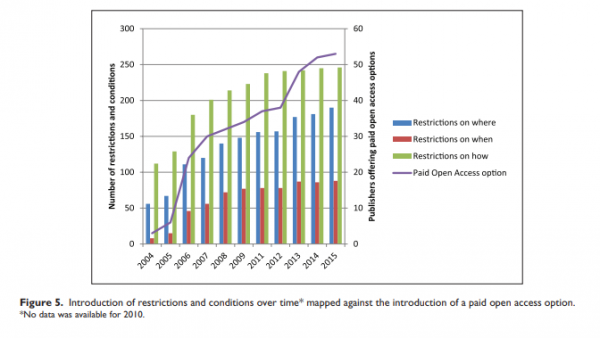
Để so sánh, từ 2005 tới 2015, số lượng các chính sách Truy cập Mở của các cơ sở và các nhà cấp vốn đã tăng từ 123 lên 830 (xem ROARMAP). [Image Source]
Với tính sẵn sàng gia tăng của các tạp chí lai, số lượng các bài báo lai cũng đã liên tục tăng. Bây giờ, bạn có thể nói “các tài liệu nghiên cứu Truy cập Mở nhiều hơn chứ? Tuyệt vời!”, nhưng có một ít vấn đề với mô hình lai.
Trả tiền 2 lần (Double Dipping)
Trả tiền 2 lần, như được RLUK định nghĩa, “phát sinh nếu nhà xuất bản tìm cách gia tăng không thể bênh vực nổi doanh thu bằng việc đánh thuế các khoản phí xử lý bài báo (APC) để xuất bản trên một tạp chí lai, trong khi không đưa ra sự giảm các chi phí thuê bao một cách tương ứng”. Để công bằng, các nhà xuất bản chính đã ban hành các tuyên bố các biện pháp đã được đưa ra để ngăn chặn việc trả tiền 2 lần, và các bảng giá được giảm một cách tương ứng. Nhưng…
Giá thành
Tôi sẽ giới hạn vấn đề giá thành chỉ về các APC, và loại bỏ các giá thành thuê bao. Các APC đối với các tạp chí lai trung bình khoảng 2.700 USD và có thể thường vượt quá 5.000 USD, khi được so sánh với trung bình 2.000 USD cho các tạp chí Truy cập Mở đầy đủ từ các nhà xuất bản dựa vào thuê bao và 1.400 USD cho các nhà xuất bản Truy cập Mở (Björk and Solomon, 2014). Để rõ ràng, việc thiết lập lựa chọn lai thường là rủi ro thấp và không đắt đối với các nhà xuất bản vì họ sẽ không phụ thuộc vào dòng doanh thu APC mà duy trì được tạp chí qua các thuê bao. Vì sao giá thành Truy cập Mở lai lại cao hơn nhiều so với Truy cập Mở đầy đủ?
Để đưa ra ví dụ thực tế hơn, vào tháng 10/2015, các biên tập viên và các thành viên ban biên tập của tạp chí Truy cập Mở lai Lingua đã từ chức khỏi các chức vụ sau khi các thương thảo với Elsevier về mô hình định giá công bằng, giữ lại bản quyền, và quyền sở hữu tạp chí đã không thành công. Trong khi Elsevier đã nêu “khoản phí xuất bản bài báo ở Lingua cho các bài báo truy cập mở là 1.800 USD. Các biên tập viên đã yêu cầu giá 400 euro, một APC không bền vững”, các cựu nhân viên ban biên tập của Lingua đã thành lập một tạp chí mới,Glossa, được Thư viện Nhân văn Mở (Open Library of Humanities) và LingOA cấp vốn, và hiện đang ổn định ở APC 400USD.
Các nhà xuất bản đã và đang tiếp thị cho Truy cập Mở lai như là cách thức dần chuyển các tạp chí dựa vào thuê bao, có uy tín, đã thành danh của họ sang Truy cập Mở đầy đủ. Tuy nhiên, để điều này trở thành lựa chọn trụ vững được, các APC phải trang trải đủ cho các chi phí vận hành tạp chí và, trong trường hợp của các nhà xuất bản vì lợi nhuận, sinh ra được lợi nhuận. Trong một vài lĩnh vực, các thuê bao bên ngoài giới hàn lâm (hầu hết chỉ đọc, với chỉ xuất bản ít) tạo ra một phần đáng kể lợi nhuận đó, điều có lẽ, dù vậy, bị giảm hoặc mất đi hoàn toàn nếu đa số các bài báo là Truy cập Mở. Như Laakso et al. Nêu, “Dù có thể là có khả năng sinh ra doanh số để trang trải cho chi phí xuất bản, có lẽ là khó để thuyết phục các nhà xuất bản từ bỏ lợi nhuận mà các tạp chí đó đã nhận được từ các thuê bao bê ngoài giới hàn lâm”.
Giá trị
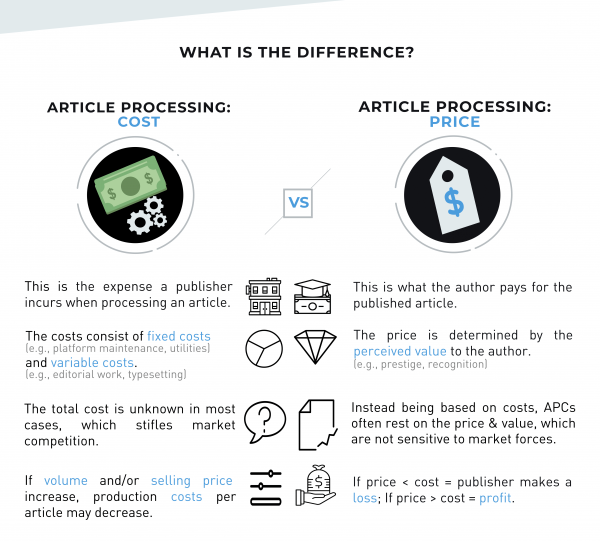
Chi phí APC so với giá thành APC [Nguồn ảnh]
Một trong những lý do các nhà xuất bản có thể thiết lập các APC của họ khá cao để trang trải cho các chi phí vận hành và duy trì (hoặc gia tăng) lợi nhuận ~35%, là vì giá trị (được thừa nhận) của xuất bản phẩm đối với nhà nghiên cứu. Thế thì Truy cập Mở lai chào cái gì?
Để tuân thủ với các yêu cầu của các nhà cấp vốn của họ cung cấp Truy cập Mở tức thì hoặc trong khung thời gian làm giảm giai đoạn cấm vận của nhà xuất bản đó, các nhà nghiên cứu có thể chọn Truy cập Mở lai. Lý do các nhà nghiên cứu từng có khả năng (hoặc còn có khả năng) xuất bản ở những nơi đó và các nhà xuất bản có thể giữ các APC lai ở mức rất cao, là vì nhiều nhà cấp vốn đã hào phòng chi trả cho Truy cập Mở mà không có bất kỳ hạn chế nào về giá thành.
Các tạp chí Truy cập Mở lai chào cho các nhà nghiên cứu thứ gì đó mà nhiều tạp chí Truy cập Mở đầy đủ không thể: uy tín và truyền thống. Các tạp chí lai là thành danh rồi và, qua nhiều năm và thập kỷ, đã tích lũy được uy tín nhất định trong cộng đồng nghiên cứu. Trong khi, Truy cập Mở vẫn chưa là chuẩn mực và có lẽ, trong một số trường hợp, thậm chí được coi là có rủi ro. Nếu các nhà nghiên cứu coi các nơi xuất bản truyền thống như là có lợi hoặc thậm chí cần thiết cho sự tiến bộ sự nghiệp của họ, thì các tạp chí lai dường như là lựa chọn an toàn và dễ dàng để cung cấp Truy cập Mở trong khi tuân thủ các quy định để tiến lên tháp ngà.
Nhưng vì thiếu khả năng phát hiện, Truy cập Mở lai có lẽ không chào cho các tác giả giá trị tốt nhất sau tất cả. Các dịch vụ phát hiện và phân giải, theo truyền thống, làm việc ở mức tạp chí, điều ngụ ý là các bài báo Truy cập Mở lai có lẽ không được các máy tìm kiếm đánh chỉ mục hoặc các hệ thống quản lý và phát hiện tài nguyên điện tử của thư viện chọn, mà vẫn là bị ẩn đi đằng sau bức tường thanh toán. Hơn nữa, đã có các trường hợp lặp đi lặp lại khi các bài báo Truy cập Mở lai đã được cấp phép không đúng, được bán như là nội dung truy cập đóng, và sử dụng lại chúng đã bị hạn chế. Xem các ví dụ gần đây ở Paywall Watch.
Cơ bản
Phong trào Truy cập Mở từng ngụ ý cung cấp sự truy cập vạn năng tới tri thức, tuy nhiên mô hình lai dường như làm thất bại điểm này bằng việc gây trở ngại cho khả năng phát hiện các bài báo Truy cập Mở lai, và tạo ra nhiều khó khăn hơn để phổ biến tri thức. Các hành động nào chúng ta có thể tiến hành để tạo ra hệ thống công bằng hơn, hoặc để loại bỏ khỏi Truy cập Mở lai?
Các nhà cấp vốn và các cơ sở

Lisa Matthias
Các bài đăng khác
A couple weeks ago, the European Commission (EC) announced that starting with their new funding programme, Horizon Europe, they will no longer reimburse publication fees for hybrid Open Access. Previously, the EC had excluded hybrid APCs when they first introduced Open Access funds during the FP7 Post-Grant Open Access Pilot, but later covered hybrid Open Access in the following funding programme, Horizon 2020 (2014-2020).
Hybrid Open Access describes an publishing model where some articles are made openly available, against the payment of an Article Processing Charge (APC), while other articles remain closed access, and the journal as a whole subscription-based. The first hybrid journals launched with Springer Open Choice and Wiley Online Open in 2004. Two years later, the publishing model was incorporated through Elsevier Open Access, Sage Choice and Taylor & Francis Open Select, and Nature Publishing Group (NPG) Open followed in 2007. Since then, the number of hybrid OA journals has skyrocketed and crossed the 10k mark, the leading 5 publishers owning the majority.
Number of hybrid Open Access Journals 2009-2017 [Source]
Björk attributes the recent increase “to two major changes in the funding infrastructure. Firstly, several leading research funders have set up centralized funds for paying APCs and secondly, a new type of consortial electronic subscription licenses which also include the payment of hybrid APCs has stated to emerge” (Björk, 2017). Additionally, several funders have introduced Open Access mandates, requiring beneficiaries to make their research outputs openly available within a certain time frame (e.g., six or twelve months for Horizon 2020 depending on the discipline), which might not comply with the publisher’s embargo period, typically ranging from 6 to 24 months. Interesting, however not surprising is the observation that with the increasing number of Open Access mandates, institutional and funding, restrictions around self-archiving have increased as well (see Laakso, 2014 and Gadd et al., 2016).
As a comparison, from 2005 to 2015, the number of institutional and funding Open Access policies rose from 123 to 830 (see ROARMAP). [Image Source]
With the increased availability of hybrid journals, the number of hybrid articles has continuously increased as well. Now, you might say “More Open Access research papers? Awesome!”, but there are a few problems with the hybrid model.
For easier navigation, jump to: Double Dipping | The Price | The Value | The Bottom Line
Double Dipping
Double dipping, as defined by the RLUK, “arises if a publisher seeks an unwarrantable increase in revenues by levying article processing charges (APCs) for publication in a hybrid journal, while not providing a proportionate decrease in subscription costs.” To be fair, the major publishers have issued statements that measures were put in place to prevent double dipping, and that list prices are reduced proportionally. But..
The Price
I will limit the price issue to solely APCs, and exclude subscription prices. APCs for hybrid journals average around $2,700 and can often exceed $5,000, as compared to an average of $2,000 for fully Open Access journals by subscription-based publishers and $1,400 for Open Access publishers (Björk and Solomon, 2014). To be clear, setting up the hybrid option is generally low risk and inexpensive for publishers as they are not dependent on the APC revenue stream but maintain the journal through subscriptions. Why then is the price for hybrid Open Access so much higher than for full Open Access?
To give a more practical example, in October 2015, the editors and editorial-board members of the hybrid Open Access journal Lingua resigned from their positions after negotiations with Elsevier about a fair pricing model, retention of copyright, and ownership of the journal had been unsuccessful. While Elsevier stated “the article publishing charge at Lingua for open access articles is $1,800 USD. The editors had requested a price of 400 euros, an APC that is not sustainable,” Lingua’s former editorial staff founded a new journal, Glossa, funded by the Open Library of Humanities and LingOA, and being sustainable at an APC of $400.
Publishers have been marketing hybrid Open Access as a way to gradually flip their well-established, prestigious, subscription-based journals to full Open Access. However, for this to be viable option, the APCs must fully cover the journal’s operational costs and, in the case of for-profit publishers, generate profit. In some fields, subscriptions outside of the academy (mostly read-only, with only little publishing) make up a notable part of the profits, which would, however, be reduced or lost entirely if the majority of articles was Open Access. As Laakso et al. note, “Although it may be possible to generate enough income to cover the cost of publication, it would be difficult to convince publishers to give up the profits these journals receive from subscriptions outside of academia.”
The Value
APC Cost vs. APC Price [Image Source]
One of the reasons publishers can set their APCs fairly high to cover operational costs and maintain (or increase) their profit margins of ~35%, is because of the publication’s (perceived) value to the researcher. So what does hybrid Open Access offer?
Hybrid Open Access journals offer researchers something that many fully Open Access journals cannot: prestige and tradition. Hybrid journals are already well-established and, over the years or decades, have accumulated a certain reputation within the research community. Whereas, Open Access still isn’t the norm and might, in some cases, even be seen as risky. If researchers regard more traditional publication venues as beneficial or even necessary for their advancing their career, hybrid journals seem like a safe and easy choice to provide Open Access while following the rules to move up the ivory tower.
But due to a lack of discoverability, hybrid Open Access might not offer authors the best value afterall. Discovery and link resolution services traditionally work on the journal level, which means that hybrid Open Access articles might not be indexed by search engines or picked up by library electronic resource management and discovery systems, but remain hidden behind a paywall. In addition, there have been repeated cases where hybrid Open Access articles have been incorrectly licensed, sold as closed access content, and their reuse has been restricted. See Paywall Watch for recent examples.
The Bottom Line
The Open Access movement was meant to provide universal access to knowledge, however the hybrid model seems to defeat this point by hindering the discoverability of hybrid Open Access articles, and creating more difficulties to disseminate knowledge. What actions can we take to create a fairer system, or to move away from hybrid Open Access?*
Funders & institutions
Lisa Matthias
More Posts
Dịch: Lê Trung Nghĩa
letrungnghia.foss@gmail.com
Lisa Matthias , 2018-06-26
*** Cảm ơn Mikael Laakso về phản hồi tuyệt vời**
*** Thank you to Mikael Laakso for the excellent feedback **
Theo: https://blogs.openaire.eu/?p=3431
Bài được đưa lên Internet ngày: 26/06/2018
Xem thêm: Khoa học Mở - Open Science
Vài tuần trước, Ủy ban châu Âu (EC) đã công bố bắt đầu với chương trình cấp vốn mới, Horizon Europe, họ sẽ không còn hoàn lại tiền các khoản phí xuất bản cho Truy cập Mở lai nữa. Trước đó, EC đã loại bỏ các khoản phí xử lý bài báo - APC (Article Processing Charges) lai (hybrid) khi họ lần đầu giới thiệu các vốn cấp Truy cập Mở trong dự án Thí điểm Truy cập Mở Sau - Trợ cấp của FP7, nhưng sau đó đã trang trải cho Truy cập Mở lai trong chương trình cấp vốn sau đó, Horizon 2020 (2014-2020).
Truy cập Mở lai mô tả mô hình xuất bản nơi mà vài bài báo được làm cho sẵn sàng mở, ngược với thanh toán của APC, trong khi các bài báo khác vẫn là truy cập đóng, và tạp chí như là tổng thể dựa vào thuê bao. Các tạp chí lai đầu tiên được tung ra với Springer Open Choice (Lựa chọn Mở của Springer) và Wiley Online Open (Mở trên Trực tuyến của Wiley) vào năm 2004. Hai năm sau, mô hình xuất bản này đã được kết hợp qua Elsevier Open Access (Truy cập Mở của Elsevier), Sage Choice và Taylor & Francis Open Select, và Nature Publishing Group (NPG) Open đi theo sau vào năm 2007. Kể từ đó, số lượng các tạp chí Truy cập Mở (OA) lai đã tăng vùn vụt và đã vượt quá mốc 10.000, với 5 nhà xuất bản hàng đầu sở hữu đa số.
Số lượng các tạp chí Truy cập Mở lai 2009-2017 [Nguồn]
Björk quy cho sự gia tăng gần đây “với 2 sự thay đổi chính trong hạ tầng cấp vốn. Trước tiên, vài nhà cấp vốn nghiên cứu hàng đầu đã thiết lập các vốn cấp tập trung cho việc thanh toán các APC; và thứ hai, dạng mới các giấy phép thuê bao điện tử theo nhóm cũng gồm thanh toán các APC lai đã nổi lên” (Björk, 2017). Hơn nữa, vài nhà cấp vốn đã giới thiệu các chỉ thị Truy cập Mở, yêu cầu các bên hưởng lợi làm cho các kết quả đầu ra nghiên cứu của họ sẵn sàng mở trong khung thời gian nhất định (như, 6 hoặc 12 tháng đối với Horizon 2020, phụ thuộc vào lĩnh vực), điều có lẽ không tuân thủ với giai đoạn cấm vận của nhà xuất bản, thường trải từ 6 – 24 tháng. Tuy nhiên, thú vị và không ngạc nhiên là sự quan sát thấy rằng với số lượng ngày càng gia tăng các chỉ thị Truy cập Mở của các cơ sở và các nhà cấp vốn, các hạn chế xung quanh việc tự lưu trữ cũng đã gia tăng (xem Laakso, 2014 và Gadd et al., 2016).
Để so sánh, từ 2005 tới 2015, số lượng các chính sách Truy cập Mở của các cơ sở và các nhà cấp vốn đã tăng từ 123 lên 830 (xem ROARMAP). [Image Source]
Với tính sẵn sàng gia tăng của các tạp chí lai, số lượng các bài báo lai cũng đã liên tục tăng. Bây giờ, bạn có thể nói “các tài liệu nghiên cứu Truy cập Mở nhiều hơn chứ? Tuyệt vời!”, nhưng có một ít vấn đề với mô hình lai.
Trả tiền 2 lần (Double Dipping)
Trả tiền 2 lần, như được RLUK định nghĩa, “phát sinh nếu nhà xuất bản tìm cách gia tăng không thể bênh vực nổi doanh thu bằng việc đánh thuế các khoản phí xử lý bài báo (APC) để xuất bản trên một tạp chí lai, trong khi không đưa ra sự giảm các chi phí thuê bao một cách tương ứng”. Để công bằng, các nhà xuất bản chính đã ban hành các tuyên bố các biện pháp đã được đưa ra để ngăn chặn việc trả tiền 2 lần, và các bảng giá được giảm một cách tương ứng. Nhưng…
- Giá thành thuê bao được tính như thế nào?
- Sự giảm giá trong bảng giá ảnh hưởng như thế nào tới tỷ lệ thuê bao khi chúng được thỏa thuận như một phần của “Bó các Vụ làm ăn Lớn” (Big Deal Bundles)?
- Những người tiêu dùng làm thế nào có thể chắc chắn tỷ lệ thuê bao đang được giảm, và ở mức độ nào, khi các chi tiết của các thương thảo của các Vụ làm ăn Lớn được/bị ẩn dấu đằng sau các thỏa thuận không công khai?
- Các APC được tính như thế nào?
Giá thành
Tôi sẽ giới hạn vấn đề giá thành chỉ về các APC, và loại bỏ các giá thành thuê bao. Các APC đối với các tạp chí lai trung bình khoảng 2.700 USD và có thể thường vượt quá 5.000 USD, khi được so sánh với trung bình 2.000 USD cho các tạp chí Truy cập Mở đầy đủ từ các nhà xuất bản dựa vào thuê bao và 1.400 USD cho các nhà xuất bản Truy cập Mở (Björk and Solomon, 2014). Để rõ ràng, việc thiết lập lựa chọn lai thường là rủi ro thấp và không đắt đối với các nhà xuất bản vì họ sẽ không phụ thuộc vào dòng doanh thu APC mà duy trì được tạp chí qua các thuê bao. Vì sao giá thành Truy cập Mở lai lại cao hơn nhiều so với Truy cập Mở đầy đủ?
Để đưa ra ví dụ thực tế hơn, vào tháng 10/2015, các biên tập viên và các thành viên ban biên tập của tạp chí Truy cập Mở lai Lingua đã từ chức khỏi các chức vụ sau khi các thương thảo với Elsevier về mô hình định giá công bằng, giữ lại bản quyền, và quyền sở hữu tạp chí đã không thành công. Trong khi Elsevier đã nêu “khoản phí xuất bản bài báo ở Lingua cho các bài báo truy cập mở là 1.800 USD. Các biên tập viên đã yêu cầu giá 400 euro, một APC không bền vững”, các cựu nhân viên ban biên tập của Lingua đã thành lập một tạp chí mới,Glossa, được Thư viện Nhân văn Mở (Open Library of Humanities) và LingOA cấp vốn, và hiện đang ổn định ở APC 400USD.
Các nhà xuất bản đã và đang tiếp thị cho Truy cập Mở lai như là cách thức dần chuyển các tạp chí dựa vào thuê bao, có uy tín, đã thành danh của họ sang Truy cập Mở đầy đủ. Tuy nhiên, để điều này trở thành lựa chọn trụ vững được, các APC phải trang trải đủ cho các chi phí vận hành tạp chí và, trong trường hợp của các nhà xuất bản vì lợi nhuận, sinh ra được lợi nhuận. Trong một vài lĩnh vực, các thuê bao bên ngoài giới hàn lâm (hầu hết chỉ đọc, với chỉ xuất bản ít) tạo ra một phần đáng kể lợi nhuận đó, điều có lẽ, dù vậy, bị giảm hoặc mất đi hoàn toàn nếu đa số các bài báo là Truy cập Mở. Như Laakso et al. Nêu, “Dù có thể là có khả năng sinh ra doanh số để trang trải cho chi phí xuất bản, có lẽ là khó để thuyết phục các nhà xuất bản từ bỏ lợi nhuận mà các tạp chí đó đã nhận được từ các thuê bao bê ngoài giới hàn lâm”.
Giá trị
Chi phí APC so với giá thành APC [Nguồn ảnh]
Một trong những lý do các nhà xuất bản có thể thiết lập các APC của họ khá cao để trang trải cho các chi phí vận hành và duy trì (hoặc gia tăng) lợi nhuận ~35%, là vì giá trị (được thừa nhận) của xuất bản phẩm đối với nhà nghiên cứu. Thế thì Truy cập Mở lai chào cái gì?
- Truy cập Mở tức thì
- Xuất bản trên các tạp chí có uy tín, đã thành danh
Để tuân thủ với các yêu cầu của các nhà cấp vốn của họ cung cấp Truy cập Mở tức thì hoặc trong khung thời gian làm giảm giai đoạn cấm vận của nhà xuất bản đó, các nhà nghiên cứu có thể chọn Truy cập Mở lai. Lý do các nhà nghiên cứu từng có khả năng (hoặc còn có khả năng) xuất bản ở những nơi đó và các nhà xuất bản có thể giữ các APC lai ở mức rất cao, là vì nhiều nhà cấp vốn đã hào phòng chi trả cho Truy cập Mở mà không có bất kỳ hạn chế nào về giá thành.
Các tạp chí Truy cập Mở lai chào cho các nhà nghiên cứu thứ gì đó mà nhiều tạp chí Truy cập Mở đầy đủ không thể: uy tín và truyền thống. Các tạp chí lai là thành danh rồi và, qua nhiều năm và thập kỷ, đã tích lũy được uy tín nhất định trong cộng đồng nghiên cứu. Trong khi, Truy cập Mở vẫn chưa là chuẩn mực và có lẽ, trong một số trường hợp, thậm chí được coi là có rủi ro. Nếu các nhà nghiên cứu coi các nơi xuất bản truyền thống như là có lợi hoặc thậm chí cần thiết cho sự tiến bộ sự nghiệp của họ, thì các tạp chí lai dường như là lựa chọn an toàn và dễ dàng để cung cấp Truy cập Mở trong khi tuân thủ các quy định để tiến lên tháp ngà.
Nhưng vì thiếu khả năng phát hiện, Truy cập Mở lai có lẽ không chào cho các tác giả giá trị tốt nhất sau tất cả. Các dịch vụ phát hiện và phân giải, theo truyền thống, làm việc ở mức tạp chí, điều ngụ ý là các bài báo Truy cập Mở lai có lẽ không được các máy tìm kiếm đánh chỉ mục hoặc các hệ thống quản lý và phát hiện tài nguyên điện tử của thư viện chọn, mà vẫn là bị ẩn đi đằng sau bức tường thanh toán. Hơn nữa, đã có các trường hợp lặp đi lặp lại khi các bài báo Truy cập Mở lai đã được cấp phép không đúng, được bán như là nội dung truy cập đóng, và sử dụng lại chúng đã bị hạn chế. Xem các ví dụ gần đây ở Paywall Watch.
Cơ bản
| Các ảnh hưởng ngắn hạn của Truy cập Mở lai | Các ảnh hưởng dài hạn của Truy cập Mở lai |
| Cung cấp Truy cập Mở tức thì tới các bài báo được xuất bản trên các tạp chí thuê bao, điều thường không thể đạt được qua việc tự lưu trừ, trong các lĩnh vực với tính sẵn sàng thấp của các tạp chí Truy cập Mở được coi là tốt. | Được tiếp thị như là pha chuyển tiếp trung lập với doanh thu, trong khi các nhà xuất bản có các ưu đãi tài chính để duy trì hệ thống lai. |
| Khả nâng phát hiện giảm khi so sánh với các tạp chí Truy cập Mở đầy đủ. | Các nhà xuất bản đã chưa bắt đầu chuyển các tạp chí phạm vi rộng vì sử dụng Truy cập Mở lai. |
| Các cơ sở /nhà cấp vốn bỏ tiền vào lai, điều có thể nếu khác sẽ được đầu từ vào các mô hình xuất bản có tính cách tân và bền vững hơn. | Các cơ sở /nhà cấp vốn bỏ tiền vào lai, điều có thể nếu khác sẽ được đầu tư vào các mô hình xuất bản có tính cách tân và bền vững hơn. |
| Sự tập trung thị trường cao độ xung quanh các nhà xuất bản chính, và các rào cản cao cho những tạp chí mới bước vào thị trường. | Làm chậm đi sự chuyển tiếp sang Truy cập Mở, và sang Khoa học Mở nói chung vì nó bám vào truyền thống. |
| Phân biệt giữa các quốc gia thu nhập thấp và các cơ sở /học giả được cấp vốn ít hơn vì các APC cao và sự không sẵn sàng của những người từ bỏ phí. | Các APC tăng tới giờ vì chúng là không nhạy cảm với thị trường, mà có kết nối chặt chẽ với giá trị được thừa nhận. |
Phong trào Truy cập Mở từng ngụ ý cung cấp sự truy cập vạn năng tới tri thức, tuy nhiên mô hình lai dường như làm thất bại điểm này bằng việc gây trở ngại cho khả năng phát hiện các bài báo Truy cập Mở lai, và tạo ra nhiều khó khăn hơn để phổ biến tri thức. Các hành động nào chúng ta có thể tiến hành để tạo ra hệ thống công bằng hơn, hoặc để loại bỏ khỏi Truy cập Mở lai?
Các nhà cấp vốn và các cơ sở
- Dừng sử dụng yếu tố ảnh hưởng như là chỉ số ủy quyền cho chất lượng và/hoặc ảnh hưởng của bài báo
- Đánh giá chất lượng nghiên cứu riêng rẽ, và không dựa nó chỉ vào uy tín của tạp chí.
- Khuyến khích và thưởng (như, bằng việc đưa vào trong các quyết định cấp vốn/ thăng tiến/ nhiệm kỳ) cho các thực hành mở như sự cộng tác, sự tham gia của công chúng, và xuất bản các kết quả bằng không và âm
- Không cấp vốn cho các APC Truy cập Mở lai. Hoặc chỉ cấp vốn cho các APC lai đáp ứng được các yêu cầu nhất định, như giá trần, các giai đoạn cấm vận ngắn, và các mô hình định giá minh bạch.
- Kiểm tra các tạp chí Truy cập Mở (chi phí thấp) nào đang tồn tại trong lĩnh vực của bạn. Kiểm tra một lần nữa khi tài liệu tiếp sau của bạn là sẵn sàng để đệ trình, các tạp chí mới có thể đã được tung ra, các tạp chí khác có thể đã được chuyển đổi từ đóng sang Truy cập Mở, và một vài tạp chí có thể đã yêu cầu một yếu tố ảnh hưởng. (Lưu ý: Tôi không hỗ trợ sử dụng hoặc thúc đẩy yếu tố ảnh hưởng, dù tôi rất biết rằng, không may, trong một số trường hợp, các nhà nghiên cứu vẫn còn phụ thuộc vào các tạp chí có ảnh hưởng lớn vì sự tiến bộ sự nghiệm của họ hoặc để nhận được các trợ cấp).
- Thương thảo hợp đồng của bạn với nhà xuất bản và cung cấp cho họ các phụ lục của tác giả (như của SPARC) để giữ lại các quyền bản quyền của bạn khi xuất bản trên các tạp chí truy cập đóng. Nếu điều đó là không thể, hãy kiểm tra Sherpa/Romeo để biết các chính sách tự lưu trữ của nhà xuất bản, và ký gửi một bản sao bản thảo của bạn vào một kho Truy cập Mở.
- Hãy làm cho các mô hình định giá - thuê bao, APC, bù đắp - thành minh bạch.
- Thay đổi hệ thống bù đặp hiện hành, và thay vì giảm bảng giá tạp chí, hãy tạo các khấu t rừ đặc thù cơ sở.
- Cải thiện khả năng phát hiện các bài báo Truy cập Mở lai, ví dụ, bằng việc thêm các yếu tố siêu dữ liệu tiêu chuẩn về bản quyền và giấy phép.
Lisa Matthias
Các bài đăng khác
A couple weeks ago, the European Commission (EC) announced that starting with their new funding programme, Horizon Europe, they will no longer reimburse publication fees for hybrid Open Access. Previously, the EC had excluded hybrid APCs when they first introduced Open Access funds during the FP7 Post-Grant Open Access Pilot, but later covered hybrid Open Access in the following funding programme, Horizon 2020 (2014-2020).
Hybrid Open Access describes an publishing model where some articles are made openly available, against the payment of an Article Processing Charge (APC), while other articles remain closed access, and the journal as a whole subscription-based. The first hybrid journals launched with Springer Open Choice and Wiley Online Open in 2004. Two years later, the publishing model was incorporated through Elsevier Open Access, Sage Choice and Taylor & Francis Open Select, and Nature Publishing Group (NPG) Open followed in 2007. Since then, the number of hybrid OA journals has skyrocketed and crossed the 10k mark, the leading 5 publishers owning the majority.
Number of hybrid Open Access Journals 2009-2017 [Source]
Björk attributes the recent increase “to two major changes in the funding infrastructure. Firstly, several leading research funders have set up centralized funds for paying APCs and secondly, a new type of consortial electronic subscription licenses which also include the payment of hybrid APCs has stated to emerge” (Björk, 2017). Additionally, several funders have introduced Open Access mandates, requiring beneficiaries to make their research outputs openly available within a certain time frame (e.g., six or twelve months for Horizon 2020 depending on the discipline), which might not comply with the publisher’s embargo period, typically ranging from 6 to 24 months. Interesting, however not surprising is the observation that with the increasing number of Open Access mandates, institutional and funding, restrictions around self-archiving have increased as well (see Laakso, 2014 and Gadd et al., 2016).
As a comparison, from 2005 to 2015, the number of institutional and funding Open Access policies rose from 123 to 830 (see ROARMAP). [Image Source]
With the increased availability of hybrid journals, the number of hybrid articles has continuously increased as well. Now, you might say “More Open Access research papers? Awesome!”, but there are a few problems with the hybrid model.
For easier navigation, jump to: Double Dipping | The Price | The Value | The Bottom Line
Double Dipping
Double dipping, as defined by the RLUK, “arises if a publisher seeks an unwarrantable increase in revenues by levying article processing charges (APCs) for publication in a hybrid journal, while not providing a proportionate decrease in subscription costs.” To be fair, the major publishers have issued statements that measures were put in place to prevent double dipping, and that list prices are reduced proportionally. But..
- How are subscription prices calculated?
- How do reductions of list prices affect subscription rates when these are negotiated as part of “Big Deal Bundles”?
- How can consumers be certain that subscription rates are being reduced, and to what extent, when the details of Big Deal negotiations are hidden behind non-disclosure agreements?
- How are APCs calculated?
The Price
I will limit the price issue to solely APCs, and exclude subscription prices. APCs for hybrid journals average around $2,700 and can often exceed $5,000, as compared to an average of $2,000 for fully Open Access journals by subscription-based publishers and $1,400 for Open Access publishers (Björk and Solomon, 2014). To be clear, setting up the hybrid option is generally low risk and inexpensive for publishers as they are not dependent on the APC revenue stream but maintain the journal through subscriptions. Why then is the price for hybrid Open Access so much higher than for full Open Access?
To give a more practical example, in October 2015, the editors and editorial-board members of the hybrid Open Access journal Lingua resigned from their positions after negotiations with Elsevier about a fair pricing model, retention of copyright, and ownership of the journal had been unsuccessful. While Elsevier stated “the article publishing charge at Lingua for open access articles is $1,800 USD. The editors had requested a price of 400 euros, an APC that is not sustainable,” Lingua’s former editorial staff founded a new journal, Glossa, funded by the Open Library of Humanities and LingOA, and being sustainable at an APC of $400.
Publishers have been marketing hybrid Open Access as a way to gradually flip their well-established, prestigious, subscription-based journals to full Open Access. However, for this to be viable option, the APCs must fully cover the journal’s operational costs and, in the case of for-profit publishers, generate profit. In some fields, subscriptions outside of the academy (mostly read-only, with only little publishing) make up a notable part of the profits, which would, however, be reduced or lost entirely if the majority of articles was Open Access. As Laakso et al. note, “Although it may be possible to generate enough income to cover the cost of publication, it would be difficult to convince publishers to give up the profits these journals receive from subscriptions outside of academia.”
The Value
APC Cost vs. APC Price [Image Source]
One of the reasons publishers can set their APCs fairly high to cover operational costs and maintain (or increase) their profit margins of ~35%, is because of the publication’s (perceived) value to the researcher. So what does hybrid Open Access offer?
- Immediate Open Access
- Publication in well-established, prestigious journals
Hybrid Open Access journals offer researchers something that many fully Open Access journals cannot: prestige and tradition. Hybrid journals are already well-established and, over the years or decades, have accumulated a certain reputation within the research community. Whereas, Open Access still isn’t the norm and might, in some cases, even be seen as risky. If researchers regard more traditional publication venues as beneficial or even necessary for their advancing their career, hybrid journals seem like a safe and easy choice to provide Open Access while following the rules to move up the ivory tower.
But due to a lack of discoverability, hybrid Open Access might not offer authors the best value afterall. Discovery and link resolution services traditionally work on the journal level, which means that hybrid Open Access articles might not be indexed by search engines or picked up by library electronic resource management and discovery systems, but remain hidden behind a paywall. In addition, there have been repeated cases where hybrid Open Access articles have been incorrectly licensed, sold as closed access content, and their reuse has been restricted. See Paywall Watch for recent examples.
The Bottom Line
| Short-term effects of hybrid Open Access | Long-term effects of hybrid Open Access |
| Provides immediate Open Access to articles published in subscription journals, which often can’t be achieved through self-archiving, in fields with a low availability of well-regarded Open Access journals. | Marketed as a revenue-neutral transition phase, while publishers have financial incentives to maintain the hybrid system. |
| Decreased discoverability than compared to fully Open Access journals. | Publishers have not started to flip journals large-scale due to the uptake of hybrid Open Access. |
| Institutions/funders spend money on hybrid, which could otherwise be invested into innovative and more sustainable publishing models. | Institutions/funders spend money on hybrid, which could otherwise be invested into innovative and more sustainable publishing models. |
| High market concentration around major publishers, and high barriers for new venues to enter the market. | Slows down the transition to Open Access, and to Open Science in general as it clings to tradition. |
| Discriminatory against low-income countries and lesser-funded institutions/scholars because of high APCs and unavailability of fee waivers. | Ever increasing APCs as they are not sensitive to the market, but closely connected to the perceived value. |
Funders & institutions
- Stop using the impact factor as a proxy indicator for an article’s quality and/or impact.
- Assess the quality of the individual research, and do not base it solely on the journal’s reputation.
- Encourage and reward (e.g., by including in funding/promotion/tenure decisions) open practices such as collaboration, public engagement, and publishing null and negative results.
- Do not fund hybrid Open Access APCs. OR only fund hybrid APCs that meet certain requirements, such as a price cap, short embargo periods, and transparent pricing models.
- Check which (low-cost) Open Access journals exist in your field. Check again when your next paper is ready to be submitted, new journals might have been launched, others might have been flipped from closed to Open Access, and some might have acquired an impact factor. (Note: I do not support using or promoting the impact factor, however I am very much aware that unfortunately, in some cases, researchers are still dependent on high-impact journals to advance their careers or to receive grants.)
- Negotiate your contract with your publisher and provide them with an author addendum (e.g., by SPARC) to retain your author rights when publishing in closed access journals. If that is not possible, check Sherpa/Romeofor publishers’ self-archiving policies, and deposit a copy of your manuscript in an Open Access repository.
- Make pricing models – subscriptions, APCs, offsetting – transparent.
- Change the current offsetting system, and instead of reducing journal list prices, make deductions institution-specific.
- Improve discoverability of hybrid Open Access articles, for example by adding standard metadata elements for copyright and license.
Lisa Matthias
More Posts
Dịch: Lê Trung Nghĩa
letrungnghia.foss@gmail.com