Blog FOSS by Lê Trung Nghĩa
Phần mềm tự do nguồn mở cho Việt Nam
Blog FOSS by Lê Trung Nghĩa
Phần mềm tự do nguồn mở cho Việt Nam
Blog FOSS by Lê Trung Nghĩa
Phần mềm tự do nguồn mở cho Việt Nam
Blog FOSS by Lê Trung Nghĩa
Phần mềm tự do nguồn mở cho Việt Nam

GO-GN Open Research Handbook v.1.1

References
Ajzen, I. (1991). Theory of planned behavior. Organization Behavior and Human Decision Processes, 50, 179-211.
Åkerlind G. (2005). Variation and commonality in phenomenographic research methods. Higher Education Research & Development, 24 321–334. https://doi.org/10.1080/07294360500284672
Akkerman, S. & Bruining, T. (2016). Multilevel Boundary Crossing in a Professional Development School Partnership. Journal of the Learning Sciences 25(2). https://doi.org/10.1080/10508406.2016.1147448
Akkerman, S. F. & Bakker, A. (2011). Boundary Crossing and Boundary Objects. Review of Educational Research, 81(2), 132-169. https://doi.org/10.3102%2F0034654311404435
Akkerman, S.F., & Bakker, A. (2011). Learning at the boundary: An introduction. International Journal of Educational Research, 50(1), 1-5. http://doi.org/10.1016/j.ijer.2011.04.002
Amendum, S. J., Conradi, K., & Hiebert, E. (2018). Does text complexity matter in the elementary grades? A research synthesis of text difficulty and elementary students’ reading fluency and comprehension. Educational Psychology Review, 30(1), 121-151.
Anderson, C., & Ellerby, W. (2018). Digital maturity model. Achieving digital maturity to drive growth. In Deloitte Digital (Issue February). https://www2.deloitte.com/content/dam/Deloitte/global/Documents/Technology-Media-Telecommunications/deloitte-digital-maturity-model.pdf
Anderson, T. (2013). Research paradigms: Ontologies, epistemologies, and methods. https://www.slideshare.net/eLearnCenter/research-methods-uoc-2013
Anderson, T., & Shattuck, J. (2012). Design-Based Research: A Decade of Progress in Education Research? Educational Researcher, 41(1), 16-25. http://doi.org/10.3102/0013189X11428813
Angrosino, M. (2007). Doing ethnographic and observational research. SAGE. Apple, W. M. (1995). Education and Power. Routledge.
Archer, M.S. (2003). Structure, agency, and the internal conversation. Cambridge: Cambridge University Press.
Archer, M.S. (2007). The Trajectory of the Morphogenetic Approach: An account in the first person. Sociologica, Problemas e Practicas. 54:35-47.
Archer, M.S. 2012. The Reflexive Imperative in Late Modernity. First ed. Cambridge: Cambridge University Press.
Area, M.; Miño, R.; Rivera-Vargas, P. & Alonso, P. (2020). Investigación sobre tecnologías educativas: más allá de los artefactos, in: J. M. S. Gil, F. H. Hernández, L. M. Mesa, J. D. P. Pons, J. I. R. Flores & A. O. Fernández (coords.), Caminos y derivas para otra investigación educativa y social. Barcelona: Octaedro.
Armellini, A., & Nie, M. (2013). Open educational practices for curriculum enhancement. Open Learning: The Journal of Open, Distance and e-Learning, 28(1), 7–20. http://doi.org/10.1080/02680513.2013.796286
Ashworth, P. D & Lucas, U., 1998. What is the ‘world’ of phenomenography?. Scandinavian journal of Educational Research, 42 (4), 415-431.
Aspers, P. (2009) Empirical Phenomenology: A Qualitative Research Approach (The Cologne Seminars), Indo-Pacific Journal of Phenomenology, 9:2, 1-12, https://doi.org/10.1080/20797222.2009.11433992
Atenas, J. & Havemann, L. (2014). Questions of quality in repositories of open educational resources: A literature review. Research in Learning Technology, 22(1), 1-13. https://journal.alt.ac.uk/index.php/rlt/article/view/1419/pdf_1
Atkins, D. E.; Brown, J. S. & Hammond, A. L. (2007). A review of the open educational resources (OER) movement: Achievements, challenges, and new opportunities. https://hewlett.org/wp-content/uploads/2016/08/ReviewoftheOERMovement.pdf
Ayres, L. (2008). Semi-structured interview. The SAGE Encyclopedia of Qualitative Research Methods, 811–813.
Bailey, K. (1994). Interview Studies in Methods of social research. Simonand Schuster, 4th ed. The Free Press, New York NY 10020.Ch8. 173-213.
Baker, A. & Ippoliti, C. (2019). Student-driven OER: Championing the student voice in campus-wide efforts. In OER: A Field Guide for Academic Librarians | Editor’s Cut. Pacific University Press. https://boisestate.pressbooks.pub/oer-field-guide/chapter/student-driven-oer-championing-the-student-voice-in-campus-wide-efforts/
Ball, S. J. (2013). Foucault, Power, and Education. Routledge.
Balloo, K., Gravett, K. & Erskine, G. (2021). ‘I’m not sure where home is’: narratives of student mobilities into and through higher education. British Journal of Sociology of Education. DOI: 10.1080/01425692.2021.1959298
Bennett, J. (2000). The Academy and Hospitality. CrossCurrents, 50(1/2), 23-35. http://www.jstor.org/stable/24461227
Bensimon, E. M. (2005). Closing the achievement gap in higher education: An organizational learning perspective. New Directions for Higher Education, 2005(131), 99-111. https://doi.org/10.1002/he.190
Bensimon, E. M. (2012). The Equity Scorecard: Theory of change. In E. M. Bensimon & L. Malcom (eds.), Confronting equity issues on campus: Implementing the Equity Scorecard in theory and practice. Stylus.
Bensimon, E. M., Dowd, A. C., & Witham, K. (2016). Five principles for enacting equity by design. Diversity and Democracy, 19(1), 1-8.
Berman, J. & Smyth, R. (2015) Conceptual frameworks in the doctoral research process: a pedagogical model. Innovations in Education and Teaching International, 52(2) 125-136, https://www.tandfonline.com/doi/abs/10.1080/14703297.2013.809011
Bernstein, B. (2000). Pedagogy, Symbolic Control, and Identity. Rowman & Littlefield.
Beyer, C. (2016). Edmund Husserl. Stanford Encyclopedia of Philosophy. https://plato.stanford.edu/entries/husserl/
Bhabha, H. K. (1994). The Location of Culture. Routledge.
Biesta, G. & Tedder, M. (2007). Agency and learning in the lifecourse: Towards an ecological perspective. Studies in the Education of Adults, 39:2, 132-149, DOI: 10.1080/02660830.2007.11661545
Birt, L., Scott, S., Cavers, D., Campbell, C., & Walter, F. (2016). Member Checking: A Tool to Enhance Trustworthiness or Merely a Nod to Validation? Qualitative Health Research, 26(13), 1802–1811. https://doi.org/10.1177/1049732316654870
Bliss, T., Robinson, T.J., Hilton, J. and Wiley, D.A. (2013). An OER COUP: College Teacher and Student Perceptions of Open Educational Resources. Journal of Interactive Media in Education, 2013(1), p.Art. 4. DOI: http://doi.org/10.5334/2013-04
Bloor, C. M., & Wood, F. (2006). Keywords in Qualitative Methods Vignettes: A vocabulary of research concepts. SAGE.
Bloor, M. (Ed.). (2001). Focus groups in social research. Sage.
Bordage, G. (2009), Conceptual frameworks to illuminate and magnify. Medical Education, 43: 312-319. https://doi.org/10.1111/j.1365-2923.2009.03295.x
Borgatti, S. P., & Halgin, D. S. (2011). On network theory. Organization science, 22(5), 1168-1181.
Borgatti, S. P., & Lopez-Kidwell, V. (2011). Network theory. In J. Scott, & P. J. Carrington (Eds.), The SAGE handbook of social network analysis (40–54). Thousand Oaks, CA: Sage.
Borgatti, S., Mehra, A., Brass, D. J., & Labianca, G. (2009). Network analysis in the social sciences. Science, 323(5916), 892–5.
Bourdieu, P. (1987). Distinction: A Social Critique of the Judgement of Taste. Harvard University Press.
Bowden, J.A. & Green, P. (Ed.s). (2005). Doing Developmental Phenomenography. RMIT University Press: Melbourne.
Bowden, J.A. & Walsh, E. (Ed.s). (2000). Phenomenography, Qualitative research methods series, RMIT University Press: Melbourne.
Box, G. E. P.. (1976). Science and Statistics. Journal of the American Statistical Association, 71(356), 791.
Bozkurt, A. (2019). Intellectual roots of distance education: a progressive knowledge domain analysis. Distance Education, 40(4), 497-514. https://doi.org/10.1080/01587919.2019.1681894
Bozkurt, A., Honeychurch, S., Caines, A., Maha, B., Koutropoulos, A., & Cormier, D. (2016). Community Tracking in a cMOOC and Nomadic Learner Behaviour Identification on a Connectivist Rhizomatic Learning Network. The Turkish Online Journal of Distance Education (TOJDE), 17(4). 4-30. DOI: http://dx.doi.org/10.17718/tojde.09231
Brame, C., (2013). Flipping the classroom. Vanderbilt University Center for Teaching. http://cft.vanderbilt.edu/guides-sub-pages/flipping-the-classroom/.
Braun, V., & Clarke, V. (2006). Using thematic analysis in psychology. Qualitative Research in Psychology, 3(2), 77–101.
Bronfenbrenner, U. (1981). The Ecology of Human Development: Experiments by Nature and Design. Harvard University Press.
Brown, M.E., & Dueñas, A.N. (2020) A Medical Science Educator’s Guide to Selecting a Research Paradigm: Building a Basis for Better Research. Medical Science Educator, 30, 545–553. https://doi.org/10.1007/s40670-019-00898-9
Brown, T., & Wyatt, J. (2010). Design thinking for social innovation. Development Outreach, 12(1), 29-43.
Bruner, J.S. (1961). The act of discovery. Harvard Educational Review, 31, 21-32.
Bryman A. (2011). Business research methods. Bell, Emma, 1968- (3rd ed.). Cambridge: Oxford University Press
Buckingham, D. (2020). Epilogue: Rethinking digital literacy: Media education in the age of digital capitalism. Digital Education Review, 37, 230–239. https://doi.org/10.1344/der.2020.37.230-239
Calitz, T. M. L. (2019). Enhancing the Freedom to Flourish in Higher Education: Participation, Equality and Capabilities. Abingdon: Routledge.
Carson, D., Gilmore, A., Perry, C. & Gronhaug, K. (2001). ‘Philosophy of Research’ in Qualitative Marketing Research. SAGE. https://dx.doi.org/10.4135/9781849209625.n1
Caruth, G. (2018). Student engagement, retention, and motivation: Assessing academic success in today’s college students. Participatory Educational Research, 5(1), 17- 30.
Casadevall, A. & Fang, F. (2016). Rigorous Science: a How-To Guide. mBio. 7. https://mbio.asm.org/content/7/6/e01902-16
Casanave C. P. & Li, Y. (2015). Novices’ Struggles with Conceptual and Theoretical Framing in Writing Dissertations and Papers for Publication. Publications, 3(2):104-119. https://doi.org/10.3390/publications3020104
Castells, M. (2011). A network theory of power. International Journal of Communication, 5, 15.
Chang, A., Torrez, M.A., Ferguson, K.N. et al. (2017). Figured Worlds and American Dreams: An Exploration of Agency and Identity Among Latinx Undocumented Students. The Urban Review 49, 189–216. https://doi.org/10.1007/s11256-017-0397-x
Chang, R., & Little, T. D. (2018). Innovations for evaluation research: Multiform protocols, visual analog scaling, and the retrospective pretest–posttest design. Evaluation & the health professions, 41(2), 246-269.
Charmaz, K. (2006). Constructing Grounded Theory. London, Thousands Oaks, New Delhi: Sage. ISBN-13 978-0-7619-7352-2
Choi, B. C., & Pak, A. W. (2006). Multidisciplinarity, interdisciplinarity and transdisciplinarity in health research, services, education and policy: 1. Definitions, objectives, and evidence of effectiveness. Clinical and investigative medicine. Medecine clinique et experimentale, 29(6), 351–364.
Christie, M., & Verran, H. (2013). Digital lives in postcolonial Aboriginal Australia. Journal of Material Culture, 18(3), 299-317. doi:10.1177/1359183513492081
Clandinin, D. J. & Connelly, F. M. (2004). Narrative inquiry: Experience and story in qualitative research. San Francisco, CA: John Wiley & Sons.
Clarke, A. E. (2005). Situational analysis: Grounded theory after the postmodern turn. Sage Publications. https://doi.org/10.4135/9781412985833
Clarke, A. E., Friese, C., & Washburn, R. S. (2017). Situational analysis: Grounded theory after the interpretive turn. Sage Publications.
Clarke, V., Braun, V., & Hayfield, N. (2015). Thematic analysis. Qualitative psychology: A practical guide to research methods, 222-248.
Clements, K. I., & Pawlowski, J. M. (2012). User-oriented quality for OER: Understanding teachers’ views on re-use, quality, and trust. Journal of Computer Assisted Learning, 28(1), 4–14. http://doi.org/10.1111/j.1365-2729.2011.00450.x
Clifford, V. & Montgomery, C. (2017). Designing an internationationalised curriculum for higher education: embracing the local and the global citizen. Higher Education Research & Development, 36:6, 1138-1151, DOI: 10.1080/07294360.2017.1296413
Clinton, V. (2018) Cost, Outcomes, Use and Perceptions of Open Educational Resources in Psychology: A Narrative Review of the Literature. Psychology, Learning and Teaching, Volume 18, Issue 1, 2019. https://journals.sagepub.com/doi/full/10.1177/1475725718799511
Clow, D. (2012, April). The learning analytics cycle: closing the loop effectively. In Proceedings of the 2nd international conference on learning analytics and knowledge (pp. 134-138). ACM. https://dl.acm.org/doi/proceedings/10.1145/2330601
Cobern, W. (1991). Contextual Constructivism: The Impact of Culture on the Learning and Teaching of Science. https://files.eric.ed.gov/fulltext/ED338488.pdf
Cobo, C. (2013). Exploration of open educational resources in non-English speaking communities. The International Review of Research in Open and Distributed Learning, 14(2), 106-128. https://doi.org/10.19173/irrodl.v14i2.1493
Conole, G. (2013). Designing for learning in an open world. New York, NY: Springer.
Corbett, H. & Rossman, G.B. (1989). Three Paths to Implementing Change: A Research Note. Curriculum Inquiry, 19(2), 164-179.
Corbin, J. M. , & Strauss, A. L. (2015). Basics of qualitative research: techniques and procedures for developing grounded theory (Fourth edition). Los Angeles: SAGE.
Cormier, D. (2008). Rhizomatic education: Community as curriculum. Innovate: Journal of Online Education, 4(5), 2. https://nsuworks.nova.edu/innovate/vol4/iss5/2/
Coughlan, T., Rodriguez-Ascaso, A., Iniesto, F., & Jelfs, A. (2016). OLA! A scenario-based approach to enhance open learning through accessibility. International Conference on Computers Helping People with Special Needs, 445-452. http://oro.open.ac.uk/46036/
Country, B., Wright, S., Suchet-Pearson, S., Lloyd, K., Burarrwanga, L., Ganambarr, R., Ganambarr-Stubbs, M., Ganambarr, B., & Maymuru, D. (2015). Working with and learning from Country: decentring human author-ity. Cultural Geographies, 22(2), 269–283. https://doi.org/10.1177/1474474014539248
Cox, G. & Trotter, H. (2016). Institutional culture and OER policy: how structure, culture and agency mediate OER policy potential in South African universities. The International Review of Research in Open and Distributed Learning, 17(5). http://journals.sagepub.com/doi/abs/10.2304/elea.2013.10.2.148
Cox, G. J., & Trotter, H. (2017). An OER framework, heuristic and lens: Tools for understanding lecturers’ adoption of OER. Open Praxis, 9(2): 151–171. http://doi.org/10.5944/openpraxis.9.2.571
Cox, G.J. & Trotter, H. (2017). An OER framework, heuristic and lens: Tools for understanding lecturers’ adoption of OER. Open Praxis, 9(2): 151-171.
CPT+10. (n.d.). Capetown open education declaration 10th anniversary. https://www.capetowndeclaration.org/cpt10
Crenshawe, K. (1989). Demarginalizing the Intersection of Race and Sex: A Black Feminist Critique of Antidiscrimination Doctrine, Feminist Theory and Antiracist Politics. University of Chicago Legal Forum, 1(8). https://chicagounbound.uchicago.edu/cgi/viewcontent.cgi?article=1052&context=uclf
Creswell, J. W. (2009). Research design: Qualitative, quantitative, and mixed methods approaches (3rd ed.). London, UK: Sage.
Creswell, J. W. (2013). Steps in Conducting a Scholarly Mixed Methods Study. DBER Speaker Series, 48. https://digitalcommons.unl.edu/dberspeakers/48
Cronin, C. (2017). Openness and praxis: Exploring the use of open educational practices in higher education. The International Review of Research in Open and Distributed Learning, 18(5), 15-34. https://doi.org/10.19173/irrodl.v18i5.3096
Crotty, M. (1998). The Foundations of Social Research: Meaning and Perspective in the Research Process. London: SAGE
Czerwonogora, A. & Rodés, V. (2019). PRAXIS: Open Educational Practices and Open Science to face the challenges of critical Educational Action Research. Open Praxis, 11(4), 381-396. https://doi.org/10.5944/openpraxis.11.4.1024
Danermark, B., Ekström, M., Liselotte, J., & Karlsson, J. (2002). Explaining Society. Critical Realism in the Social Sciences. London and New York: Routledge.
Davis, B. & Sumara, D. (2006). Complexity and Education. Inquiries into Learning, Teaching, and Research. New York: Routledge.
Davis, F. (1989). Perceived usefulness, perceived ease of use, and user acceptance of information technology. MIS Quarterly, 13(3), 319-340.
Dawson, S., Gašević, D., Siemens, G. & Joksimovic, S. (2014). Current state and future trends: a citation network analysis of the learning analytics field. Proceedings of the Fourth International Conference on Learning Analytics and Knowledge. Indianapolis, USA, 24-28 March, 231-240. https://dl.acm.org/doi/proceedings/10.1145/2567574
Deci, E.L. & Ryan, R.M. (eds.). (2002). Handbook of self-determination research. Rochester, NY: University of Rochester Press
Deleuze, G. , & Guattari, F. (1985). Kafka: Toward a minor literature: The components of expression. New Literary History, 16(3), 591-608.
Deleuze, G. , & Guattari, F. (1987). A Thousand Plateaus: Capitalism and Schizophrenia. University of Minnesota Press.
Deleuze, G. , & Guattari, F. (1991). What is philosophy? New York: Columbia University Press.
Denzin, N. K. (2017). Critical Qualitative Inquiry. Qualitative Inquiry, 23(1), 8–16. https://doi.org/10.1177/1077800416681864
Derry, J. (2008). Technology-enhanced learning: A question of knowledge. Journal of Philosophy of Education, 42(3–4), 505–519. https://doi.org/10.1111/j.1467-9752.2008.00638.x
Design Thinking for Educators (2013). Toolkit. IDEO Riverdale. https://designthinkingforeducators.com
Design-Based Research Collective. (2003). Design-based research: An emerging paradigm for educational inquiry. Educational Researcher, 32(1), 5-8.
Dominguez, S. & Hollstein, B. (2014). Mixed methods social networks research: Design and analysis. Cambridge, Cambridge University Press.
Du Bois, W. E. B. (1903). The Souls of Black Folk. Penguin Classics.
Dweck, C. S. (1999). Self-theories: their role in motivation, personality, and development. Philadelphia, PA: Psychology Press.
Edward N. Zalta (ed.) (2022). Stanford Encyclopedia of Philosophy. Philosophy Department, Stanford University https://plato.stanford.edu/
Edwards, G. (2010) Mixed-method approaches to social network analysis. Discussion Paper. NCRM.
Elliot, D. L., Reid, K. & Baumfield, V. (2016). Beyond the amusement, puzzlement and challenges: an enquiry into international students’ academic acculturation, Studies in Higher Education, 41:12, 2198-2217, DOI: 10.1080/03075079.2015.1029903
Engeström (2001) Expansive Learning at Work: Toward an activity theoretical reconceptualization. Journal of Education and Work, 14:1, 133-156, DOI: 10.1080/13639080020028747
Engeström, Y. & Sannino, A. (2010). Studies of expansive learning: Foundations, findings and future challenges. Educational Research Review, 5:1-24. DOI:10.1016/j.edurev.2009.12.002.
Engestrom, Y. (1987). Learning by Expanding: An Activity Theoretical Approach to Developmental Research. Helsinki, Finland: Orienta-Konsultit. https://lchc.ucsd.edu/mca/Paper/Engestrom/Learning-by-Expanding.pdf
Érdi, P. (2010). Complexity explained. Berlin: Springer.
Fakunle, O. (2020). Developing a framework for international students’ rationales for studying abroad, beyond economic factors. Policy Futures in Education. https://doi.org/10.1177/1478210320965066
Falzon, M. (2005). Multi-sited ethnography: theory, praxis and locality in contemporary research. Routledge.
Farias-Gaytan, S., Aguaded, I., & Ramirez-Montoya, M.-S. (2021). Transformation and digital literacy: Systematic literature mapping. Education and Information Technologies. https://doi.org/10.1007/s10639-021-10624-x
Farrow, R. (2016). A Framework for the Ethics of Open Education. Open Praxis, 8(2). http://dx.doi.org/10.5944/openpraxis.8.2.291
Farrow, R. (2017). Open Education and Critical Pedagogy. Learning, Media and Technology 42 (2): 130–146. https://doi.org/10.1080/17439884.2016.1113991
Farrow, R., Iniesto, F., Weller, M. & Pitt., R. (2020). The GO-GN Research Methods Handbook. Open Education Research Hub. The Open University, UK. CC-BY 4.0. https://go-gn.net/gogn_outputs/research-methods-handbook/
Fanon, F. (1967). Black Skin, White Masks. Grove Press.
Finfgeld-Connett, D. (2014). Use of content analysis to conduct knowledge-building and theory-generating qualitative systematic reviews. Qualitative Research, 14(3), 341–352. https://doi.org/10.1177/1468794113481790
Forbes-Mewett, H., & McCulloch, J. (2016). International Students and Gender-Based Violence. Violence Against Women, 22(3), 344–365. https://doi.org/10.1177/1077801215602344
Foucault, M. (1972). Archaeology of Knowledge. Routledge.
Foucault, M. (1977). Discipline and Punish: The Birth of the Prison. Pantheon.
Foucault, M. (1982). The subject and power. Critical inquiry, 8(4), 777-795.
Fowler, F. J. (2014). Survey research methods (Fifth edition.). SAGE. framework. Innovations in Education and Teaching International, 44:1, 93-105, DOI:
Franklin, U. (1999). The real world of technology. House of Anansi.
Freire, P. (1970). Pedagogy of the Oppressed. Continuum.
Freire, P. (1994). Pedagogy of Hope. London and New York: Bloomsbury Publishing.
Friesen, N., Henriksson, C., & Saevi, T. (2012). Hermeneutic Phenomenology in Education: Method and Practice. SensePublishers.
Garrison, D. R., & Anderson, T. D. (1999). Avoiding the industrialization of research universities: Big and little distance education. American Journal of Distance Education, 13(2), 48-63.
Garrison, D. R., Anderson, T., & Archer, W. (2000). Critical inquiry in a text-based environment: Computer conferencing in higher education. The Internet and Higher Education, 2, 87–105. doi:10.1016/S1096-7516
Garrison, D. R., Anderson, T., & Archer, W. (2001). Critical thinking, cognitive presence, and computer conferencing in distance education. American Journal of Distance Education, 15, 7–23. doi:10.1080/08923640109527071
Gaver, W.W., Dunne, A. and Pacenti, E. (1999) Design: Cultural Probes. Interactions, (6) 1, 21-29. http://doi.org/10.1145/291224.291235
Gee, J. P. (2000). Identity as an analytic lens for research in education. Review of Research in Education 25, 99-125. Doi: 10.2307/1167322.
Gee, J. P. (2011). How to do Discourse Analysis: A Toolkit. Routledge: New York and London.
Gee, J. P. (2014). An introduction to discourse analysis: Theory and method. Routledge.
Gee, J. P. (2017). Teaching, learning, literacy in our high-risk high-tech world: A framework for becoming human. New York, NY: Teachers College Press.
Gee, J. P., Michaels, S., & O’Connor, M. C. (2017). Discourse analysis. In LeCompte, M. D., Millroy, W. L. & Goetz, J. P. (eds.) The handbook of qualitative research in education. San Diego : Academic Press
Giorgi, A. (1997). The Theory, Practice, and Evaluation of the Phenomenological Method as a Qualitative Research Procedure. Journal of Phenomenological Psychology; Leiden, 28(2), 235–260. https://doi.org/10.1163/156916297X00103
Giroux, H. A. (2011). On Critical Pedagogy. Bloomsbury.
Glaser, B. (2002). Constructivist Grounded Theory?, Forum: Qualitative Social Research, vol. 3, no. 3. http://www.qualitativeresearch.net/index.php/fqs/article/view/825/
Glaser, B. G. , & Strauss, A. L. (1967). The discovery of grounded theory: strategies for qualitative research. Aldine Pub. Co.
Goff, W. M., & Getenet, S.. (2017). Design based research in doctoral studies: Adding a new dimension to doctoral research. International Journal of Doctoral Studies, 12, 107-121. http://www.informingscience.org/Publications/3761
Gramsci, A., In Hoare, Q., & In Nowell-Smith, G. (1971). Selections from the prison notebooks of Antonio Gramsci. Lawrence & Wishart Ltd.
Gravett, K. (2021). Troubling transitions and celebrating becomings: from pathway to rhizome. Studies in Higher Education, 46:8, 1506-1517, DOI: 10.1080/03075079.2019.1691162
Gray, D. E. (2014). Doing Research in the Real World (3rd ed.). SAGE.
Grenfell, J. G. (2013). Pierre Bourdieu: Key Concepts. Routledge.
Groves, R. M., Fowler Jr, F. J., Couper, M. P., Lepkowski, J. M., Singer, E., & Tourangeau, R. (2011). Survey methodology (Vol. 561). John Wiley & Sons.
Guba E., & Lincoln, Y., (1994). Competing paradigms in qualitative research. In Denzin, N. & Lincoln, Y (eds.) Handbook on qualitative research. Thousand Oaks, Ca: Sage. 105-118.
Guba, E. (1981). ERIC/ECTJ Annual Review Paper: Criteria for Assessing the Trustworthiness of Naturalistic Inquiries. Educational Communication and Technology, 29(2), 75.
Guskey, T. R. (2002). Does it make a difference? Educational Leadership, 59(6), 45-51.
Guthadjaka, K., Christie, M., & Verran. (2015). Manbuynga Garmak Warramirri: The meaning of the deep sea water belonging to the Warramiri People. Darwin: Northern institute, CDU.
Hall, S. (2011). Introduction: who needs ‘identity’?. In S. Hall, & P. du Gay (Eds.), Questions of cultural identity (pp. 1-17). SAGE Publications Ltd. https://www.doi.org/10.4135/9781446221907.n1
Hansen, D., Shneiderman, B., & Smith, M. A. (2010). Analyzing social media networks with NodeXL: Insights from a connected world. Morgan Kaufmann.
Harrison N. (2018). Using the Lens of ‘Possible Selves’ to Explore Access to Higher Education: A New Conceptual Model for Practice, Policy, and Research. Social Sciences, 7(10):209. https://doi.org/10.3390/socsci7100209
Heath, C., Hindmarsh, J. and Luff, P. (2010) Using video in qualitative research. London: Sage.
Henderson, H., Stevenson, J. & Bathmaker, A.-M. (eds.) (2019). Possible Selves and Higher Education: New Interdisciplinary Insights. Routledge.
Hendricks, C. (2016) Literature on Open Textbooks: COUP You’re the Teacher http://blogs.ubc.ca/chendricks/2016/09/11/literature-on-open-textbooks-coup/
Heron, J. & Reason, P. (1997). A participatory inquiry paradigm. Qualitative Inquiry. 3 (3) 274-294.
Hetherington, L. (2013). Complexity Thinking and Methodology: The Potential of ‘Complex Case Study’ for Educational Research. Complicity: An International Journal of Complexity and Education, 10 (1/2), 71-85.
Hilton III, J. (2016). Open educational resources and college textbook choices: a review of research on efficacy and perceptions. Educational Technology Research and Development.http://link.springer.com/article/10.1007/s11423-016-9434-9/fulltext.html
Hilton III, J., Wiley, D., Chaffee, R., Darrow, J., Guilmett, J., Harper, S., & Hilton, B. (2019). Student perceptions of open pedagogy: An exploratory study. Open Praxis, 11(3), 275–288. http://dx.doi.org/10.5944/openpraxis.11.3.973
Hodgkinson-Williams, C., & Paskevicius, M. (2012). Framework to understand postgraduate students’ adaption of academics’ teaching materials as OER. Open Educational Resources and Social Networks: Colearning and Professional Development. https://open.uct.ac.za/bitstream/item/2003/CET_HodgkinsonWilliams_FrameworkAdaptionTeachingMaterialsOER_2011.pdf?sequence=1
Holdsworth, S., Turner, M., & Scott-Young, C. M. (2018) ... Not drowning, waving. Resilience and university: a student perspective. Studies in Higher Education, 43:11, 1837-1853, DOI: 10.1080/03075079.2017.1284193
Holland, D., Lachicotte, W. S., Skinner, D. & Cain, C. (2001). Identity and Agency in Cultural Worlds. Harvard University Press.
hooks, b. (1994). Teaching to Transgress: Education as the Practice of Freedom. Routledge.
Hu, Y., Xu, C. L. & Tu, M. (2020) Family-mediated migration infrastructure: Chinese international students and parents navigating (im)mobilities during the COVID-19 pandemic. Chinese Sociological Review. https://doi.org/10.1080/21620555.2020.1838271
Inamorato dos Santos, A., Punie, Y., & Castaño Muñoz, J. (2016). Opening up education: A support framework for higher education institutions (EUR 27938). https://doi.org/10.2791/293408
Iniesto, F. (2020). An Investigation Into The Accessibility Of Massive Open Online Courses (MOOCs) (Doctoral dissertation, The Open University). http://oro.open.ac.uk/70010/
Ivankova, N. V. (2015). Mixed methods applications in action research: From methods to community action. Thousand Oaks, CA: Sage Publications, Inc.
Jabareen, Y. (2009). Building a Conceptual Framework: Philosophy, Definitions, and Procedure. International Journal of Qualitative Methods, 8(4) 49-62. https://doi.org/10.1177/160940690900800406
James, F. (2013). An exploration of grounded theory with reference to self and identity of part-time, mature learners in Higher Education. PhD Thesis, The University of Hull. https://hydra.hull.ac.uk/assets/hull:7163a/content
Jatowt, A., & Tanaka, K. (2012). Is Wikipedia too difficult? Comparative analysis of readability of Wikipedia, Simple Wikipedia and Britannica. In Proceedings of the 21st ACM International Conference on Information and Knowledge Management, (pp. 2607-2610). https://dl.acm.org/doi/proceedings/10.1145/2396761
Jhangiani, R. (2017). Pragmatism vs. idealism and the identity crisis of OER advocacy. Open Praxis, 9(2), 141-150.
Jin, E. M., Girvan, M., & Newman, M. E. (2001). Structure of growing social networks. Physical Review E, 64(4), 046132
Jindal-Snape, D. & Ingram, R. (2013). Understanding and Supporting Triple Transitions of International Doctoral Students: ELT And SuReCom Models. Journal of Perspective in Applied Academic Practice, 1(1). https://doi.org/10.14297/jpaap.v1i1.39
Jindal-Snape, D. & Rientes, B. (eds.) (2016). Multi-dimensional Transitions of International Students to Higher Education. Routledge.
Johnstone, B. (2018). Discourse analysis. John Wiley & Sons.
Jones, R. (2018) The student experience of undergraduate students: towards a conceptual framework. Journal of Further and Higher Education, 42:8, 1040-1054, DOI: 10.1080/0309877X.2017.1349882
Jordan, K. (2016). Understanding the structure and role of academics’ ego-networks on social networking sites. The Open University, UK. http://oro.open.ac.uk/48259/
Jordan, K. (2017). From crowdsourcing data to network building: Reflections on conducting research in the open. Research for All, 1(2). https://doi.org/10.18546/RFA.01.2.09
Jordan, K. (2018) Validity, reliability and the case for participant-centred research: Reflections on a multi-platform social media study. International Journal of Human-Computer Interaction, 34(10), 913-921
Kain, D. & Wardle, E. (2005). Building context: Using Activity Theory to teach about genre in multi-major Professional Communication courses. Technical Communication Quarterly, 14(2):113-139.
Kalman, Y. M. (2014). A race to the bottom: MOOCs and higher education business models. Open Learning: The Journal of Open, Distance and e-Learning, 29(1), 5-14. https://doi.org/10.1080/02680513.2014.922410
Kalz, M., Kreijns, K., Walhout, J., Castaño-Munoz, J., Espasa, A., & Tovar, E. (2015). Setting-up a European cross-provider data collection on open online courses. The International Review of Research in Open and Distributed Learning, 16(6). https://doi.org/10.19173/irrodl.v16i6.2150
Kane, M. &Trochim, W. M. (2007) Concept Mapping for Planning and Evaluation (vol. 50), Sage, Thousand Oaks, CA.
Kaptelinin, V. (2005). The Object of Activity: Making Sense of the Sense-
Karaman, N., & Christian, M. (2020). “My Hijab Is Like My Skin Color”: Muslim Women Students, Racialization, and Intersectionality. Sociology of Race and Ethnicity, 6(4), 517–532. https://doi.org/10.1177/2332649220903740
Kazdin, A. E. (2016). Single-case experimental research designs.
Kear, K., Rosewell, J., Williams, K., Ossiannilsson, E., Rodrigo, C., Sánchez-Elvira Paniagua, Á., Santamaría Lancho, M., Vyt, A., & Mellar, H. (2016). Quality assessment for e-learning: A benchmarking approach. European Association of Distance Teaching Universities. http://oro.open.ac.uk/47597/
Kemmis, S., McTaggart, R., & Nixon, R. (2013). The action research planner: Doing critical participatory action research. Springer Science & Business Media.
Kerlinger, F. N. & Lee, H. B. (2000). Foundations of Behavioural Research. 4th ed. Belmont, CA: Cengage Learning.
Khalideen, R. (2015). A Freirean Approach to Internationalization in Higher Education Within the Context of Globalization. Counterpoints, 500, 379-390. http://www.jstor.org/stable/45178225
Khan, M. H. (2018). Ethnography: An Analysis of its Advantages and Disadvantages. Available at SSRN 3276755.
Kuhn, T. S. (1962). The Structure of Scientific Revolutions. The University of Chicago.
Kidman, J., Manathunga, C. & Cornforth, S. (2017). Intercultural PhD supervision: exploring the hidden curriculum in a social science faculty doctoral programme. Higher Education Research & Development, 36:6, 1208-1221, DOI: 10.1080/07294360.2017.1303457
Kim, J. (2012). The Birth of Academic Subalterns: How Do Foreign Students Embody the Global Hegemony of American Universities? Journal of Studies in International Education, 16(5), 455–476. https://doi.org/10.1177/1028315311407510
Kimberly A. Neuendorf (2016). The Content Analysis Guidebook. SAGE.
Kivuna, C. & Kuyini, A. B. (2017). Understanding and Applying Research Paradigms in Educational Contexts. International Journal of Higher Education, v6 n5 p26-41. https://eric.ed.gov/?id=EJ1154775
Kivunja, C. (2018). Distinguishing between Theory, Theoretical Framework, and Conceptual Framework: A Systematic Review of Lessons from the Field. International Journal of Higher Education 7(6). https://doi.org/10.5430/ijhe.v7n6p44
Kizilcec, R. F., Piech, C., & Schneider, E. (2013). Deconstructing disengagement: Analyzing learner subpopulations in massive open online courses. Third International Conference on Learning Analytics and Knowledge, LAK ’13 Leuven, Belgium. https://dl.acm.org/doi/proceedings/10.1145/2460296
Koehler, M., & Mishra, P. (2009). What is technological pedagogical content knowledge (TPACK)? Contemporary Issues in Technology and Teacher Education, 9(1), 60-70.
Koehne, M. (2006) (Be)Coming, (Be)Longing: Ways in which international students talk about themselves. Discourse: Studies in the Cultural Politics of Education, 27:2, 241-257, DOI: 10.1080/01596300600676219
Kolb, D.A. (1984). Experiential Learning: Experience as the Source of Learning and Development. Englewood Cliffs, NJ: Prentice Hall.
Kop, R. (2011). The challenges to connectivist learning on open online networks: Learning experiences during a massive open online course. The International Review Of Research In Open And Distributed Learning, 12(3), 19-38. doi:http://dx.doi.org/10.19173/irrodl.v12i3.882
Kozinets, R.V. (2015). Netnography: Redefined. Los Angeles, CA: Sage.
Kuhn, T. (1962). The Structure of Scientific Revolutions. Chicago: University of Chicago Press.
Lambert, S. R. (2018). Changing our (Dis)Course: A Distinctive Social Justice Aligned Definition of Open Education. Journal of Learning for Development , 5(3). Retrieved from https://jl4d.org/index.php/ejl4d/article/view/290
Lambert, S. R. (2020). Do MOOCs contribute to student equity and social inclusion? A systematic review 2014–18. Computers & Education, 145. https://doi.org/10.1016/j.compedu.2019.103693
Larsen, M. A. & Beech, J. (2014). Spatial Theorizing in Comparative and International Education Research. Comparative Education Review, 58:2, 191-214. https://www.journals.uchicago.edu/doi/abs/10.1086/675499
Lave, J., & Wenger, E. (1991). Situated learning: Legitimate peripheral participation. Cambridge University Press. https://doi.org/10.1017/CBO9780511815355
Leask, D. (2015). Internationalizing the Curriculum. Routledge.
Lefebvre (1991). The Production of Space. Wiley.
Lefever S, Dal M, Matthíasdóttir Á. (2007) Online data collection in academic research: advantages and limitations. British Journal of Educational Technology, Jul 1;38(4):574–82.
Leonardo Z. & Singh M. (2017). Fanon, Education and the Fact of Coloniality. In: Parker S., Gulson K., Gale T. (eds) Policy and Inequality in Education. Education Policy & Social Inequality, vol 1. Springer, Singapore. https://doi.org/10.1007/978-981-10-4039-9_6
Leonardo, Z. (2020). Edward Said and Education. Routledge.
Leong, F.T.L. & Austin, J.T. (2006). The Psychology Research Handbook (2nd ed.). Sage Publications, Thousand Oaks, California.
Leshem, S. & Trafford, V. (2007). Overlooking the conceptual framework. Innovations in Education and Teaching International, 44:1, 93-105, DOI: 10.1080/14703290601081407
Levine, H. G., Gallimore, R., Weisner, T. S., & Turner, J. L. (1980). Teaching Participant‐Observation Research Methods: A Skills‐Building Approach. Anthropology & Education Quarterly, 11(1), 38-54.
Lewis, J., & Sanderson, H. (2011). A practical guide to delivering personalisation: Person-centred practice in health and social care. Jessica Kingsley Publishers.
López Murillo, K. A. (2021). Experiences of Mexican doctoral students supported by the CONACYT international mobility scholarship programme. Doctoral thesis (Ph.D), UCL (University College London). https://discovery.ucl.ac.uk/id/eprint/10122361/
López, M. & Bernal, C. (2016). La cultura digital en la escuela pública. Revista interuniversitaria de formación del profesorado, (85), 103-110. https://dialnet.unirioja.es/servlet/articulo?codigo=5573949
Lucas-Dominguez, R. et al. The sharing of research data facing the COVID-19 pandemic. Scientometrics (2021). https://doi.org/10.1007/s11192-021-03971-6
Madge, C., Raghuram, P. & Noxolo, P. (2009). Engaged pedagogy and responsibility: A postcolonial analysis of international students. Geoforum 40(1), 34-45. https://doi.org/10.1016/j.geoforum.2008.01.008
Maker. Mind, Culture, and Activity, 12(1), 4-18.
Manen, M. V. (2018). Researching lived experience: Human science for an action sensitive pedagogy. New York, NY: Althouse.
Marcus, G. E. (1995). Ethnography in/of the world system: The emergence of multi-sited ethnography. Annual review of Anthropology, 24(1), 95-117.
Marcus, G. E. (1999). What is at stake–and is not–in the idea and practice of multi-sited ethnography. Canberra Anthropology, 22(2), 6-14.
Markus, H., & Nurius, P. (1986). Possible selves. American Psychologist, 41(9), 954–969. https://doi.org/10.1037/0003-066X.41.9.954
Martin, K. & Mirraboopa, B. (2003). 'Ways of knowing, being and doing: A theoretical framework and methods for indigenous and indigenist research'. Journal of Australian Studies, 27:76, 203-214. https://www-tandfonline-com.ezproxy.cdu.edu.au/doi/abs/10.1080/14443050309387838
Marton, F. & Booth, S., (1997). The idea of phenomenography. In: Marton, F. & Booth, S., eds., 1997. Learning and awareness. New Jersey: Lawrence Erlbaum Ass. 110-136.
Marton, F., 1981. Phenomenography – describing conceptions of the world around us. Instructional Science, 10 (2), 177-200.
Marton, F., 1986. Phenomenography – A research approach to investigating different understandings of reality. Journal of Thought, 21 (3), Fall 1986, Periodicals Archive Online, 28-49.
Maslow, A.H. (1943). A theory of human motivation. Psychological Review, 50(4), 370-96.
Maxwell, J. (2012). A Realist Approach for Qualitative Research. London, Thousands Oaks, New Delhi: SAGE Publications. ISBN 978-0-7619-2923-9
Maxwell, J. A. (2004). Using Qualitative Methods for Causal Explanation. Field Methods, 16(3), 243–264. https://doi.org/10.1177/1525822X04266831
Maxwell, J. A. (2013). Qualitative Research Design: An Interactive Approach (3rd ed). SAGE Publications.
Mayo, P. (2015) Gramsci, Education and Power. In: Kupfer A. (eds) Power and Education. Palgrave Macmillan, London. https://doi.org/10.1057/9781137415356_4
Mazur, E. (2009). Farewell, Lecture?. Science, 323(5910), 50-51. https://doi.org/10.1126/science.1168927
McCoy, D. L. & Rodricks, D. J. (2015). Critical Race Theory in Higher Education: 20 Years of Theoretical and Research Innovations. ASHE Higher Education Report 41: 1-117. https://doi.org/10.1002/aehe.20021
McKenney, S., & Reeves, T. C. (2012). Conducting educational design research. Florence, KY: Taylor and Francis.
McLean, L., & Connor, C. M. (2018). Challenges, Benefits, and Considerations When Conducting Classroom Video Observation Research. SAGE Publications Ltd.
Mertler, C. A. (2014). Action research: Improving schools and empowering educators (4th ed.). Thousand Oaks, CA: Sage Publications, Inc.
Meyer, A., Rose, D. H., & Gordon, D. T. (2014). Universal design for learning: Theory and practice. CAST Professional Publishing.
Meyer, J., & Land, R. (2006). Overcoming barriers to student understanding: Threshold concepts and troublesome knowledge. Routledge Ltd. https://doi.org/10.4324/9780203966273
Mezirow, J. (1991). Transformative Dimensions of Adult Learning. Wiley.
Miles, M. B. & Huberman, A. M. (1984). Qualitative data analysis: a sourcebook of new methods. London, Sage.
Mills, M., Van de Bunt, G. G., & De Bruijn, J. (2006). Comparative research: Persistent problems and promising solutions. International Sociology, 21(5), 619–631.
Mishra, P., & Koehler, M. J. (2006). Technological pedagogical content knowledge: A framework for teacher knowledge. Teachers College Record, 108(6), 1017-1054.
Mitchell, M. (2009). Complexity: A Guided Tour. Oxford University Press.
Montgomery, C., & McDowell, L. (2009). Social Networks and the International Student Experience: An International Community of Practice? Journal of Studies in International Education, 13(4), 455–466. https://doi.org/10.1177/1028315308321994
Morgan, D. L. (1996). Focus Groups. Annual Review of Sociology. 22: 129–152
Morgan, D. L. (2014). Integrating qualitative and quantitative methods: A pragmatic approach. Thousand Oaks, CA: SAGE Publications Ltd. http://doi.org/10.4135/9781544304533
Mtebe, J. S., & Raisamo, R. (2014). Challenges and instructors’ intention to adopt and use open educational resources in higher education in Tanzania. The International Review of Research in Open and Distributed Learning, 15(1), 1-24. Retrieved from http://www.irrodl.org/index.php/irrodl/article/view/1687/2771
Munafò, M., Nosek, B., Bishop, D. et al. (2017). A manifesto for reproducible science. Nature Human Behavior 1, 0021. https://doi.org/10.1038/s41562-016-0021
Murphy, J. (2006) Cultural Probes: Understanding Users in Context. User Experience: the magazine of the User Experience Professionals Association, (5) 3. https://uxpamagazine.org/issue/5-3/
Murua, I.; Gallego, D., & Cacheiro, M. L. (2015). Caracterización de las cibercomunidades de aprendizaje (cCA). RED, Revista de Educación a Distancia, 47, 1-18. http://www.um.es/ead/red/47/Murua.pdf
Nada, C. I., Montgomery, C. & Araújo, H. C. (2018). ‘You went to Europe and returned different’: Transformative learning experiences of international students in Portugal. European Educational Research Journal, 17(5), 696-713. https://doi.org/10.1177%2F1474904118765334
Nascimbeni, F., & Burgos, D. (2016). In search for the open educator: Proposal of a definition and a framework to Increase openness adoption among university educators. The International Review of Research in Open and Distributed Learning, 17(6). https://doi.org/http://dx.doi.org/10.19173/irrodl.v17i6.2736
Newman, M. (2018). Networks (2nd ed.). Oxford University Press
Niyazov, Y., Vogel, C., Price, R., Lund, B., Judd, D., Akil, A., Mortonson, M., Schwartzman, J. & Shron, M. (2016). Open Access Meets Discoverability: Citations to Articles Posted to Academia.edu. PLoS ONE 11(2): e0148257. https://doi.org/10.1371/journal.pone.0148257
Nussbaum, M. (2011). Creating Capabilities: The Human Development Approach. Harvard University Press.
O’Sullivan, P. & Uijtdehaage, S. (2013). Example Conceptual Frameworks: To Guide Educational Scholarship. Teaching Academy of the Consortium of Western Regional Colleges of Veterinary Medicine. https://medicine.utah.edu/faculty-dev/programs/academy-med-education/files/symposium_2015_powerpoints/conceptual-framework-booklet-how-succeed.pdf
OE Global Consortium. (n.d.). About OE Global 2017. https://conference.oeglobal.org/2017/about-oe-global-2017/
Oliver, C. (2011). Critical realist grounded theory : A new approach for social work research. British Journal of Social Work, 42(2), 1–17. https://doi.org/10.1093/bjsw/bcr064
Oliver, M., (2002). Special Issue on Theory for Learning Technologies: Editorial. Journal of Interactive Media in Education, Art. 8. http://doi.org/10.5334/2002-9
Open Education Group (n.d.) The COUP Framework. https://openedgroup.org/coup
OpenEd17: The 14th annual open education conference. (n.d.). Sharing, gratitude, and hope. https://openedconference.org/2017/
Oumard, M., Mirza, D., Kroy, J. and Chorianopoulos, K. (2008) A cultural probes study on video sharing and social communication on the internet. DIMEA '08: Proceedings of the 3rd international conference on Digital Interactive Media in Entertainment and Arts, 142–148. http://doi.org/10.1145/1413634.1413664
Papert, S. (1986). Constructionism: A New Opportunity for Elementary Science Education. Cambridge, MA: Massachusetts Institute of Technology, Media Laboratory, Epistemology and Learning Group.
Parker, J., Crabtree, S. A., bin Baba, I., Carlo, D. P. & Azman, A. (2012). Liminality and learning: international placements as a rite of passage. Asia Pacific Journal of Social Work and Development, 22:3, 146-158, DOI: 10.1080/02185385.2012.691715
Paskevicius, M. and Irvine, V. (2019). Practicalities of implementing open pedagogy in higher education. Smart Learning Environments 6, 23 (2019). https://doi.org/10.1186/s40561-019-0110-5
Passey, D. (2019). Technology-enhanced learning: Rethinking the term, the concept and its theoretical background. British Journal of Educational Technology, 50(3), 972-986. https://doi.org/10.1111/bjet.12783
Passey, D. (2020). Theories, theoretical and conceptual frameworks, models and constructs: Limiting research outcomes through misconceptions and misunderstandings. Studies in Technology Enhanced Learning 1(1). https://assets.pubpub.org/bcha1jdt/21595481330398.pdf
Passey, D., Dagien, V., Atieno, L., & Baumann, W. (2019). Computational Practices, Educational Theories, and Learning Development. Problemos, 2018(Suppl.), 24-38.
Patel, F. & Lynch, H. (2013). Glocalization as an Alternative to Internationalization in Higher Education: Embedding Positive Glocal Learning Perspectives. International Journal of Teaching and Learning in Higher Education, 25(2), 223-230. https://files.eric.ed.gov/fulltext/EJ1016539.pdf
Patterson, M. and Williams, D. (1998). Paradigms and problems: The practice of social science in natural resource management. Society and Natural Resources, 11, 3: 279-295. http://doi.org/10.1080/08941929809381080
Patton, M. Q. (2010). Developmental evaluation: Applying complexity concepts to enhance innovation and use. New York: Guilford Press.
Patton, M.Q. (2006). Evaluation for the Way We Work. The Nonprofit Quarterly, Vol. 13 (1): 28-33.
Pham, L. (2018). A Review of key paradigms: positivism, interpretivism and critical inquiry. University of Adelaide. doi: 10.13140/RG.2.2.13995.54569.
Pham, L., & Saltmarsh, D. (2013). International students’ identities in a globalized world: Narratives from Vietnam. Journal of Research in International Education, 12(2), 129–141. https://doi.org/10.1177/1475240913481171
Pitts, M. J. & Brooks, C. F. (2017). Critical pedagogy, internationalisation, and a third space: cultural tensions revealed in students’ discourse. Journal of Multilingual and Multicultural Development, 38:3, 251-267, DOI: 10.1080/01434632.2015.1134553
Ploner, J. (2018). International students’ transitions to UK Higher Education – revisiting the concept and practice of academic hospitality. Journal of Research in International Education, 17(2), 164–178. https://doi.org/10.1177/1475240918786690
Ponto, J. (2015). Understanding and evaluating survey research. Journal of the advanced practitioner in oncology, 6(2), 168.
Powell, R. R. (2006). Evaluation research: An overview. Library trends, 55(1), 102-120.
Pring, R. (2002). The virtues and vices of an educational researcher. In M. NcNamee & D. Bridges (Eds.), The ethics of educational research (pp. 111-127). Oxford, UK: Blackwell Publishing.
Quiñones, M., Supervielle, M., & Acosta, M. J. (2017). Introduction to qualitative sociology: epistemological foundations and elements of design and analysis. UDELAR University editions.
Rabin, E., Kalman, Y. M., & Kalz, M. (2019). Predicting learner-centered MOOC outcomes: Satisfaction and intention-fulfillment. International Journal of Educational Technology in Higher Education, 16(14). https://doi.org/10.1186/s41239-019-0144-3
Rau, A., Elliker, F. & Coetzee, J. K. (2018). Collecting Data for Analyzing Discourses. In Flick, U. (ed.) The SAGE Handbook of Qualitative Data Collection. http://dx.doi.org/10.4135/9781526416070.n19
Ravitch, S. M. & Riggan, M. (2017). Reason & Rigor: How Conceptual Frameworks Guide Research, 2nd Edition. SAGE Publications, Inc., Thousand Oaks, CA,
Raymond, E. S. (1999). The cathedral and the bazaar : musings on Linux and open source by an accidental revolutionary. O'Reilly & Associates.
Razzouk, R., & Shute, V. (2012). What is design thinking and why is it important? Review of Educational Research, 82(3), 330-348. doi:10.3102/0034654312457429
Recio Mayorga, J.; Gutiérrez-Esteban, P. & Suárez-Guerrero, C. (2018). Diseño y validación de un instrumento para el análisis de recursos educativos abiertos en comunidades virtuales, en Campus digitales en la educación superior. Experiencias e investigaciones. Cáceres: Servicio de Publicaciones UEX.
Recio Mayorga, J.; Gutiérrez-Esteban, P. & Suárez-Guerrero, C. (2021). Recursos educativos abiertos en comunidades virtuales docentes. Apertura, 13(1), pp. 101-117. http://dx.doi.org/10.32870/Ap.v13n1.1921
Redmond, P., Heffernan, A., Abawi, L., Brown, A., & Henderson, R. (2018). An Online Engagement Framework for Higher Education. Online Learning, 22(1), 183-204. https://doi.org/10.24059/olj.v22i1.1175 [CC-BY]
Rets, I. & Rogaten, J. (2021) To simplify or not? Facilitating English L2 users' comprehension and processing of open educational resources in English using text simplification. Journal of Computer Assisted Learning, 37: 705– 717. https://doi.org/10.1111/jcal.12517.
Rets, I., Coughlan, T., Stickler, U., & Astruc, L. (2023). Accessibility of Open Educational Resources: how well are they suited for English learners? Open Learning: The Journal of Open and Distance Learning, 38(1), 38-57. https://doi.org/10.1080/02680513.2020.1769585
Rets, I., Rienties, B. & Lewis, T. (2020) Transforming pre-service teacher education through virtual exchange:a mixed-methods analysis of perceived TPACK development. Interactive Learning Environments. https://doi.org/10.1080/10494820.2020.1826983
Rienties, B., Beausaert, S., Grohnert, T. et al. (2012). Understanding academic performance of international students: the role of ethnicity, academic and social integration. Higher Education 63, 685–700. https://doi.org/10.1007/s10734-011-9468-1
Roberts, V. (2019). Open educational practices (OEP): Design-based research on expanded high school learning environments, spaces, and experiences [Doctoral Dissertation, University of Calgary]. https://prism.ucalgary.ca/bitstream/handle/1880/110926/ucalgary_2019_roberts_verena.pdf?sequence=6&isAllowed=y
Robertson, R. (1994). lobalisation or glocalisation? The Journal of International Communication, 1:1, 33-52, DOI: 10.1080/13216597.1994.9751780
Robeyns, I. (2017). Wellbeing, Freedom and Social Justice: The Capability Approach Re-Examined. Open Book Publishers. https://www.openbookpublishers.com/product?xProd=682¤cy=4 [CC-BY]
Rogers, E. (2003). Diffusion of innovations (5th ed.). Free Press.
Rogers, R. (2016). Using Lenses to Make Sense of Research: A Review of Sharon M. Ravitch and Matthew Riggan’s Reason & Rigor: How Conceptual Frameworks Guide Research. The Qualitative Report, 21(9), 1708-1712. https://doi.org/10.46743/2160-3715/2016.2642
Ross, S. M., & Morrison, G. R. (2004). Experimental research methods. Handbook of research on educational communications and technology, 2, 1021-43.
Rutman, L. S. (1977). Evaluation research methods: A basic guide. Sage.
Ryan, B. & Gross, N. (1943). The Diffusion of Hybrid Seed Corn in Two Iowa Communities. Rural Sociology, 8 (March): 15.
Ryan, G. Introduction to positivism, interpretivism and critical theory. Nurse Researcher, 25(4) 41–49. http://oro.open.ac.uk/49591/
Ryan, R. M., & Deci, E. L. (2017). Self-determination theory : basic psychological needs in motivation, development, and wellness. New York, NY: Guilford Press.
Saeed, S., & Zyngier, D. (2012). How Motivation Influences Student Engagement: A Qualitative Case Study. Journal of Education and Learning, 1(2), 252–267.
Saïd, E. (1978). Orientalism. Pantheon.
Saldaña, J. (2016). The coding manual for qualitative researchers. Thousand Oaks, CA: Sage Publications, Inc.
Salkind, N. J. (2002). Narrative research. Handbook of research design and social measurement, 143-196.
Salmon, G. K. (2004). E-moderating: The key to teaching and learning online. Routledge Falmer.Stoffregen, J., & Pawlowski, J. M. (2018). Theorising about barriers to open e-learning systems in public administrations. Technological Forecasting and Social Change, 132, 81–91. https://doi.org/10.1016/j.techfore.2018.01.010
Saunders, M., Lewis, P., Thornhill, A. (2009). Research Methods for Business Students. 5th ed. Pearson.
Scanlon, E., Blake, C., Issroff, K. & Lewin, C. (2006). Evaluating learning technologies: frameworks and case studies. International Journal of Learning Technology, 2(2-3), 243–263.
Scardamalia, M., & Bereiter, C. (2014). Knowledge building and knowledge creation. In R. K. Sawyer (Ed.), The Cambridge handbook of the learning sciences (pp. 397–417). Cambridge University Press
Schramm, W. L. (1977). Big media, little media. Sage Publications.
Scott, J. (2000). Social network analysis: A handbook (2nd ed.). Thousand Oaks, CA: Sage
Seery, K., Barreda, A., Hein, S., & Hiller, J. (2021). Retention strategies for online students: A systematic literature review. Journal of Global Education and Research, 5(1), 72-84.
Selod, S. (2019). Gendered racialization: Muslim American men and women’s encounters with racialized surveillance. Ethnic and Racial Studies, 42:4, 552-569, DOI: 10.1080/01419870.2018.1445870
Sen, A. (1973). On Economic Inequality. Oxford: Oxford University Press.
Sen, A. (1999). Development as Freedom. Oxford: Oxford University Press.
Sen, A. K. (1995). Inequality Reexamined (Reprint Edition). Boston: Harvard University Press.
Shento, A. K. (2004). Strategies for ensuring trustworthiness in qualitative research projects. Education for Information, 22(2), 63–75.
Sheremeta, R. M. (2018). Behavior in group contests: A review of experimental research. Journal of Economic Surveys, 32(3), 683-704.
Shields, P. & Rangarajan, N. (2013). A Playbook for Research Methods: Integrating Conceptual Frameworks and Project Management. New Forums Press
Shneider, A. M. (2009). Four stages of a scientific discipline; four types of scientist. Trends in Biochemical Sciences 34 (5), 217-233. https://doi.org/10.1016/j.tibs.2009.02.002
Shorten, A., & Smith, J. (2017). Mixed methods research: expanding the evidence base. Evidence Based Nursing, 20(3):74-75. doi: 10.1136/eb-2017-102699.
Shuttleworth, M. (2008). Case Study Research Design. https://explorable.com/case-study-research-design
Siddaway, A. P., Wood, A. M., & Hedges, L. V. (2019). How to do a systematic review: a best practice guide for conducting and reporting narrative reviews, meta-analyses, and meta-syntheses. Annual review of psychology, 70, 747-770.
Siemens, G. (2005). Connectivism: A learning theory for the digital age. International Journal of Instructional Technology and Distance Learning, 2(1). https://www.itdl.org/Journal/Jan_05/article01.htm
Siemens, G. (2006). Knowing knowledge. Vancouver, BC, Canada: Lulu Press.
Siemens, G., & Baker, R. S. J. d. (2012). Learning analytics and educational data mining: towards communication and collaboration. In Proceedings of the 2nd international conference on learning and analytics and knowledge (pp. 252-254). New York, NY: ACM.http://dl.acm.org/citation.cfm?id=2330661
Siemens, G., Gasevic, D., Haythornthwaite, C., Dawson, S., Shum, S. B., Ferguson, R., et al. (2011). Open Learning Analytics: an integrated & modularized platform. Proposal to design, implement and evaluate an open platform to integrate heterogeneous learning analytics techniques. https://solaresearch.org/wp-content/uploads/2011/12/OpenLearningAnalytics.pdf
Sills, S. J., & Song, C. (2002). Innovations in Survey Research: An Application of Web-Based Surveys. Social Science Computer Review, 20(1), 22–30. https://doi.org/10.1177/089443930202000103
Singh, J.K.N. (2021). Academic resilience among international students: lived experiences of postgraduate international students in Malaysia. Asian Review of Pacific Education, Rev. 22, 129–138 (2021). https://doi.org/10.1007/s12564-020-09657-7
Skinner, B.F. (1953). Science and human behavior. New York, NY: Simon and Schuster.
Smith B. (2009) Why I Am No Longer a Philosopher (or: Ontology Leaving the Mother Ship of Philosophy). In: An Introduction to Ontology: From Aristotle to the Universal Core. Buffalo, NY. http://www.bioontology.org/node/560
Smith, J. A., Flowers, P. & Larkin, M. (2009). Interpretive phenomenological analysis: Theory, method and research. London, UK: SAGE.
Smith, L. T. (1999). Decolonizing methodologies. London: Zed Books Ltd
Smith, L. T. (2005). On tricky ground: Researching the native in the age of uncertainty. In N. Denzin & Y. Lincoln (eds.). The SAGE handbook of qualitative research (3rd ed.). Thousand Oaks, CA: SAGE.
Solomon, D. (2001). Conducting web-based surveys. Practical Assessment, Research & Evaluation, 7(19). http://PAREonline.net/getvn.asp?v=7&n=19.
Spante, M., Sofkova Hashemi, S., Lundin, M., & Algers, A. (2018). Digital competence and digital literacy in higher education research: Systematic review of concept use. Cogent Education. https://doi.org/https://doi.org/10.1080/2331186X.2018.1519143
Spivak, G. C. (2003). Can the subaltern speak?. Die Philosophin, 14(27), 42-58.
Stake, R. (1995). The art of case study research. Thousand Oaks, CA: Sage.
Stalder, F. (2019). Kultur der Digitalität. Berlin: Suhr-kamp.
Star, S. L., & Griesemer, J. R. (1989). Institutional ecology, “translations” and boundary objects: Amateurs and professionals in Berkeley’s Museum of Vertebrate Zoology, 1907–39. Social Studies of Science, 19, 387–420.
Straker, J. (2016). International Student Participation in Higher Education: Changing the Focus From “International Students” to “Participation.” Journal of Studies in International Education, 20(4), 299–318. https://doi.org/10.1177/1028315316628992
Strevens, M. (2003). Bigger than Chaos. Understanding Complexity through Probability. Cambridge, Massachusetts: Harvard University Press.
Strevens, M. (2003). Bigger than Chaos. Understanding Complexity through Probability. Cambridge, Massachusetts: Harvard University Press.
Sundell, K. & Olsson, T. (2017). Social Intervention Research. Oxford Bibliographies in Social Work, Publisher: Oxford University Press, Editors: Edward J. Mullen
Tashakkori, A., & C. Teddlie (2010). SAGE Handbook of Mixed Methods in Social & Behavioral Research. Thousand Oaks, California: Sage. ISBN 978-1-4129-7266-6.
The Design-Based Research Collective. (2003). Design-based research: An emergent paradigm for educational inquiry. Educational Researcher, 32(1), 5–8. https://doi.org/10.3102/0013189X032001005
Thoring, K., Luippold, C. and Mueller, R.M. (2013) Opening the Cultural Probes Box: A Critical Reflection and Analysis of the Cultural Probes Method. Conference: 5th International Congress of International Association of Societies of Design Research (IASDR)
Tietjen, P., & Asino, T. I. (2021). What Is open pedagogy? Identifying commonalities. The International Review of Research in Open and Distributed Learning, 22(2), 185–204. https://doi.org/10.19173/irrodl.v22i2.5161
Tight, M. (2016). Phenomenography: the development and application of an innovative research design in higher education research. International Journal of Social Research Methodology, 19(3), 319-338, http://dx.doi.org/10.1080/13645579.2015.1010284
Tinto, V. (1975). Dropout from Higher Education: A Theoretical Synthesis of Recent Research. Review of Educational Research, 45(1), 89–125. https://doi.org/10.3102/00346543045001089
Toledo-Pereyra L. H. (2012). Ten qualities of a good researcher. Journal of Investigative Surgery 25(4):201-2. doi: 10.3109/08941939.2012.701543. PMID: 22853811.
Trafford, V. N. & Leshem, S. (2002a). Starting at the end to undertake doctoral research: predictable questions as stepping stones. Higher Education Review, 35(1), 31–49.
Trafford, V. N. & Leshem, S. (2002b). Anatomy of a doctoral viva. Journal of Graduate Education, 3, 33–40
Tran, L. T. & Vu, T. T. P. (2018) ‘Agency in mobility’: towards a conceptualisation of international student agency in transnational mobility. Educational Review, 70:2, 167-187, DOI: 10.1080/00131911.2017.1293615
Turner, V., Abrahams, R. D. & Harris, A. (1969). The Ritual Process: Structure and Anti-Structure. Routledge.
UNESCO. (2012, June 22). 2012 Paris OER Declaration. http://www.unesco.org/new/fileadmin/MULTIMEDIA/HQ/CI/WPFD2009/English_Declaration.html
Urry, J. & Larsen, J. (2011). The Tourist Gaze 3.0. SAGE.
Uzunboylu, H., & Karagozlu, D. (2015). Flipped classroom: A review of recent literature. World Journal on Educational Technology. 7(2), 142-147. doi: http://dx.doi.org/10.18844/wjet.v7i2.46
Vaismoradi, M., Turunen, H., & Bondas, T. (2013). Content analysis and thematic analysis: Implications for conducting a qualitative descriptive study. Nursing & health sciences, 15(3), 398-405.
Valdez, G. (2015). U. S. Higher Education Classroom Experiences of Undergraduate Chinese International Students. Journal of International Students, 5(2), pp.188-200.
Van Allen, J. and Katz, S. (2020) Teaching with OER during pandemics and beyond. Journal for Multicultural Education 14(3/4): 209–18. https://www.emerald.com/insight/content/doi/10.1108/JME-04-2020-0027/full/html
Vansteenkiste, M., Lens, W., & Deci, E. L. (2006). Intrinsic versus extrinsic goal contents in self-determination theory: Another look at the quality of academic motivation. Educational Psychologist, 41(1), 19–31.
Vehovar, V. & Manfreda, K. L. (2008). Overview: Online surveys. In R. M. Lee & G. Blank (2008) (Eds.) The Sage Handbook of Online Research Methods. SAGE. 177–94.
Vehovar, V., Manfreda, K. L. & Berzelak, J. (2018). Web Survey Methodology. University of Ljubljana. http://www.websm.org/
Venkatesh, V., Morris, M.G., Davis, F.D., & Davis, G.B. (2003). User acceptance of information technology: Toward a unified view. MIS Quarterly, 27, 425-478.
Vinall, K. & Shin, J. (2019) The construction of the tourist gaze in English textbooks in South Korea: exploring the tensions between internationalisation and nationalisation. Language, Culture and Curriculum, 32:2, 173-190. https://doi.org/10.1080/07908318.2018.1513022
Vishwanath, T. P. & Mummery, J. (2019) Reflecting critically on the critical disposition within Internationalisation of the Curriculum (IoC): the developmental journey of a curriculum design team. Higher Education Research & Development, 38:2, 354-368, https://doi.org/10.1080/07294360.2018.1515181
von Wehrden, H., Guimarães, M.H., Bina, O. et al. (2019). Interdisciplinary and transdisciplinary research: finding the common ground of multi-faceted concepts. Sustainability Science 14, 875–888. https://doi.org/10.1007/s11625-018-0594-x
Vygotsky, L. S. (1978). Mind in society: The psychology of higher mental functions. Cambridge: Harvard University Press.
Vyt, A., & Mellar, H. (2016). Quality assessment for e-learning: A benchmarking approach (3rd ed.). European Association of Distance Teaching Universities
Warschauer (2002). A Developmental Perspective on Technology in Language Education. TESOL Quarterly, 36: 453-475. https://doi.org/10.2307/3588421
Warschauer, M. (2003). Technology and Social Inclusion: Rethinking the Digital Divide. In The MIT Press. https://doi.org/10.1086/381987
Waters, J. and Leung, M. (2013), A Colourful University Life? Transnational Higher Education and the Spatial Dimensions of Institutional Social Capital in Hong Kong. Population, Space and Place, 19: 155-167. https://doi.org/10.1002/psp.1748
Weaver-Hart, A. (1988) Framing an innocent concept and getting away with it, UCEA Review, 24(2), 11–12.
Weller, M. (2010). Big and little OER. In: OpenED2010: Seventh Annual Open Education Conference, 2-4 Nov 2010, Barcelona, Spain. https://oro.open.ac.uk/24702/2/926FFABC.pdf
Weller, M. (2011). The Digital Scholar: How Technology Is Transforming Scholarly Practice. Basingstoke: Bloomsbury Academic.
Weller, M. (2013). The Art Of Guerrilla Research. The Ed Techie. https://nogoodreason.typepad.co.uk/no_good_reason/2013/10/the-art-of-uerrilla-research.html
Weller, M,. Jordan, K., DeVries, I. & Rolfe, V. (2018). Mapping the open education landscape: citation network analysis of historical open and distance education research. Open Praxis, 10(2) pp. 109–126. DOI: https://doi.org/10.5944/openpraxis.10.2.822
Wenger, E. (2000). Communities of Practice: Learning, Meaning, and Identity. https://doi.org/10.1017/CBO9780511803932
Wenger, E., Trayner, B., and de Laat, M. (2011). Promoting and assessing value creation in communities and networks: a conceptual framework. Netherlands: Open University of the Netherlands. http://wenger-trayner.com/wp-content/uploads/2011/12/11-04-Wenger_Trayner_DeLaat_Value_creation.pdf
Wenger-Trayner, E. (2013). The Practice Of Theory: confessions of a social learning theorist. In V. Farnsworth & Y. Solomon (eds.), Reframing Educational Research (105–118). Milton Park: Routledge.
Whyte, W. F., Greenwood, D. J., & Lazes, P. (1991). Participatory action research: Through practice to science in social research. Participatory action research, 19-55
Wiley, D. (2019). The OER Adoption Impact Calculator, version 1.2. Available at http://impact.lumenlearning.com/.
Wiley, D. (2014). The Access Compromise and the 5th R. Improving Learning [Blog post]. https://opencontent.org/blog/archives/3221
Wiley, D (2015). Forgetting Our History: From the Reusability Paradox to the Remix Hypothesis. Improving Learning [Blog post]. https://opencontent.org/blog/archives/3854
Wiley, D., & Hilton III, J. L. (2018). Defining OER-Enabled Pedagogy. The International Review of Research in Open and Distributed Learning, 19(4). https://doi.org/10.19173/irrodl.v19i4.3601
Wiley D., Webb A., Weston S. and Tonks, D. (2017) A preliminary exploration of the relationships between student-created OER, sustainability, and students’ success. The International Review of Research in Open and Distributed Learning 18(4). https://doi.org/10.19173/irrodl.v18i4.3022
Williams, A., Lindtner, S., Anderson, K., and Dourish, P. 2014. Multi-sited Design: An Analytic Lens for Transnational HCI. Human-Computer Interaction, 29, 78-108. https://doi.org/10.1080/07370024.2013.823819
Witthaus, G. (2022). Exploring the Capability Approach as a Social Justice Framework for Researching Higher Education in 12 blog posts. Zenodo. https://doi.org/10.5281/zenodo.6463267
Wolff, S. (2015). Experiences with multi-sited ethnographies in transnational studies. MultiPluriTrans in educational ethnography: Approaching the multimodality, plurality and translocality of educational realities, 57-78.
Xiang, B., & Lindquist, J. (2014). Migration Infrastructure. International Migration Review, 48(1_suppl), 122–148. https://doi.org/10.1111/imre.12141
Xu, C. L. (2018). Transborder habitus in a within-country mobility context: A Bourdieusian analysis of mainland Chinese students in Hong Kong. The Sociological Review, 66(6), 1128–1144. https://doi.org/10.1177/0038026117732669
Yang, R. P. & Noels, K. A. (2013). The possible selves of international students and their cross-cultural adjustment in Canada. International Journal of Psychology, 48:3, 316-323. https://doi.org/10.1080/00207594.2012.660161
Yao, C. W. (2018). “They Don’t Care About You”: First-Year Chinese International Students’ Experiences With Neo-racism and Othering on a U.S. Campus". Faculty Publications in Educational Administration, 84. https://digitalcommons.unl.edu/cehsedadfacpub/84/
Yao, C. W., George Mwangi, C. A. & Malaney Brown, V. K. (2019). Exploring the Intersection of Transnationalism and Critical Race Theory: A Critical Race Analysis of International Student Experiences in the United States. Race Ethnicity and Education 22 (1): 38–58. http://dx.doi.org/10.1080/13613324.2018.1497968
Yin, R. K. (2003). Case study research: Design and methods (3rd ed.). Thousand Oaks, CA: Sage.
Yu, T. and Richardson, J.C. (2015) An Exploratory Factor Analysis and Reliability Analysis of the Student Online Learning Readiness (SOLR) Instrument. Online Learning, 19, 120-141. https://doi.org/10.24059/olj.v19i5.593
Zeegers, M. & Barron, D. (2008). Discourses of Deficit in Higher Degree Research Supervisory Pedagogies for International Students. Pedagogies: An International Journal, 3:2, 69-84. http://dx.doi.org/10.1080/15544800801929393

---------------------------------------------------
Thừa nhận:
Nội dung này được dịch từ tài liệu của các tác giả: Farrow, R. (ed.), Weller, M., Pitt, R., Iniesto, F., Algers, A., Almousa, S., Baas, M., Bentley, P., Bozkurt, A., Butler, W., Cardoso, P., Chtena., N., Cox, G., Czerwonogora, A., Dabrowski, M.T., Derby, R., DeWaard, H., Elias, T., Essmiller, K., Funk, J., Hayman, J., Helton, E., Huth, K., Hutton, S. C., Iyinolakan, O., Johnson, K. R., Jordan, K., Kuhn, C., Lambert, S., Mittelmeier, J., Nagashima, T., Nerantzi, C., O’Reilly, J., Paskevicius, M., Peramunugamage, A., Pete, J., Power, V., Pulker, H., Rabin, E., Rets, I., Roberts, V., Rodés, V., Sousa, L., Spica, E., Vizgirda, V., Vladimirschi, V., & Witthaus, G. (2023). Sổ tay Nghiên cứu Mở của GO-GN.
Mạng lưới Cao học Toàn cầu về Tài nguyên Giáo dục Mở / Trung tâm Nghiên cứu Giáo dục Mở.
https://go-gn.net/gogn_outputs/open-research-handbook/.

Giấy phép nội dung: CC BY 4.0 Quốc tế.
---------------------------------------------------
---------------------------------------------------
Xem thêm:
Tác giả: Nghĩa Lê Trung
Ý kiến bạn đọc
Những tin mới hơn
Những tin cũ hơn
Blog này được chuyển đổi từ http://blog.yahoo.com/letrungnghia trên Yahoo Blog sang sử dụng NukeViet sau khi Yahoo Blog đóng cửa tại Việt Nam ngày 17/01/2013.Kể từ ngày 07/02/2013, thông tin trên Blog được cập nhật tiếp tục trở lại với sự hỗ trợ kỹ thuật và đặt chỗ hosting của nhóm phát triển...
 Sổ tay Nghiên cứu Mở của Mạng lưới Cao học Toàn cầu Tài nguyên Giáo dục Mở - GO-GN (Global OER - Graduate Network)
 DigComp 3.0: Khung năng lực số châu Âu
 Các bài toàn văn trong năm 2025
 Các bài trình chiếu trong năm 2025
 Các lớp tập huấn thực hành ‘Khai thác tài nguyên giáo dục mở’ tới hết năm 2025
 Tập huấn thực hành ‘Khai thác tài nguyên giáo dục mở’ cho giáo viên phổ thông, bao gồm cả giáo viên tiểu học và mầm non tới hết năm 2025
 Các tài liệu dịch sang tiếng Việt tới hết năm 2025
 Loạt bài về AI và AI Nguồn Mở: Công cụ AI; Dự án AI Nguồn Mở; LLM Nguồn Mở; Kỹ thuật lời nhắc;
 Tổng hợp các bài của Nhóm các Nhà cấp vốn Nghiên cứu Mở (ORFG) đã được dịch sang tiếng Việt
 Tổng hợp các bài của Liên minh S (cOAlition S) đã được dịch sang tiếng Việt
 Hướng dẫn kỹ thuật lời nhắc. Kỹ thuật viết lời nhắc. Lời nhắc Tái Hành động (ReAct)
 DigComp 3.0: Khung năng lực số châu Âu
 Thông cáo báo chí của Liên minh S về Truy cập Mở trong giai đoạn 2026-2030 - bản dịch sang tiếng Việt
Các bài trình chiếu trong năm 2025
Hướng dẫn kỹ thuật lời nhắc. Giới thiệu. Các thành phần của lời nhắc
Tập huấn thực hành ‘Khai thác tài nguyên giáo dục mở’ cho giáo viên phổ thông, bao gồm cả giáo viên tiểu học và mầm non tới hết năm 2025
Hướng dẫn kỹ thuật lời nhắc. Các tác nhân. Giới thiệu các tác nhân AI
Thông cáo báo chí của Liên minh S về Truy cập Mở trong giai đoạn 2026-2030 - bản dịch sang tiếng Việt
Các bài trình chiếu trong năm 2025
Hướng dẫn kỹ thuật lời nhắc. Giới thiệu. Các thành phần của lời nhắc
Tập huấn thực hành ‘Khai thác tài nguyên giáo dục mở’ cho giáo viên phổ thông, bao gồm cả giáo viên tiểu học và mầm non tới hết năm 2025
Hướng dẫn kỹ thuật lời nhắc. Các tác nhân. Giới thiệu các tác nhân AI
 cOAlition S củng cố cam kết Truy cập Mở trong khi thúc đẩy giai đoạn chiến lược tiếp theo
Các bài toàn văn trong năm 2025
Các tài liệu dịch sang tiếng Việt tới hết năm 2025
cOAlition S củng cố cam kết Truy cập Mở trong khi thúc đẩy giai đoạn chiến lược tiếp theo
Các bài toàn văn trong năm 2025
Các tài liệu dịch sang tiếng Việt tới hết năm 2025
 ‘Chiến lược 2026-2030 của Liên minh S’ - bản dịch sang tiếng Việt
 Hướng dẫn Khung khái niệm. Vị thế (Positionality)
 Schmidt Sciences ra nhập Nhóm các Nhà cấp vốn Nghiên cứu Mở (ORFG)
 Sổ tay Phương pháp Nghiên cứu. Giới thiệu các phương pháp nghiên cứu
DigComp 3.0: Khung năng lực số châu Âu. Tóm lược
Hướng dẫn Khung khái niệm. Khung khái niệm và triển vọng nghiên cứu
DigComp 3.0: Khung năng lực số châu Âu
Sổ tay Phương pháp Nghiên cứu. Giới thiệu các phương pháp nghiên cứu
DigComp 3.0: Khung năng lực số châu Âu. Tóm lược
Hướng dẫn Khung khái niệm. Khung khái niệm và triển vọng nghiên cứu
DigComp 3.0: Khung năng lực số châu Âu
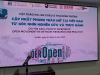 Hội thảo ‘Cập nhật phong trào Mở tại Việt Nam từ góc nhìn nghiên cứu và thực hành’ do GO-GN ASIA PACIFIC tổ chức tại Hà Nội ngày 1/12/2025 Hà Nội
Các lớp tập huấn thực hành ‘Khai thác tài nguyên giáo dục mở’ tới hết năm 2025
Hội thảo ‘Cập nhật phong trào Mở tại Việt Nam từ góc nhìn nghiên cứu và thực hành’ do GO-GN ASIA PACIFIC tổ chức tại Hà Nội ngày 1/12/2025 Hà Nội
Các lớp tập huấn thực hành ‘Khai thác tài nguyên giáo dục mở’ tới hết năm 2025
 Các nội dung về AI trong tài liệu ‘Khung năng lực Tài nguyên Giáo dục Mở cho giảng viên V3.0’